Aadhaar Face Authentication Barriers for Visually Impaired Persons
Source:The Hindu ↗
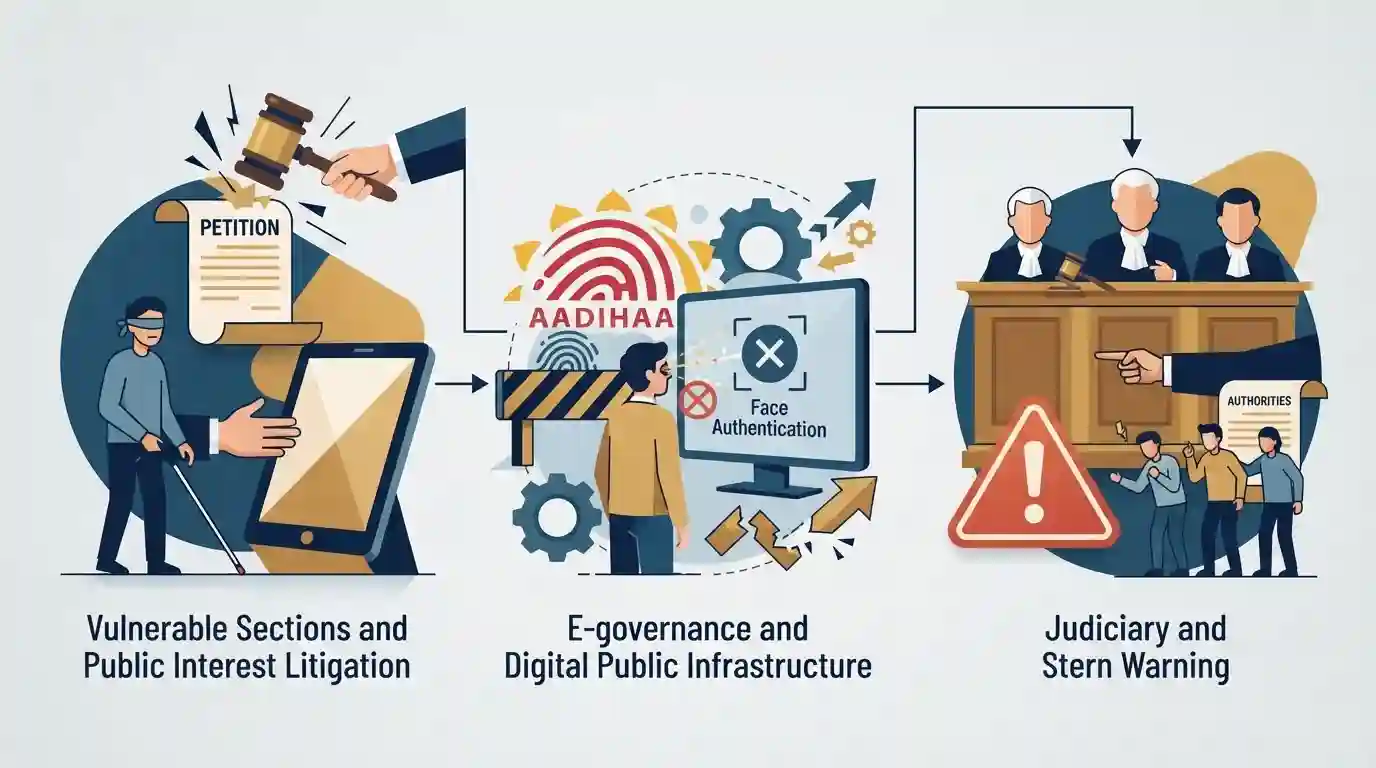
Why It Matters
It highlights the critical gap between digital governance deployment and accessibility rights for vulnerable sections like persons with disabilities, aligning closely with syllabus themes on social justice, e-governance user bias, and judicial intervention.
Summary
The Supreme Court has issued a stern warning of contempt proceedings against authorities for failing to file a detailed response to a petition highlighting accessibility issues faced by visually impaired persons during Aadhaar face authentication. The case underscores broader challenges of technological exclusion and user-centric design flaws in digital public infrastructure.
Key Points
- The Supreme Court warned authorities of contempt proceedings over failure to respond to a petition regarding visually impaired individuals facing barriers with Aadhaar face authentication.
- The petition highlights technological exclusions and accessibility issues faced by persons with disabilities in digital governance and identification systems.
- The case brings to light user-centric design flaws in e-governance infrastructure, emphasizing the need for inclusive technology.
Important Terms
Unique Identification Authority of India

A statutory body established under the Aadhaar Act, 2016, responsible for issuing Aadhaar numbers, managing authentication processes, and ensuring data security for residents of India.
UPSC context
GS Paper II (Statutory Bodies, E-governance, DPI). Tests knowledge of governance institutions, digital identity frameworks, and regulatory mechanisms.
Aadhaar Act
Legislation enacted in 2016 to provide for the statutory backing of the Aadhaar digital identity system and regulate biometric data collection and e-KYC services.
UPSC context
GS Paper II (Polity and Governance). Tests understanding of digital governance, data protection laws, and statutory rights.
Rights of Persons with Disabilities Act
Comprehensive legislation enacted in 2016 to give effect to the United Nations Convention on the Rights of Persons with Disabilities, protecting rights and ensuring non-discrimination.
UPSC context
GS Paper II (Vulnerable Sections, Social Justice). Tests awareness of legal protections, accessibility mandates, and welfare schemes for persons with disabilities.
Static Concepts Connected
What are the key statutory bodies and provisions under the Rights of Persons with Disabilities Act, 2016?
- Expanded Disabilities: The Act increases the types of disabilities from 7 to 21, adding acid attack victims and specific learning disabilities.
- Statutory Authorities: It provides for Chief Commissioner and State Commissioners for Persons with Disabilities as statutory quasi-judicial bodies to redress grievances.
- Penal Provisions: It mandates a penalty of up to 2 years imprisonment and a fine of Rs 5 lakh for atrocities or violations against disabled persons.
Cross-Topic Patterns
Digital Public Infrastructure vs. Disability Rights
The integration of Aadhaar in welfare delivery intersects with legal mandates under the Rights of Persons with Disabilities Act, testing state compliance on mandatory digital accessibility in public services.

Aadhaar face auth accessibility issues + RPWD Act 2016 statutory duties make a prime statement for Mains GS-2 (Vulnerable Sections/Governance).
Linked PYQs · 3
Linked PYQs · 3
- 2025MainsGS2
e-governance projects have a built-in bias towards technology and back-end integration than user-centric designs. Examine.
- 2017MainsGS2
Does the Rights of Persons with Disabilities Act, 2016 ensure effective mechanism for empowerment and inclusion of the intended beneficiaries in the society? Discuss.
- 2024MainsGS2
Explain the reasons for the growth of public interest litigation in India. As a result of it, has the Indian Supreme Court emerged as the world's most powerful judiciary ?
