Environmental Pollution Regulations and Judicial Enforcement Powers
Source:The Hindu ↗
Why It Matters
It is a textbook example of the constitutionalization of environmental issues by the Supreme Court (a specific UPSC Mains theme). It illustrates the intersection of judicial activism (through PILs like the M.C. Mehta case), statutory enforcement (EPA 1986), and the mechanisms the judiciary uses to ensure compliance (Contempt of Court) when addressing severe public health crises like air pollution in Delhi-NCR.
Summary
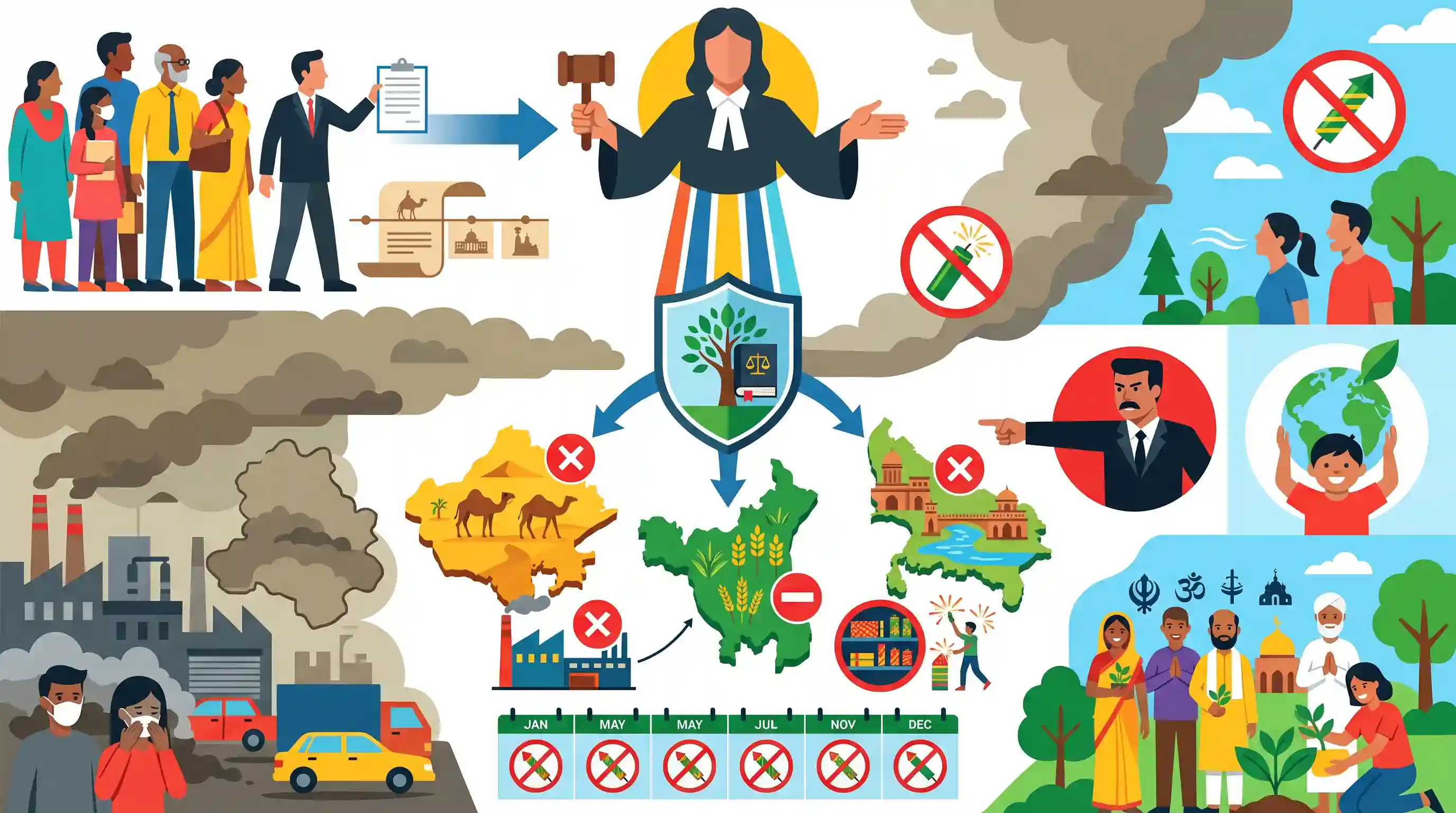
The Supreme Court of India directed the states in the National Capital Region (NCR)—specifically Haryana, Rajasthan, and Uttar Pradesh—to implement a complete and scrupulous ban on the manufacture, sale, and bursting of firecrackers throughout the year. Warning of contempt actions for failure, the Court mandated that governments use their powers under Section 5 of the Environment Protection Act (EPA), 1986. The Court highlighted that air pollution in Delhi-NCR is exceptionally poor, dismissed the utility of 'green crackers' due to enforcement challenges, and stressed that no religion encourages pollution. The order follows proceedings arising from the historic M.C. Mehta public interest litigation regarding air quality.
Key Points
- The Supreme Court warned NCR states of contempt of court if they failed to strictly enforce a year-round ban on firecrackers.
- States must issue comprehensive directives using Section 5 of the Environment Protection Act (EPA) 1986 to ban all firecrackers, including online deliveries.
- The Court dismissed the utility of 'green crackers', noting the practical impossibility of differentiating them during enforcement.
- These directives stem from the long-standing M.C. Mehta public interest litigation (PIL) filed in 1985 to curb air pollution.
- The bench emphasized that no religion encourages pollution, reinforcing the fundamental right to a clean environment over other considerations.
Important Terms
Environment Protection Act (EPA) 1986

An 'umbrella legislation' enacted post-Bhopal Gas Tragedy to protect and improve the environment. Section 5 empowers the Central Government to issue directions for closing or regulating polluting activities.
UPSC context
GS3: Environmental Conservation and Pollution. Tests understanding of statutory frameworks and executive powers for environmental governance.
Public Interest Litigation (PIL)
A legal mechanism allowing any public-spirited individual to file a petition for the protection of public interest, relaxing the traditional rule of 'locus standi'.
UPSC context
GS2: Judiciary and Judicial Activism. Tests knowledge of judicial innovations that expand access to justice.
M.C. Mehta Case
A landmark environmental litigation that led to historic rulings on air pollution, the Ganga cleaning, and the protection of the Taj Mahal from industrial emissions.
UPSC context
GS3: Environment. Key case study for environmental jurisprudence and the 'Polluter Pays Principle'.
Contempt of Court
Powers under the 1971 Act and Articles 129/215 to punish 'civil contempt' (willful disobedience of orders) or 'criminal contempt' (scandalizing the court's authority).
UPSC context
GS2: Structure, Organization, and Functioning of the Judiciary. Tests the mechanisms ensuring the enforceability of judicial orders.
Green Crackers
Low-emission fireworks developed by CSIR-NEERI that reduce particulate matter by 30%. Examples include SWAS, STAR, and SAFAL.
UPSC context
GS3: Environmental Pollution. Relevant for current affairs questions on technological solutions to air quality issues.
Article 21 (Right to Clean Environment)
Includes the judicially recognized fundamental right to a clean and healthy environment as an essential component of the Right to Life and Personal Liberty.
UPSC context
GS2: Indian Constitution and Fundamental Rights. Tests the interpretative expansion of rights by the Supreme Court.
Prelims Trap
"Green crackers certified by CSIR-NEERI are exempt from the year-round firecracker ban in the Delhi-NCR region."
The Supreme Court explicitly banned ALL firecrackers in the NCR, noting that distinguishing green crackers from conventional ones is practically impossible for enforcement agencies.
Static Concepts Connected
What are the powers under Section 5 of the Environment Protection Act, 1986?
- Issue Directives: Empowers the Central Government to issue written directions for the closure, prohibition, or regulation of any industry, operation, or process.
- Supply Cut-off: Includes the explicit power to direct the stoppage or regulation of electricity, water, or any other essential service to the violating entity.
- Delegated Authority: These sweeping powers are not exclusively central; they are routinely delegated to State Governments and State Pollution Control Boards.
What makes 'Green Crackers' different from conventional firecrackers?
- Emissions Reduction: Formulated by CSIR-NEERI, they use alternative chemicals and dust suppressants to reduce particulate matter emissions by 30-40% and lower noise levels.
- Barium Ban: They completely eliminate the use of barium nitrate, a highly toxic chemical traditionally used to emit bright green light.
- Major Variants: The three main types developed are SWAS (Safe Water Releaser), STAR (Safe Thermite Cracker), and SAFAL (Safe Minimal Aluminium).
Cross-Topic Patterns
Article 21 vs Article 25
The ruling reinforces constitutional jurisprudence where the Right to a Clean Environment (Article 21) supersedes freedom of religious practice (Article 25) when public health is threatened.
Continuous Mandamus and Environmental PILs
The directives stem from the 1985 M.C. Mehta PIL, showcasing the judicial innovation of 'continuous mandamus' where the court keeps a case open for decades to monitor ongoing executive compliance.

Expect a 2026 Prelims question contrasting statutory powers under EPA 1986 Section 5 with the mandate of the CAQM in NCR.
Linked PYQs · 5
Linked PYQs · 5
- 2019PrelimsGS1
Consider the following statements : The Environment Protection Act, 1986 empowers the Government of India to 1. state the requirement of public participation in the process of environmental protection, and the procedure and manner in which it is sought 2. lay down the standards for emission or discharge of environmental pollutants from various sources Which of the statements given above is/are correct?
- 2022PrelimsGS1
Which one of the following has been constituted under the Environment (Protection) Act, 1986?
- 2022PrelimsGS1
Consider the following statements: 1. Pursuant to the report of H.N. Sanyal Committee, the Contempt of Courts Act, 1971 was passed. 2. The Constitution of India empowers the Supreme Court and the High Courts to punish for contempt of themselves. 3. The Constitution of India defines Civil Contempt and Criminal Contempt. 4. In India, the Parliament is vested with the powers to make laws on Contempt of Court. Which of the statements given above is/are correct?
- 2024MainsGS2
Explain the reasons for the growth of public interest litigation in India. As a result of it, has the Indian Supreme Court emerged as the world's most powerful judiciary ?
- 2022MainsGS2
“The most significant achievement of modern law in India is the constitutionalization of environmental problems by the Supreme Court.” Discuss this statement with the help of relevant case laws.
