Supreme Court Seeks Comprehensive Law to Safeguard Court Deposits
Source:The Hindu ↗
हे का महत्त्वाचे आहे
It highlights structural and financial governance gaps within the administration of justice, emphasizing transparency and institutional accountability regarding public and litigant funds held by courts.
सारांश
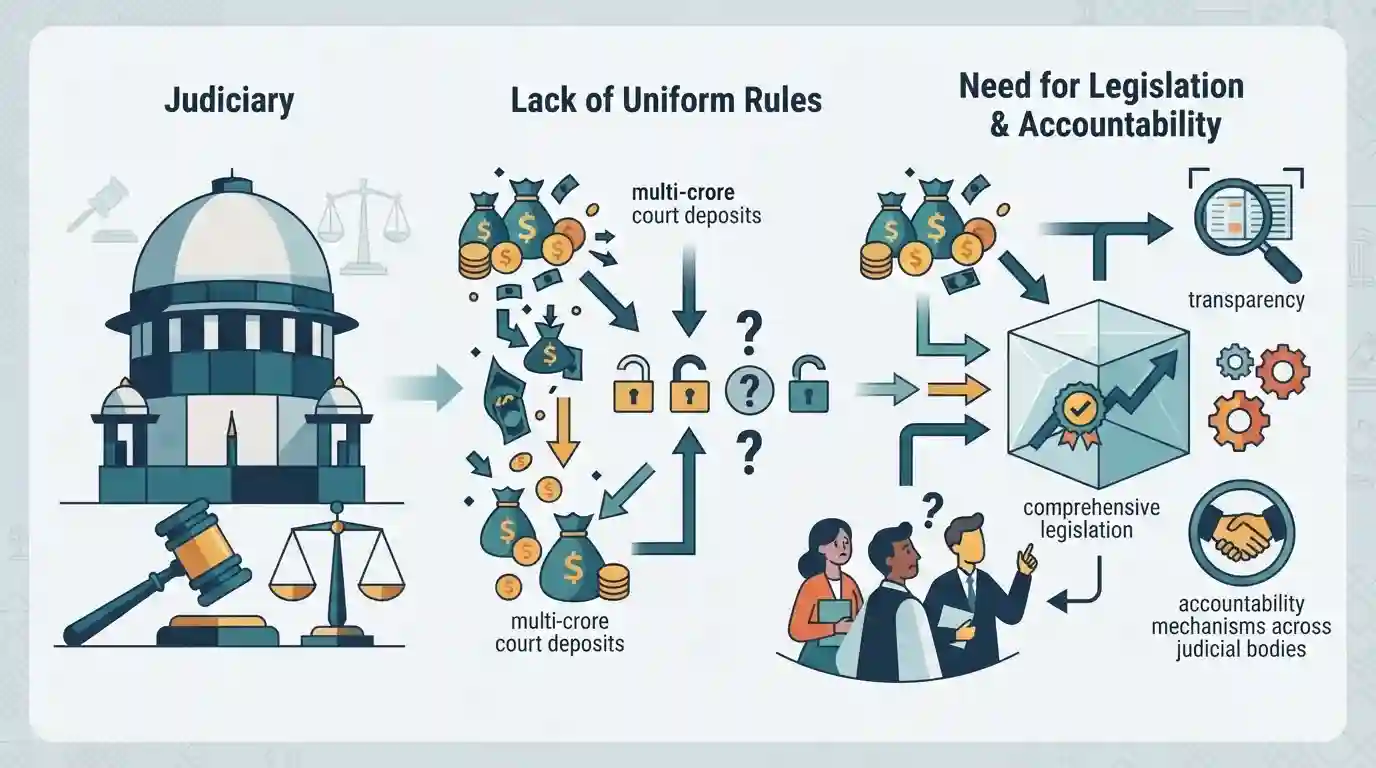
The Supreme Court of India has stressed the urgent requirement for a comprehensive legislation to safeguard multi-crore court deposits. Highlighting the absence of uniform statutory rules governing funds deposited by litigants during legal proceedings, the apex court called for rigorous financial management, transparency, and accountability mechanisms across judicial bodies to protect public money.
मुख्य मुद्दे
- The Supreme Court of India expressed serious concern over the lack of a uniform regulatory framework or legislation to safeguard multi-crore court deposits held across various courts in the country.
- Substantial amounts of money deposited by litigants during legal disputes often lie unmonitored or vulnerable to financial mismanagement.
- The apex court emphasized the urgent need for a comprehensive statutory law to govern the management, security, and auditing of these funds.
- Proper oversight of court deposits is vital to ensure financial transparency, accountability, and public trust in the judicial system.
महत्त्वाच्या संज्ञा
Supreme Court of India

The apex judicial body of India, established under Article 124 of the Constitution, serving as the final court of appeal and custodian of the Constitution.
UPSC context
UPSC Mains GS Paper 2 (Indian Polity - Judiciary, Structure, Organization, and Functioning). Essential for questions on judicial accountability and reforms.
High Courts
The highest constitutional courts at the state level in India, exercising original and appellate jurisdiction as well as superintendence over all subordinate courts under Articles 226 and 227.
UPSC context
UPSC Mains GS Paper 2 (Polity - Judiciary, State Administration). Important for understanding judicial oversight, federal structure, and financial governance in courts.
पूर्वपरीक्षा सापळा
court deposits function as direct state revenue similar to court fees collected under the Court Fees Act.
Aspirants often confuse court deposits with court fees. Court deposits are litigant funds held in trust during disputes (and do not belong to the state), whereas court fees are statutory revenues credited to the Consolidated Fund.
संबंधित स्थिर संकल्पना
What is the constitutional and statutory framework governing court funds and judicial financial administration in India?
- Constitutional Provisions: Constitutional Provisions, such as Article 146 and 229, empower the Supreme Court and High Courts respectively to frame rules regarding administrative expenses and staff, but do not comprehensively regulate litigant deposit accounting.
- Public Account: Public Accounts, wherein moneys received by courts in judicial proceedings are typically held in civil court deposits, falling under the Public Account of India or State Public Accounts under Article 266(2).
- CAG Audit Role: CAG Audit, where the Comptroller and Auditor General inspects and audits transactions of the Union and States, though the extent of direct audit over specific uninvested judicial deposit accounts varies by state and court rules.
आंतर-विषय नमुने
Judicial Accountability + CAG Audit Mandate
The judiciary's financial oversight gap connects institutional accountability directly to CAG audit scope and public fund management under Article 149.
Court Deposits + Digital Public Infrastructure
Managing massive litigant deposits across disparate High Courts highlights the urgency of unified digital public infrastructure for judicial disbursements.

Court deposits + judicial accountability + CAG audit scope may appear in mains GS-2 as a question on separation of powers and institutional integrity.
संबंधित PYQ · 2
संबंधित PYQ · 2
- 2023MainsGS2
“Constitutionally guaranteed judicial independence is a prerequisite of democracy.” Comment.
- 2024MainsGS2
“The duty of the Comptroller and Auditor General is not merely to ensure the legality of expenditure but also its propriety.” Comment.
