Judicial Challenges of AI Hallucinations in Legal Case Citations
Source:The Hindu ↗
Why It Matters
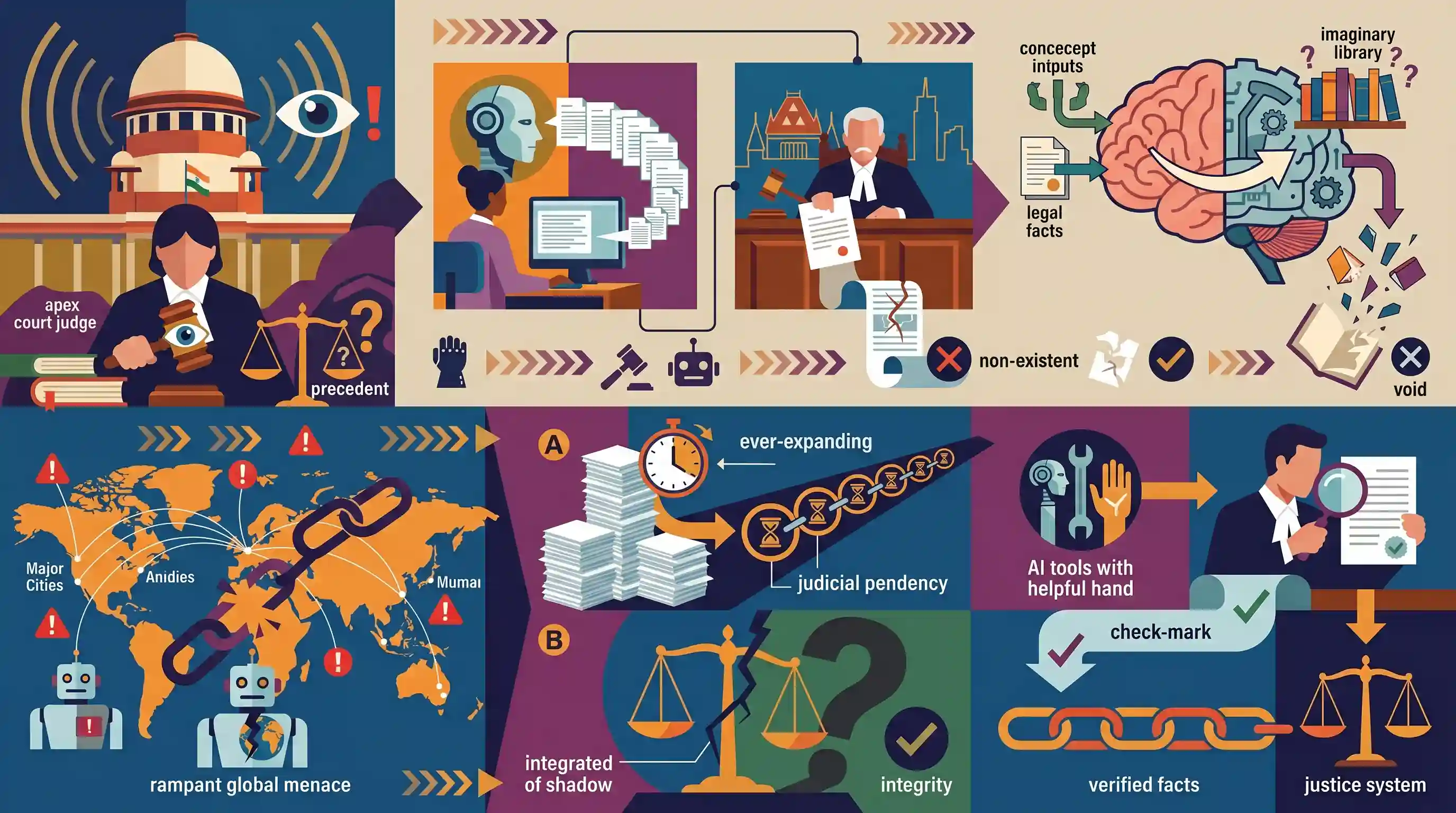
Illustrates the real-world consequences of 'AI hallucinations' in critical governance sectors like the judiciary, underscoring the urgent need for regulatory guardrails and digital literacy to ensure technological aids do not compromise administrative efficiency and ethical decision-making.
Summary
The Supreme Court of India has raised alarms over the increasing trend of litigants and lawyers citing fake, AI-generated judgements in courts. The concern stems from a recent instance where the Bombay High Court identified submissions drafted using ChatGPT that included a non-existent case citation. Although the apex court expunged the specific remarks made against the appellant by the High Court, it affirmed that AI "hallucinations" in legal submissions are a rampant global menace. The courts emphasized that while AI tools can assist in research, users bear a fundamental responsibility to cross-verify facts to prevent the wastage of critical judicial time and maintain the integrity of the justice system.
Key Points
- The Supreme Court has flagged the growing global menace of lawyers and litigants citing non-existent, AI-generated judgements in court proceedings.
- The issue was highlighted when the Bombay High Court found submissions prepared using ChatGPT that cited a fake case law, 'Jyoti w/o Dinesh Tulsiani Vs. Elegant Associates'.
- The High Court noted that verifying fabricated citations leads to a significant waste of precious judicial time.
- While Justices Rajesh Bindal and Vijay Bishnoi expunged the specific High Court remarks against a company director, they reiterated the crucial need for cross-verifying AI-generated research material.
Important Terms
Supreme Court of India

Highest judicial authority in India (established 1950). It acts as the final court of appeal, guardian of the Constitution, and protector of Fundamental Rights under Article 32.
UPSC context
GS Paper II (Polity): Structure, functions, and powers of the Indian judiciary.
AI Hallucination
A phenomenon where Generative AI creates plausible but factually incorrect outputs, such as non-existent legal precedents, posing risks to judicial integrity and wasting court time.
UPSC context
GS Paper III (Science & Tech) and GS Paper IV (Ethics): Challenges of emerging technology and professional integrity.
Judicial Pendency
The backlog of unresolved cases across various levels of the Indian judiciary, currently exceeding 50 million, impacting the 'Right to Speedy Trial' and public trust.
UPSC context
GS Paper II (Polity/Social Justice): Issues related to the functioning of the judiciary and judicial reforms.
Legal Ethics
Moral principles governing legal practitioners. Citing AI-generated fake judgments is viewed as professional misconduct, violating the fundamental duty of truthfulness and accuracy to the court.
UPSC context
GS Paper IV (Ethics): Professional standards, integrity, and accountability in public and judicial life.
Bombay High Court
One of India's oldest High Courts (est. 1862), exercising territorial jurisdiction over Maharashtra, Goa, and the Union Territories of Dadra and Nagar Haveli and Daman and Diu.
UPSC context
GS Paper II (Polity): Organization and territorial jurisdiction of High Courts in the Indian federal structure.
Judicial Jurisdiction
The legal authority of a court to hear and decide cases. The Supreme Court's scope includes Original (Article 131), Appellate (Articles 132-136), and Advisory (Article 143) jurisdictions.
UPSC context
GS Paper II (Polity): Constitutional provisions defining the reach and limits of judicial power.
Prelims Trap
"AI Hallucination refers exclusively to the generation of fake images or videos by generative models."
AI hallucination refers to AI confidently generating false or fabricated textual/factual information (like fake legal citations), whereas fake visual or audio media are generally termed deepfakes.
Static Concepts Connected
What are the key tech initiatives launched by the Supreme Court of India?
- SUPACE: Supreme Court Portal for Assistance in Court's Efficiency. It assists judges with legal research and data extraction but deliberately lacks independent decision-making capacity to prevent algorithmic bias.
- SUVAS: Supreme Court Vidhik Anuvaad Software. A machine-learning translation tool that converts English judicial documents into several vernacular languages to democratize legal access.
- FASTER: Fast and Secured Transmission of Electronic Records. A system designed to securely and swiftly transmit apex court orders to respective authorities.
What distinguishes AI Hallucination from Deepfakes in generative AI?
- AI Hallucination: The probabilistic generation of highly plausible but entirely fabricated factual text, such as non-existent legal precedents or historical events, caused by gaps in training data.
- Deepfakes: AI-generated synthetic visual or audio media specifically designed to convincingly manipulate, alter, or replicate a person's likeness or voice.
Cross-Topic Patterns
Tech solutions vs Judicial Pendency
Contrasts the promise of AI solving judicial backlog (via tools like SUPACE) against the reality of AI (hallucinated citations) actively worsening pendency by wasting precious verification time.
AI Ethics + Human Accountability
Connects GS-3 Tech to GS-4 Ethics. The 'human-in-the-loop' principle dictates that despite algorithmic assistance, human professionals retain absolute legal and moral accountability for their inputs.

Expect a 2026 Prelims pair-matching question on AI terms (Hallucination vs Deepfakes) or a GS2 question on AI's double-edged judicial role
Linked PYQs · 3
Linked PYQs · 3
- 2024MainsGS4
The application of Artificial Intelligence as a dependable source of input for administrative rational decision-making is a debatable issue. Critically examine the statement from the ethical point of view.
- 2021MainsGS4
Impact of digital technology as reliable source of input for rational decision making is a debatable issue. Critically evaluate with suitable example.
- 2023MainsGS3
Introduce the concept of Artificial Intelligence (AI). How does Al help clinical diagnosis? Do you perceive any threat to privacy of the individual in the use of Al in healthcare?
