Supreme Court Ruling on SC Status for Religious Converts
Source:The Hindu ↗
Why It Matters
The intersection of religion, caste, and affirmative action is a persistent constitutional and social issue. This development highlights the legal debate around the Constitution (Scheduled Castes) Order, 1950, which restricts SC status to Hindus, Sikhs, and Buddhists, and touches upon the broader demand to implement the Ranganath Misra Commission recommendations for extending SC benefits to Dalit Christians and Muslims.
Summary
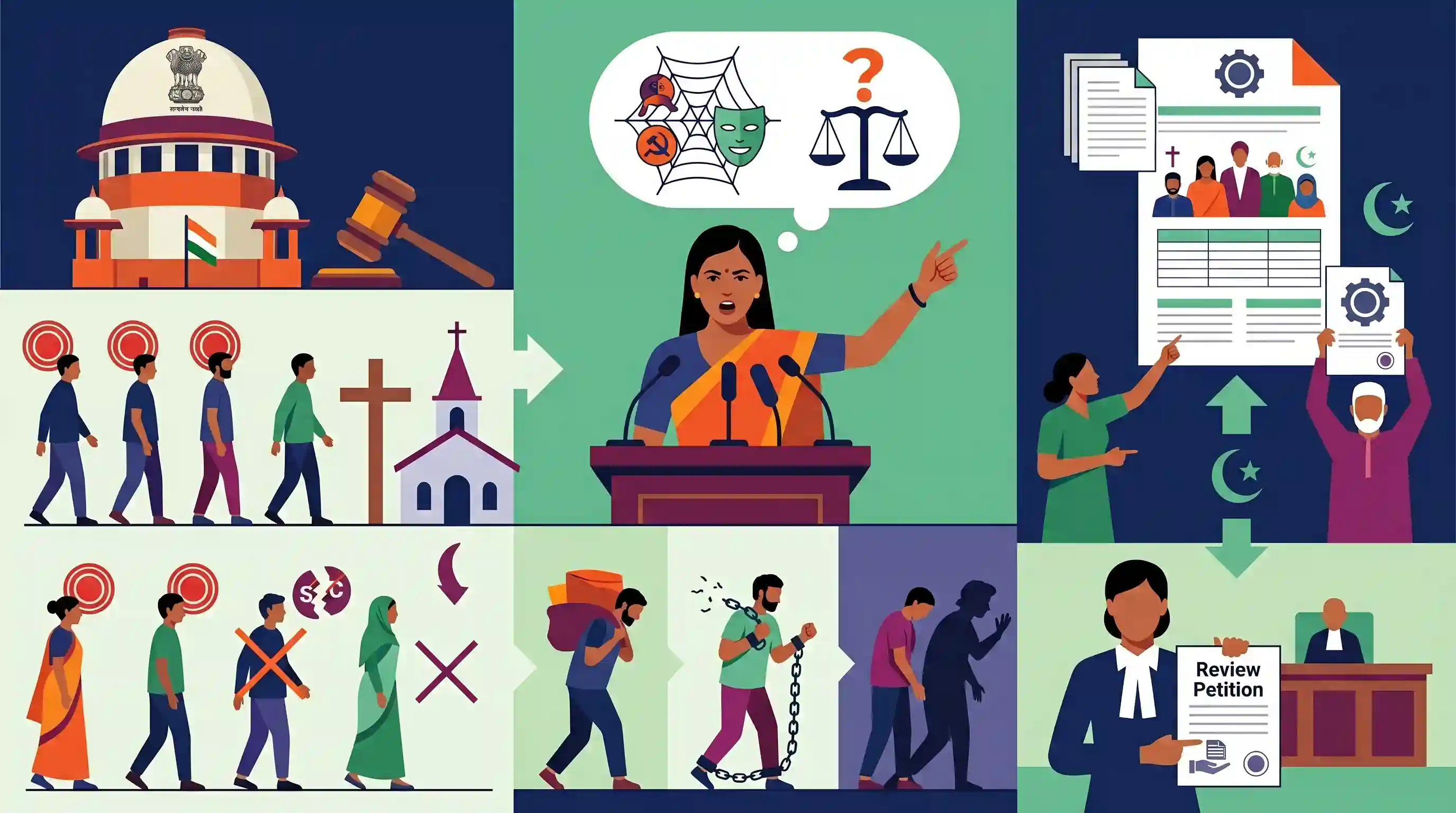
The Supreme Court has ruled that individuals belonging to Scheduled Castes (SC) lose their SC status upon converting to Christianity, a decision sharply criticized by AP Congress Committee president Y.S. Sharmila. Calling the verdict a 'BJP conspiracy,' she questioned the autonomy of the judiciary and pointed out that religious conversion does not erase the socio-economic marginalization or atrocities faced by Dalits. Sharmila demanded the tabling of the Ranganath Misra Commission report, which supports extending SC status to Dalit Christians and Muslims, and urged the filing of a review petition.
Key Points
- The Supreme Court ruled that a person converting from a Scheduled Caste (SC) to Christianity cannot retain their SC status and related benefits.
- The verdict in Chinthada Anand vs State of Andhra Pradesh upheld the disqualification of a converted Christian from claiming SC status.
- AP Congress Committee president Y.S. Sharmila criticized the judgment as a BJP conspiracy, questioning the independence of the judiciary under PM Modi.
- Sharmila highlighted that despite converting to Christianity, marginalized communities continue to face socio-economic backwardness and attacks, demanding SC status for Dalit Christians.
- The Congress leader urged the tabling of the Ranganath Misra Commission report, which recommended granting SC status to Dalits who convert to Christianity or Islam, and called for a review petition of the SC verdict.
Important Terms
Constitution (Scheduled Castes) Order, 1950

A presidential notification issued under Article 341 listing castes eligible for affirmative action. Its Paragraph 3 restricts SC status to Hindus, Sikhs, and Buddhists, excluding those who convert to other religions.
UPSC context
GS II (Polity); defines the legal and religious criteria for reservation eligibility and the exclusion of certain converts.
Ranganath Misra Commission
Formally the National Commission for Religious and Linguistic Minorities (2007), it recommended de-linking SC status from religion to include Dalit Christians and Muslims due to persistent social backwardness.
UPSC context
GS II (Social Justice); critical for arguments regarding minority rights and the expansion of affirmative action to converts.
Article 341
Empowers the President to specify castes, races, or tribes as Scheduled Castes in a State/UT. Once notified, only Parliament can amend the list through legislation.
UPSC context
GS II (Polity); the constitutional source for identifying SCs and the mechanism for modifying the SC list.
Dalit Christians
Individuals of Dalit origin who converted to Christianity but argue that social stigma and economic deprivation persist despite their change in faith, justifying their demand for SC status.
UPSC context
GS I/II (Society/Social Justice); focuses on intersectional discrimination where caste identity persists across religious boundaries.
Review Petition
A legal recourse under Article 137 enabling the Supreme Court to revisit its own judgment to correct a "patent error" or "miscarriage of justice" within 30 days.
UPSC context
GS II (Judiciary); tests understanding of the Supreme Court's power to self-correct and the finality of its verdicts.
Prelims Trap
"Conversion to Christianity or Islam results in the loss of both Scheduled Caste (SC) and Scheduled Tribe (ST) status."
ST status is entirely religion-neutral. Only SC status is restricted to Hinduism, Sikhism, and Buddhism by the Constitution (Scheduled Castes) Order, 1950.
Static Concepts Connected
How is the list of Scheduled Castes notified and modified under Article 341?
- Presidential Notification: The President first specifies the castes deemed as SCs for a State/UT, after consulting the respective Governor.
- Parliamentary Power: Once the initial list is notified, only Parliament can enact a law to include or exclude entries. State legislatures have no power to alter it.
Which key commissions have examined the status of Dalit converts?
- Ranganath Misra (2007): Recommended completely delinking Scheduled Caste status from religion, advocating that it be made religion-neutral.
- K.G. Balakrishnan (2022): Currently examining the socio-economic conditions of Dalit converts to Christianity and Islam to assess if they warrant SC status.
Cross-Topic Patterns
SC Status vs. Article 15 Non-Discrimination
Highlights the tension between fundamental rights (Article 15 prohibiting discrimination based on religion) and the 1950 SC Order restricting reservation benefits to specific faiths.
Divergence from ST identification criteria
Contrasts sharply with Scheduled Tribe status (Article 342), which is based on traits like shyness of contact and geographic isolation, remaining completely independent of the person's religion.

Expect a multi-statement Prelims question in 2026 contrasting the religious criteria and modification procedures for SC vs ST lists.
Linked PYQs · 2
Linked PYQs · 2
- 2018MainsGS2
Whether National Commission for Scheduled Castes (NCSC) can enforce the implementation of constitutional reservation for the Scheduled Castes in the religious minority institutions? Examine.
- 2020PrelimsGS1
Which one of the following categories of Fundamental Rights incorporates protection against untouchability as a form of discrimination?
