Supreme Court Winter Benches and Judicial Pendency Reforms
Source:The Hindu ↗
Why It Matters
This event is highly relevant for GS Paper 2 as it illustrates practical administrative reforms within the Supreme Court (winter benches, strict SOPs for arguments) aimed at tackling the systemic issue of judicial pendency and improving court management. Furthermore, it touches upon GS Paper 3 by highlighting the judiciary's crucial role in environmental protection, specifically concerning the ecological definition and conservation of the Aravalli range against potentially harmful developmental reclassifications.
Summary
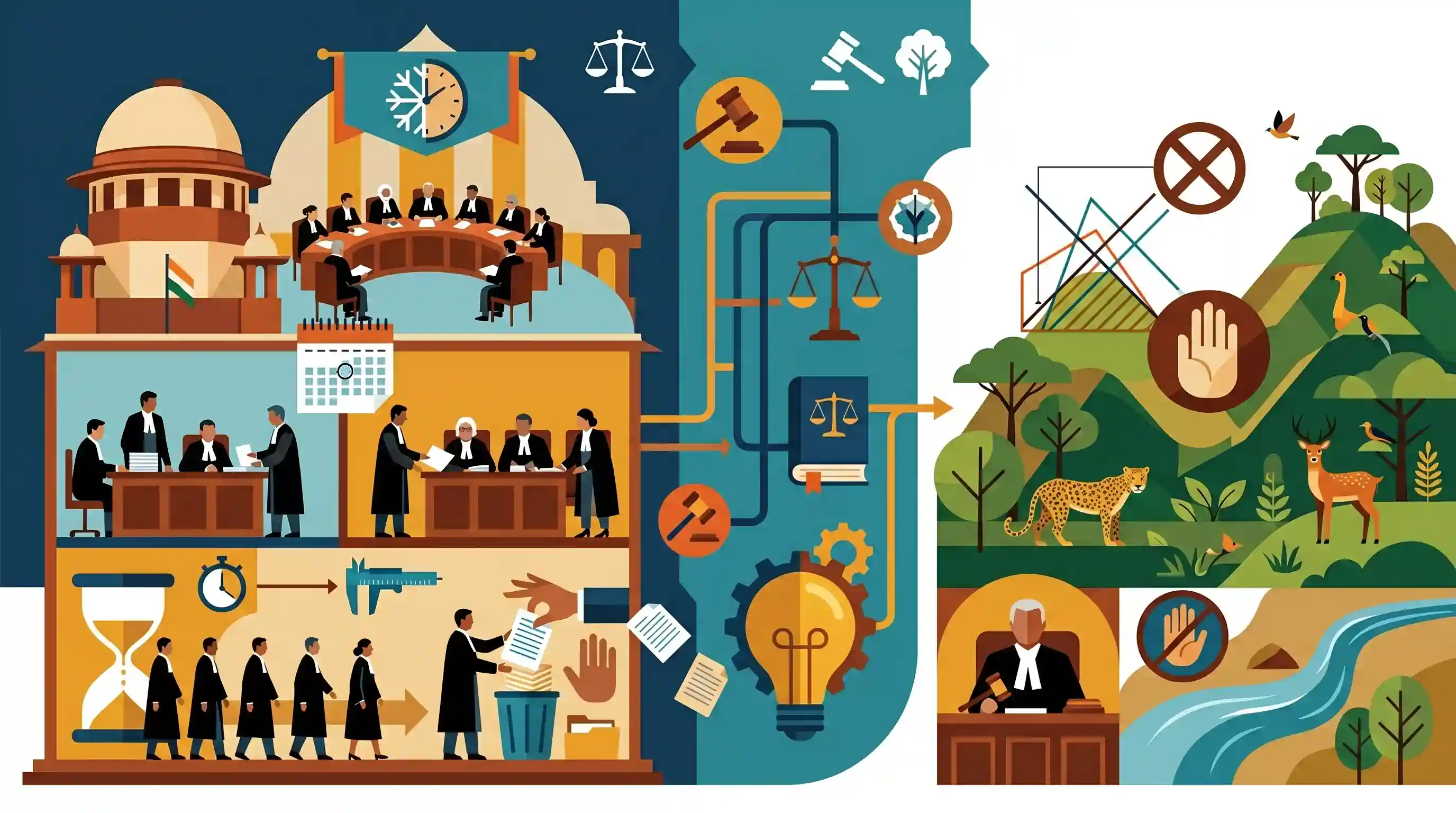
For the first time, the Supreme Court of India held vacation benches during its winter break to hear urgent matters, reflecting a proactive stance on judicial administration. Alongside these special sittings, the apex court issued a comprehensive Standard Operating Procedure (SOP) aimed at rationalizing judicial time by prescribing strict timelines for oral arguments and capping written submissions at five pages. During the vacation sessions, the bench notably intervened in a suo motu case regarding the ecological status of the Aravallis, temporarily freezing earlier directions on a new uniform definition for hills that environmentalists warned would remove vital protections from significant sections of the range.
Key Points
- The Supreme Court operated winter vacation benches for the first time, breaking from past traditions to address urgent legal matters.
- To optimize judicial time and manage pendency, the Supreme Court introduced a Standard Operating Procedure (SOP) enforcing strict timelines for oral arguments and limiting written submissions to five pages.
- The vacation bench took suo motu action to stay previous directions concerning a controversial new uniform definition of the Aravalli hills and ranges.
- The proposed definition (requiring a 100-m elevation and 500-m gap between hills) had sparked protests for potentially stripping environmental protections from large parts of the ecologically sensitive Aravalli range.
- Other urgent matters addressed included a stay on the suspension of a life sentence in the Unnao rape case and a habeas corpus petition against illegal arrest.
Important Terms
Supreme Court of India

The highest judicial body in India and final court of appeal, acting as the ultimate interpreter of the Constitution and protector of fundamental rights.
UPSC context
GS Paper 2: Structure, organization, and functioning of the Judiciary; jurisdictional powers under Articles 124-147.
Vacation Bench
A special bench constituted by the Chief Justice during court recesses to hear 'urgent matters,' such as bail or stay orders, ensuring justice is accessible year-round.
UPSC context
GS Paper 2: Judicial administration and reforms aimed at reducing pendency and improving judicial productivity.
Judicial Reforms
Systematic structural or procedural changes—like streamlining arguments or using technology—intended to enhance efficiency, transparency, and the speed of case disposal in the legal system.
UPSC context
GS Paper 2: Issues relating to the Judiciary; critical for addressing India’s massive case backlog and 'pendency crisis.'
Suo Motu Jurisdiction
The power of constitutional courts to initiate legal proceedings on their own motion, without a formal petition, typically in cases involving public interest or environmental protection.
UPSC context
GS Paper 2: Judicial Activism and Public Interest Litigation (PIL); tests the court's proactive role in governance.
Aravalli Range
One of the world's oldest mountain ranges, stretching from Delhi to Gujarat, serving as a vital ecological barrier against desertification and a major groundwater recharge zone.
UPSC context
GS Paper 3: Environment and Biodiversity; critical for questions on ecological governance and sustainable development.
Standard Operating Procedure (SOP)
In judicial administration, a set of formal guidelines—such as limits on oral arguments—designed to rationalize court time and standardize proceedings for faster resolution.
UPSC context
GS Paper 2: Important aspects of governance; tests knowledge of administrative measures to optimize judicial resources.
Prelims Trap
"The Constitution of India explicitly mandates the Chief Justice of India to constitute Vacation Benches during court recesses."
Vacation Benches are not constitutionally mandated. They are constituted under the Supreme Court Rules, 2013, derived from the CJI's administrative authority to manage the roster.
Static Concepts Connected
How are Vacation Benches constituted in the Supreme Court?
- SC Rules 2013: Governed by Order II, Rule 6 of the Supreme Court Rules, 2013, giving the CJI administrative power to constitute special benches.
- CJI's Discretion: The Chief Justice of India, acting as the Master of Roster, nominates the judges who will preside during court recesses.
- Urgent Matters: These benches prioritize urgent matters involving constitutional liberties, such as habeas corpus writs, bail applications, and stays on evictions.
What is the geographical and ecological significance of the Aravalli Range?
- Relic Mountains: Formed in the Proterozoic era, it is one of the world's oldest fold mountain systems, existing today as highly denuded relic mountains.
- Desert Barrier: Acts as a crucial climatic and physical divide, checking the eastward expansion of the Thar Desert into the fertile Indo-Gangetic plains.
- Hydrological Anchor: Serves as a primary groundwater recharge zone, which is critical for the long-term water security of the National Capital Region (NCR).
Cross-Topic Patterns
Judicial reforms for case pendency
The new SOP limiting oral arguments and capping written submissions directly targets the pendency crisis, echoing long-standing Law Commission recommendations on judicial time management.
Suo motu ecological jurisprudence
The SC's vacation bench intervention reflects its ongoing activism in environmental governance, paralleling historic cases like T.N. Godavarman where the court actively froze detrimental definitions.

SC Rules on Vacation Benches and the ecological definition of Aravallis are prime for a mixed multi-statement Prelims question in 2026.
Linked PYQs · 2
Linked PYQs · 2
- 2023MainsGS2
“Constitutionally guaranteed judicial independence is a prerequisite of democracy.” Comment.
- 2025MainsGS3
Mineral resources are fundamental to the country's economy and these are exploited by mining. Why is mining considered an environmental hazard? Explain the remedial measures required to reduce the environmental hazard due to mining.
