Supreme Court Directs Haldwani Land Transfer for High Court Building
Source:abplive ↗
Why It Matters
This ruling clarifies the constitutional distinction between the judicial and administrative jurisdictions of High Courts, while addressing a major infrastructural transition (shifting the high court infrastructure from Nainital to Haldwani) in Uttarakhand.
Summary
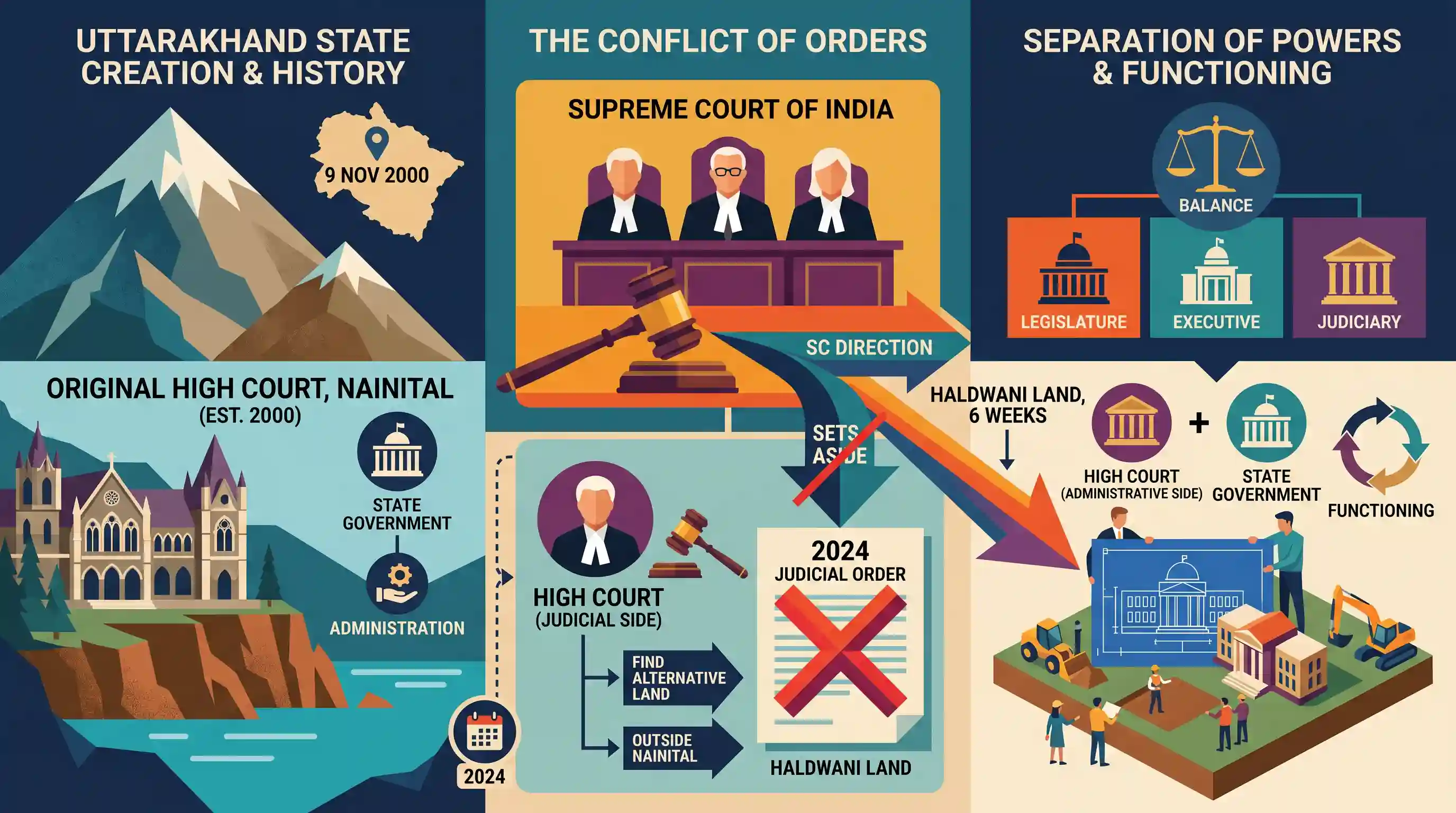
The Supreme Court of India directed the Uttarakhand government to hand over earmarked land in Haldwani within six weeks for the construction of a new High Court building. In doing so, the apex court set aside a 2024 judicial order of the Uttarakhand High Court that had ordered the state to find alternative land outside Nainital. The Supreme Court emphasized that administrative and infrastructural issues should be resolved on the High Court\'s administrative side in consultation with the state government, rather than through judicial orders. This development touches upon the separation of administrative and judicial powers as well as the historical context of the Uttarakhand High Court\'s establishment since the state\'s creation on November 9, 2000.
Key Points
- The Supreme Court directed the Uttarakhand government to hand over earmarked land in Haldwani within six weeks for a new High Court building.
- The apex court set aside a 2024 judicial order of the Uttarakhand High Court that had directed the state\'s chief secretary to search for alternative land outside Nainital.
- The Supreme Court bench (headed by CJI Surya Kant) clarified that infrastructural and land allotment matters belong to the administrative side of the High Court, in consultation with the state government, rather than its judicial side.
- The High Court of Uttarakhand was established in Nainital on November 9, 2000, concurrently with the creation of the state of Uttarakhand (formerly Uttaranchal).
- The High Court Bar Association had appealed against the High Court\'s judicial directions, which had included conducting an opinion poll among advocates, litigants, and the public on the location of the court.
Important Terms
Uttar Pradesh Reorganisation Act, 2000

An Act of the Parliament of India that created the state of Uttaranchal (later renamed Uttarakhand) by carving out thirteen hill districts of Uttar Pradesh on November 9, 2000.
UPSC context
GS Paper II (Polity) - Reorganisation of states under Article 3 of the Constitution, distribution of assets, and federal dynamics.
High Court of Uttarakhand
The apex judicial body of the state of Uttarakhand, established in 2000 at Nainital and currently undergoing transition to Haldwani for better infrastructure and accessibility.
UPSC context
GS Paper II (Judiciary) - Structure and functioning of State High Courts, administrative powers, and infrastructure challenges.
Uttaranchal (Change of Name) Act, 2006
An Act of the Indian Parliament enacted in December 2006 that officially changed the name of the state of Uttaranchal to Uttarakhand, effective from January 1, 2007.
UPSC context
GS Paper II (Polity) - Power of Parliament to alter names of states under Article 3 of the Constitution.
High Court Bar Association
A professional body of advocates practicing before a High Court, representing lawyers' interests, and playing a vital role in legal reform, litigation, and judicial administration.
UPSC context
GS Paper II (Judiciary) - Role of civil society and professional associations in judicial governance and access to justice.
Supreme Court of India
The highest judicial court and final court of appeal under the Constitution of India, possessing extensive original, appellate, and advisory jurisdictions over all other courts.
UPSC context
GS Paper II (Judiciary) - Power of judicial review, appellate jurisdiction, and maintaining the federal structure and separation of powers.
Prelims Trap
The Chief Justice of a High Court can unilaterally shift the principal seat of the High Court under Article 229.
Article 229 covers officers and expenses, not seats. Shifting a High Court's seat requires Presidential notification/legislation, not unilateral judicial or administrative orders.
Static Concepts Connected
How is the principal seat of a High Court established or shifted in India?
- Presidential authority: The President of India notifies the principal seat or benches, often under State Reorganisation Acts or constitutional provisions.
- State-court consultation: Any administrative proposal requires consultation between the High Court's Chief Justice and the State Governor before Union approval.
- Parliamentary role: Parliament can establish or alter High Court seats and jurisdictions through legislative acts under Article 3 and Article 231.
What constitutes the administrative autonomy of a High Court under Article 229?
- Staff appointments: The Chief Justice of the High Court has exclusive authority to appoint officers and staff of the court.
- Financial rules: Rules for salaries and pensions of staff are framed by the Chief Justice, requiring the Governor's approval if they have financial implications.
- Charged expenditure: Administrative expenses of the High Court are charged directly upon the Consolidated Fund of the State, protecting them from legislative voting.
Cross-Topic Patterns
Judicial infrastructure & Executive finance
Infrastructure expansion relies on state funding, highlighting how judicial administrative independence is practically tethered to executive budgetary approvals and Article 229 fiscal provisions.
State Reorganisation & Judicial Seats
Under Article 3, state bifurcations split judicial assets, requiring delicate federal balancing between the Union's legislative power and the state's executive domain over land.

2026 exams may test the constitutional process of shifting a High Court's seat, contrasting Presidential power with HC administrative roles.
Linked PYQs · 3
Linked PYQs · 3
- 2021UKPSC_PRELIMSGS1
The state of Uttarakhand came into existence on which of the following dates ?
- 2021UKPSC_PRELIMSGS1
The Uttaranchal (Change of Name) Act, came into existence is which of the following years ?
- 2012UKPSC_PRELIMSGS1
Where the Public Interest Litigation (PIL) can be filed?
