Supreme Court Intervention on Manipur Ethnic Conflict and Blockades
Source:The Hindu ↗
Why It Matters
The prolonged ethnic violence and economic blockades in Manipur present a critical case study on internal security, the socio-economic impacts of blockades, and the judiciary's role in enforcing fundamental rights (Article 19). It is highly relevant for GS3 (Internal Security challenges in border areas) and GS2 (Judiciary, Fundamental Rights).
Summary
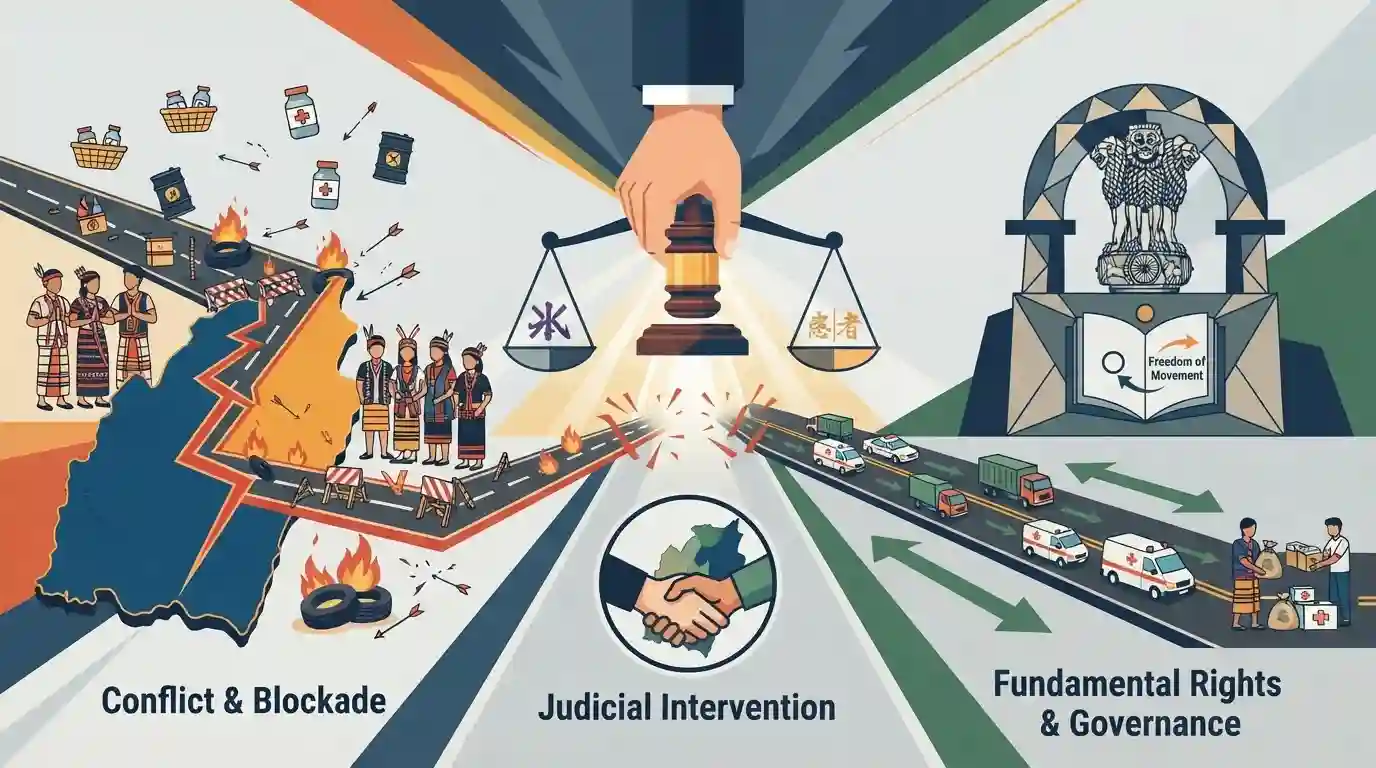
The Supreme Court has intervened in the ongoing Manipur ethnic conflict, urging both Kuki and Meitei communities to restore peace and lift blockades on National Highway 2. The blockades have severely impacted the supply of essential commodities and medicines to the region. The Court's directive underscores the constitutional necessity to maintain the right to movement and ensure the basic needs of citizens are met amid internal security and governance challenges in the state.
Key Points
- The Supreme Court of India has appealed to both Kuki and Meitei groups to restore peace and normalcy in Manipur.
- The Court emphasized the urgent need to remove blockades on National Highway 2 (NH-2), which acts as a crucial lifeline for the state.
- Economic blockades severely disrupt the supply of essential commodities, causing humanitarian distress and violating fundamental rights, including the right to free movement.
- The ongoing ethnic conflict highlights significant internal security, governance, and peacebuilding challenges in the North-Eastern region.
Important Terms
Supreme Court of India

The highest judicial court of India under the Constitution, serving as the ultimate court of appeal, interpreter of constitutional provisions, and protector of citizens' fundamental rights.
UPSC context
GS Paper II (Polity/Constitution); tests the powers and judicial intervention capabilities of the apex court in public order crises.
Freedom of Movement
A fundamental right guaranteed under Article 19(1)(d) of the Indian Constitution, ensuring all citizens have the liberty to travel freely throughout the territory of India.
UPSC context
GS Paper II (Fundamental Rights); evaluates understanding of citizen rights, reasonable restrictions, and state obligation to secure public pathways.
Public Interest Litigation (PIL)
A legal mechanism allowing public-spirited individuals or organizations to file petitions in courts for public interest protection, bypassing traditional rules of personal injury (locus standi).
UPSC context
GS Paper II (Polity/Judiciary); tests judicial activism, access to justice for marginalized groups, and Article 32 remedies.
National Highway 2 (NH-2)
A major national highway connecting Assam, Nagaland, Manipur, and Mizoram, serving as a vital economic and logistics lifeline for the landlocked state of Manipur.
UPSC context
GS Paper I/III (Geography/Infrastructure); tests awareness of strategic regional transit corridors and internal security risks.
Kuki-Meitei Conflict
An ethnic conflict in Manipur between the valley-based Meitei majority and the hill-based Kuki-Zo tribes, centered around reservation, land rights, and political representation.
UPSC context
GS Paper III (Internal Security); tests knowledge of ethnic divisions in Northeast India, societal friction, and conflict resolution.
National Highways Authority of India (NHAI)
An autonomous statutory body established under the NHAI Act, 1988, responsible for the development, maintenance, and management of the national highways network in India.
UPSC context
GS Paper III (Infrastructure); tests understanding of statutory bodies, transportation infrastructure, and logistical connectivity.
Prelims Trap
The fundamental right to peacefully protest protects indefinite occupations of national highways.
The Supreme Court has ruled (e.g., Shaheen Bagh case) that public spaces/highways cannot be occupied indefinitely; the right to protest is subject to the public's right to commute.
Static Concepts Connected
What are the special provisions for Manipur under Article 371C?
- Hill Area Committee: The President may provide for the creation of a committee of the Legislative Assembly consisting of members elected from the Hill Areas of the state.
- Governor's Responsibility: The Governor has special responsibility for Hill Areas and must submit an annual administration report to the President of India.
- Union Executive Power: The executive power of the Union extends to giving directions to the State regarding the administration of these Hill Areas.
What are the reasonable restrictions on the Freedom of Movement (Art 19(1)(d))?
- General Public Interest: The State can impose restrictions to maintain public order, ensure smooth traffic, and prevent highway blockades.
- Protection of STs: Movement and settlement can be restricted in designated tribal areas to protect indigenous populations from exploitation and cultural loss.
Cross-Topic Patterns
Asymmetric Warfare & Geography
Landlocked Northeast topography makes national highways (like NH-2) vulnerable 'choke points', regularly exploited by ethnic groups and non-state actors as an internal security pressure tactic.
Article 21 & Governance Vacuum
When state machinery fails to clear economic blockades, the judiciary increasingly intervenes citing Article 21, interpreting access to essential medicines and food as an integral part of the Right to Life.

Expect a 2026 prelims question pairing Article 371C (Manipur Hill Areas) with limits on the right to protest (highway blockades).
Linked PYQs · 4
Linked PYQs · 4
- 2025MainsGS3
What are the major challenges to internal security and peace process in the North-Eastern States? Map the various peace accords and agreements initiated by the government in the past decade.
- 2017MainsGS3
The North-East region of India has been infested with insurgency for a very long time. Analyze the major reasons for the survival of armed insurgency in this region.
- 2022MainsGS2
“Right of movement and residence throughout the territory of India are freely available to the Indian citizens, but these rights are not absolute.” Comment.
- 2019MainsGS3
Cross-border movement of insurgents is only one of the several security challenges facing the policing of the border in North-East India. Examine the various challenges currently emanating across the India-Myanmar border. Also, discuss the steps to counter the challenges.
