Supreme Court protects tribal land rights against mining acquisition
Source:The Hindu ↗
Why It Matters
This ruling is vital for understanding judicial protection of tribal land rights, Fifth Schedule provisions, and the legal constraints on corporate land acquisition in Scheduled Areas.
Summary
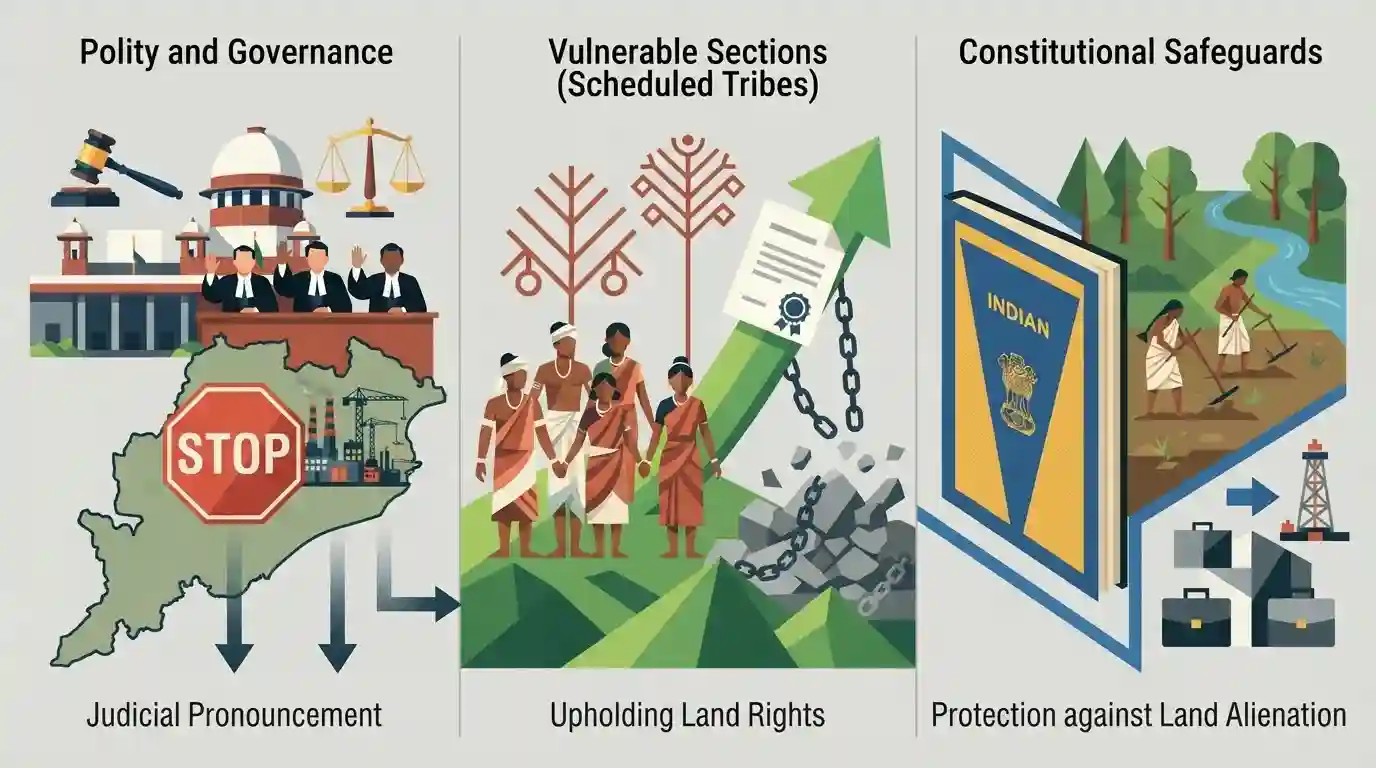
The Supreme Court of India delivered a landmark judgment upholding tribal land rights by quashing a mining-linked land acquisition in Odisha. The ruling reinforces constitutional safeguards for Scheduled Areas under the Fifth Schedule, protecting indigenous communities against forced land alienation for industrial and corporate mining projects.
Key Points
- The Supreme Court upheld tribal land rights by quashing a mining-linked land acquisition in Odisha.
- Reaffirmed statutory and constitutional protections preventing the transfer of tribal land to private non-tribal entities for industrial or mining purposes.
- Reinforced the legal safeguards for Scheduled Areas and the protective mandate of the Fifth Schedule of the Constitution.
Important Terms
Fifth Schedule

A constitutional provision under Article 244(1) providing a special governance and protective framework for Scheduled Areas with predominant tribal populations across ten states to safeguard their land, culture, and interests.
UPSC context
UPSC GS Paper II (Polity & Governance) — tests understanding of federalism, local governance, and constitutional protections for Scheduled Tribes.
Supreme Court of India
The apex constitutional court of India, responsible for interpreting the Constitution, reviewing executive and legislative actions, and protecting fundamental rights and federal principles.
UPSC context
UPSC GS Paper II (Indian Judiciary) — tests judicial review, doctrine of basic structure, and landmark rulings on fundamental rights and tribal rights.
Static Concepts Connected
What are the key constitutional protections and governance mechanisms under the Fifth Schedule of the Indian Constitution?
- Geographical Scope: Applies to Scheduled Areas in states other than Assam, Meghalaya, Tripura, and Mizoram (which fall under the Sixth Schedule).
- Governor's Powers: Empowers the Governor to modify central or state laws in their application to Scheduled Areas and form Tribes Advisory Councils.
- Land Alienation: Prohibits or restricts the transfer of land by tribals to non-tribals and regulates the allotment of land to members of Scheduled Tribes.
Cross-Topic Patterns
Tribal Land Rights vs Industrial Land Acquisition
Judicial rulings protecting Fifth Schedule lands directly intersect with industrial land acquisition statutes and corporate ESG compliance frameworks under Indian corporate law.
Fifth Schedule Governance and PESA Implementation
Supreme Court insistence on Gram Sabha consent reinforces grassroots democratic decentralization, linking Fifth Schedule safeguards with Panchayati Raj Extension to Scheduled Areas (PESA) Act mandates.

Expect statements on whether Fifth Schedule provisions give absolute veto power to Gram Sabhas or if state acquisition overrides them.
Linked PYQs · 3
Linked PYQs · 3
- 2019PrelimsGS1
Under which Schedule of the Constitution of India can the transfer of tribal land to private parties for mining be declared null and void?
- 2022PrelimsGS1
If a particular area is brought under the Fifth Schedule of the Constitution of India, which one of the following statements best reflects the consequence of it ?
- 2025PrelimsGS1
Consider the following statements : With reference to the Constitution of India, if an area in a State is declared as Scheduled Area under the Fifth Schedule I. the State Government loses its executive power in such areas and a local body assumes total administration II. the Union Government can take over the total administration of such areas under certain circumstances on the recommendations of the Governor Which of the statements given above is/are correct?
