Supreme Court upholds ruling against free land allotment to IAMC
Source:The Hindu ↗
Why It Matters
This ruling is critical for understanding the limits of executive discretion when distributing public resources (state largesse). It highlights the interplay between the public trust doctrine, transparency in governance, and institutional arbitration, making it relevant for GS2 questions on governance ethics, dispute redressal bodies, and judicial review.
Summary
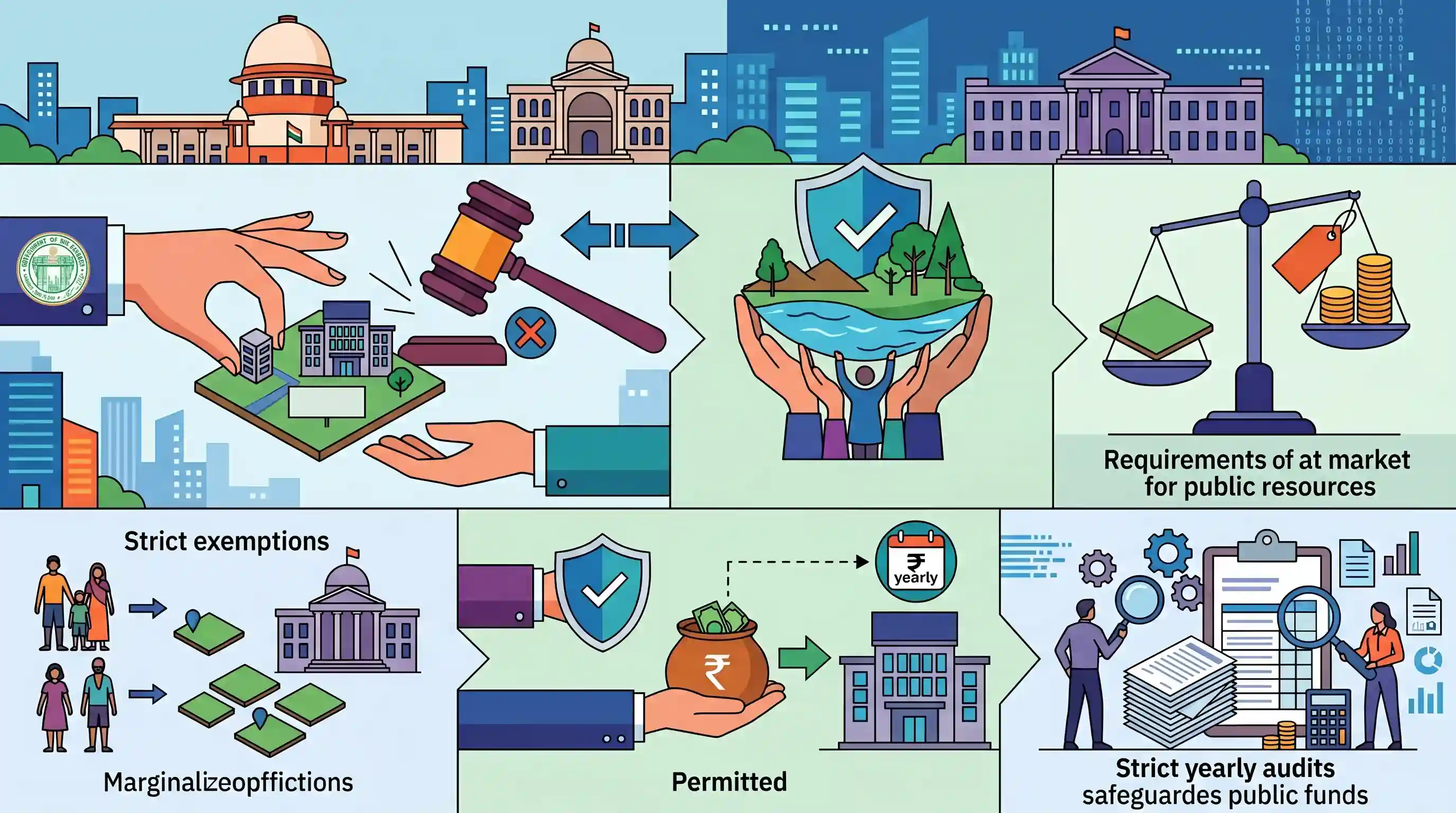
The Supreme Court upheld a Telangana High Court judgment quashing the free allotment of land by the state government to the International Arbitration & Mediation Centre (IAMC) in Hyderabad. The High Court ruled that natural resources are held under the public trust doctrine, and gratuitous distribution of such state largesse—even to a public charitable trust aimed at promoting institutional arbitration—is contrary to the law. While recognizing the value of the IAMC as an alternative dispute resolution hub, the courts affirmed that public resources must be allotted at market value, with exemptions strictly limited to marginalized groups or government departments. Furthermore, the court permitted the state’s ₹3 crore annual financial assistance to the IAMC but mandated strict yearly audits to safeguard public funds.
Key Points
- The Supreme Court declined to interfere with the Telangana High Court’s ruling that cancelled the free allotment of land to the International Arbitration & Mediation Centre (IAMC).
- The High Court emphasized that natural resources are held in public trust and their gratuitous distribution (state largesse) without adequate compensation is unsustainable and violates established procedures.
- Under the state's 2012 land allotment policy, free land is strictly restricted to government departments or BPL families; other public or private entities must pay market value.
- While the High Court struck down the land allotment, it upheld the state's provision of ₹3 crore in annual financial assistance to IAMC, provided it undergoes strict annual performance reviews and audits by the Principal Accountant General.
- The IAMC was established as a public charitable trust to promote institutional arbitration in India and compete with global hubs, but the court ruled this objective does not grant immunity from fair resource allocation norms.
Important Terms
Public Trust Doctrine

A legal principle establishing that certain resources (land, water, air) are held by the State as a trustee for the public, preventing their arbitrary private allotment.
UPSC context
GS-II (Judiciary/Governance); tests resource management principles and state accountability in distributing public assets.
State Largesse
Government resources or benefits (contracts, land, licenses) whose distribution must follow fair, transparent, and non-arbitrary procedures under Article 14 of the Constitution.
UPSC context
GS-II (Polity/Governance); tests constitutional limits on executive discretion and the requirement for transparency.
International Arbitration & Mediation Centre (IAMC)
An autonomous ADR institution in Hyderabad providing specialized facilities and rules for resolving commercial disputes through arbitration and mediation.
UPSC context
GS-II (Judiciary/Governance); relevant for reforms in the justice delivery system and Ease of Doing Business.
Principal Accountant General (Audit)
A senior official under the Comptroller and Auditor General (CAG) responsible for auditing state-level government expenditure and ensuring financial accountability.
UPSC context
GS-II (Constitutional Bodies); tests knowledge of audit mechanisms and fiscal oversight of state funds.
Alternative Dispute Resolution (ADR)
Legal methods like arbitration and mediation used to resolve disputes outside the traditional court system to reduce pendency and lower costs.
UPSC context
GS-II (Judiciary); tests understanding of judicial reforms and mechanisms for faster justice delivery.
Institutional Arbitration
Arbitration conducted under the specialized rules and administrative framework of a permanent organization, offering more structure and predictability than ad-hoc arbitration.
UPSC context
GS-II (Judiciary/Governance); tests knowledge of legal infrastructure and modern commercial conflict resolution.
Prelims Trap
The Public Trust Doctrine applies exclusively to ecological and environmental resources such as rivers and forests.
While originating in environmental law, the doctrine also governs the allocation of all natural resources, public land, and 'state largesse' to prevent arbitrary distribution under Article 14.
Static Concepts Connected
What is the "Public Trust Doctrine" in Indian constitutional law?
- Origin: First explicitly applied in India via the M.C. Mehta v. Kamal Nath (1997) case, drawing from ancient Roman law principles.
- Core Principle: The state acts as a trustee of natural resources meant for public use, rather than an absolute commercial owner with unfettered disposal rights.
- Article 14 link: Prevents the arbitrary, gratuitous distribution of 'state largesse' (like land or spectrum) to private entities, ensuring state actions meet the test of equality.
How does Institutional Arbitration differ from Ad-hoc Arbitration?
- Institutional: Administered by an established institution (e.g., IAMC, SIAC) possessing pre-existing rules, fixed fee structures, and dedicated administrative support.
- Ad-hoc: Parties themselves determine the rules, appoint the arbitrators, and manage the administrative process without any formal institutional backing.
- Statutory Push: The Arbitration and Conciliation (Amendment) Act, 2019 heavily promotes institutional arbitration to establish India as a competitive, global ADR hub.
Cross-Topic Patterns
Public Trust vs. Ease of Doing Business
Attempts to build global dispute hubs (like IAMC) to rival Singapore often clash with Article 14 norms when public land is subsidized, highlighting limits on executive discretion in economic promotion.
CAG audits of autonomous non-state bodies
State grants to public charitable trusts (like the ₹3 crore IAMC grant) immediately attract mandatory audit scrutiny by the Accountant General, linking state largesse directly to CAG financial accountability mechanisms.

Expect a multi-statement Polity question testing the overlap of the Public Trust Doctrine with Article 14 limits on State Largesse.
Linked PYQs · 3
Linked PYQs · 3
- 2024MainsGS2
Explain and distinguish between Lok Adalats and Arbitration Tribunals. Whether they entertain civil as well as criminal cases ?
- 2015MainsGS2
What are the major changes brought in the Arbitration and Conciliation Act, 1996 through the recent Ordinance promulgated by the President? How far will it improve India's dispute resolution mechanism? Discuss.
- 2024MainsGS2
Public charitable trusts have the potential to make India's development more inclusive as they relate to certain vital public issues. Comment.
