Supreme Court Upholds Special Revision of Electoral Rolls
Source:The Hindu ↗
Why It Matters
Clarifies the extent of the Election Commission's powers under Article 324 regarding the verification of citizenship for electoral rolls and balances it with the statutory framework of the Citizenship Act, crucial for topics on electoral reforms and constitutional bodies.
Summary
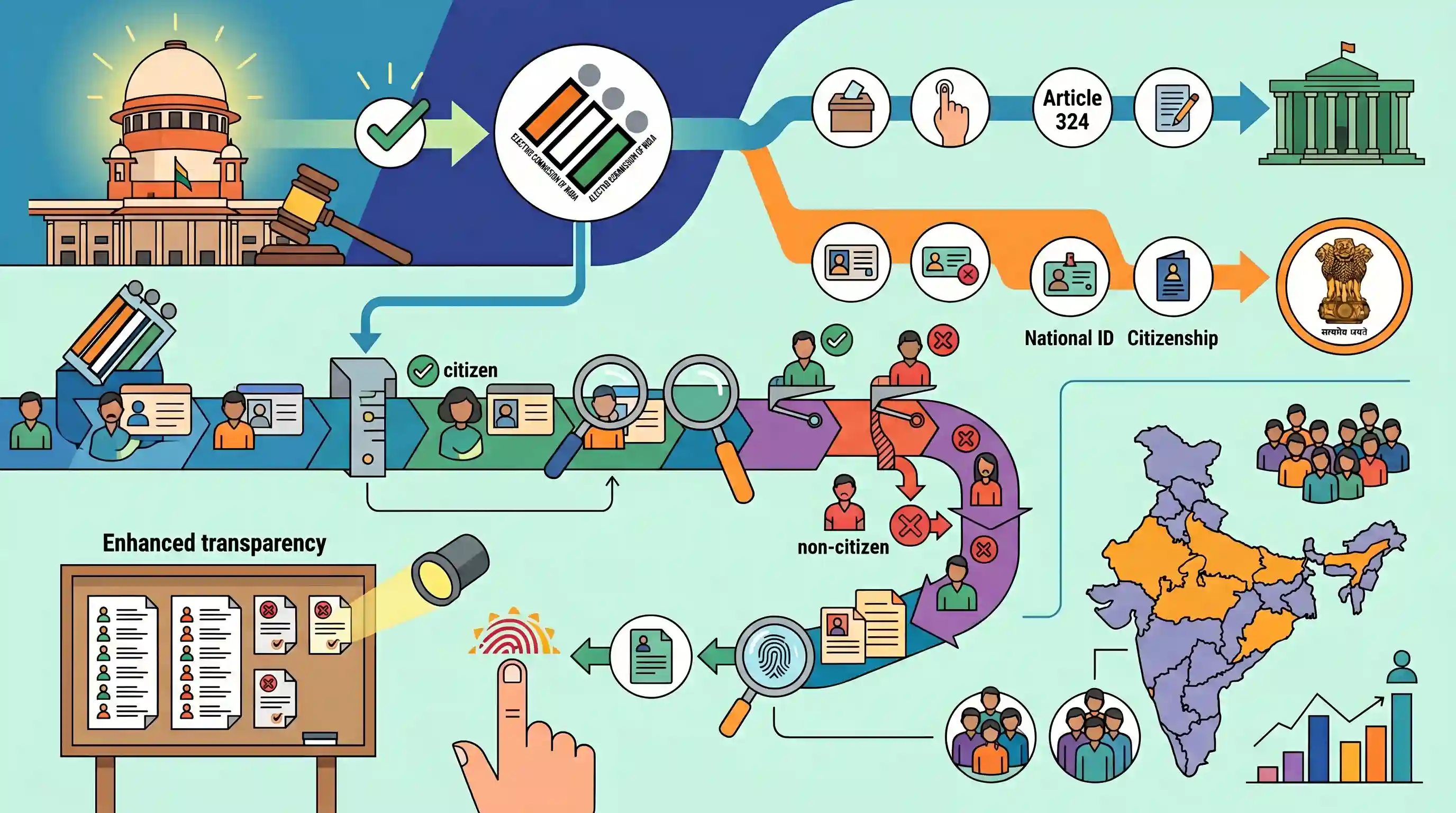
The Supreme Court has validated the Election Commission of India's (ECI) Special Intensive Revision (SIR) exercise, aimed at purging non-citizens from electoral rolls. The Court noted that under Article 324, the ECI holds the authority to verify citizenship for the purpose of electoral registration, though the Central Government retains the ultimate power to adjudicate citizenship under the Citizenship Act, 1955. Additionally, the Court enhanced transparency by mandating the publication of lists of purged voters with reasons and accepted Aadhaar as a supplementary document for verification. This decision impacts the ongoing phase of SIR covering 51 crore voters across 12 States and Union Territories.
Key Points
- The Supreme Court upheld the Election Commission of India's (ECI) 'Special Intensive Revision' (SIR) of electoral rolls as a vital step towards ensuring free and fair elections.
- The Court ruled that the ECI is empowered under Article 324 to verify citizenship status for electoral roll inclusion, though its decision is not the final word on a person's citizenship.
- Doubtful cases regarding citizenship will be forwarded by the ECI to the Central government for adjudication under the Citizenship Act, 1955.
- Aadhaar has been incorporated as the 12th indicative document to help verify identity and residence.
- To ensure transparency, the Supreme Court directed the ECI to publish district-wise, booth-level searchable lists of purged voters along with the reasons for their removal.
Important Terms
Article 324

Constitutional provision vesting the Election Commission of India with the power of 'superintendence, direction, and control' over the preparation of electoral rolls and the conduct of all elections.
UPSC context
GS-II (Polity); essential for understanding the plenary and residual powers of constitutional bodies in ensuring electoral integrity.
Election Commission of India (ECI)
An independent, permanent constitutional body responsible for administering union and state election processes in India, including the preparation of accurate electoral rolls.
UPSC context
GS-II (Constitutional Bodies); frequently tested in the context of institutional autonomy and electoral reforms.
Special Intensive Revision (SIR)
A large-scale house-to-house enumeration and verification exercise conducted by the ECI to ensure electoral rolls are accurate, inclusive, and free from deceased or non-citizen voters.
UPSC context
GS-II (Electoral Reforms); tests knowledge of administrative mechanisms used to maintain the purity of the democratic mandate.
Citizenship Act, 1955
The primary law governing the acquisition, determination, and termination of Indian citizenship, which the Supreme Court clarified is the ultimate domain of the Central Government.
UPSC context
GS-II (Citizenship); critical for distinguishing between electoral eligibility (ECI's domain) and formal legal citizenship (Government's domain).
Aadhaar
A 12-digit unique identity number used for biometric authentication; in this context, it was mandated as an 'indicative' document for inclusive voter verification.
UPSC context
GS-II (Governance); examines the intersection of technology, documentation, and fundamental rights in administrative processes.
Representation of the People Act, 1950 (RPA)
The principal legislation providing the legal framework for voter qualifications and the preparation/revision of electoral rolls, specifically under Section 21(3).
UPSC context
GS-II (Salient features of the RPA); a core statutory topic for understanding India’s electoral legal architecture.
Association for Democratic Reforms (ADR)
A non-partisan NGO that works on electoral and political reforms; it challenged the SIR exercise over concerns of arbitrary citizenship determination by the ECI.
UPSC context
GS-II (Civil Society/Pressure Groups); relevant for the role of NGOs in seeking judicial review of government/body actions.
Prelims Trap
"The ECI has the final authority to determine a voter's citizenship status during Special Intensive Revisions."
The ECI only verifies citizenship for electoral roll inclusion. Final adjudication of citizenship status legally rests exclusively with the Central Government under the Citizenship Act, 1955.
Static Concepts Connected
How is the preparation of electoral rolls governed in India?
- Constitutional Mandate: Article 325 ensures a general electoral roll, prohibiting discrimination. Article 326 guarantees adult suffrage for citizens.
- Statutory Basis: The Representation of the People Act, 1950 (RPA) governs the preparation and revision of electoral rolls, including Special Intensive Revisions (SIR).
- Doubtful Cases: Doubtful cases regarding citizenship identified during electoral roll revisions are forwarded to the Central Government for final adjudication.
What is the legal status of Aadhaar regarding citizenship?
- Proof of Identity: Aadhaar is a valid proof of identity and residence, used as a supplementary indicative document for verification purposes.
- Not Citizenship: As per the Aadhaar Act, 2016, and SC rulings, an Aadhaar number is solely proof of identity and does not confer the right of citizenship.
Cross-Topic Patterns
ECI Autonomy vs. Executive Jurisdiction
The ruling maps the boundary between ECI’s plenary powers under Article 324 for fair elections and the Centre’s statutory monopoly on citizenship adjudication under the 1955 Act.
Aadhaar-Voter ID linkage debate
Connects this verdict to the Election Laws (Amendment) Act 2021 and the Puttaswamy privacy test, emphasizing Aadhaar's role as supplementary rather than mandatory for voter registration.

A multi-statement Prelims question contrasting ECI's electoral roll powers under RPA 1950 with the Centre's Citizenship Act powers is highly likely.
Linked PYQs · 4
Linked PYQs · 4
- 2022MainsGS2
Discuss the role of the Election Commission of India in the light of the evolution of the Model Code of Conduct.
- 2021PrelimsGS1
With reference to India, consider the following statements : 1. There is only one citizenship and one domicile. 2. A citizen by birth only can become the Head of State. 3. A foreigner once granted the citizenship cannot be deprived of it under any circumstances. Which of the statements given above is/are correct?
- 2017PrelimsGS1
Right to vote and to be elected in India is a
- 2017PrelimsGS1
For election to the Lok Sabha, a nomination paper can be filed by
