Tribal Women Inheritance: Supreme Court Ruling on Property Rights
Source:The Hindu ↗
Why It Matters
This judgment highlights the evolving jurisprudence of the Supreme Court in harmonizing customary practices with fundamental constitutional rights. It reinforces the application of Article 15 against gender discrimination, specifically extending property and succession rights to Scheduled Tribe women, challenging patriarchal customs. It serves as a crucial case study for GS2 topics like gender equality, vulnerable sections (STs), and constitutional morality.
Summary
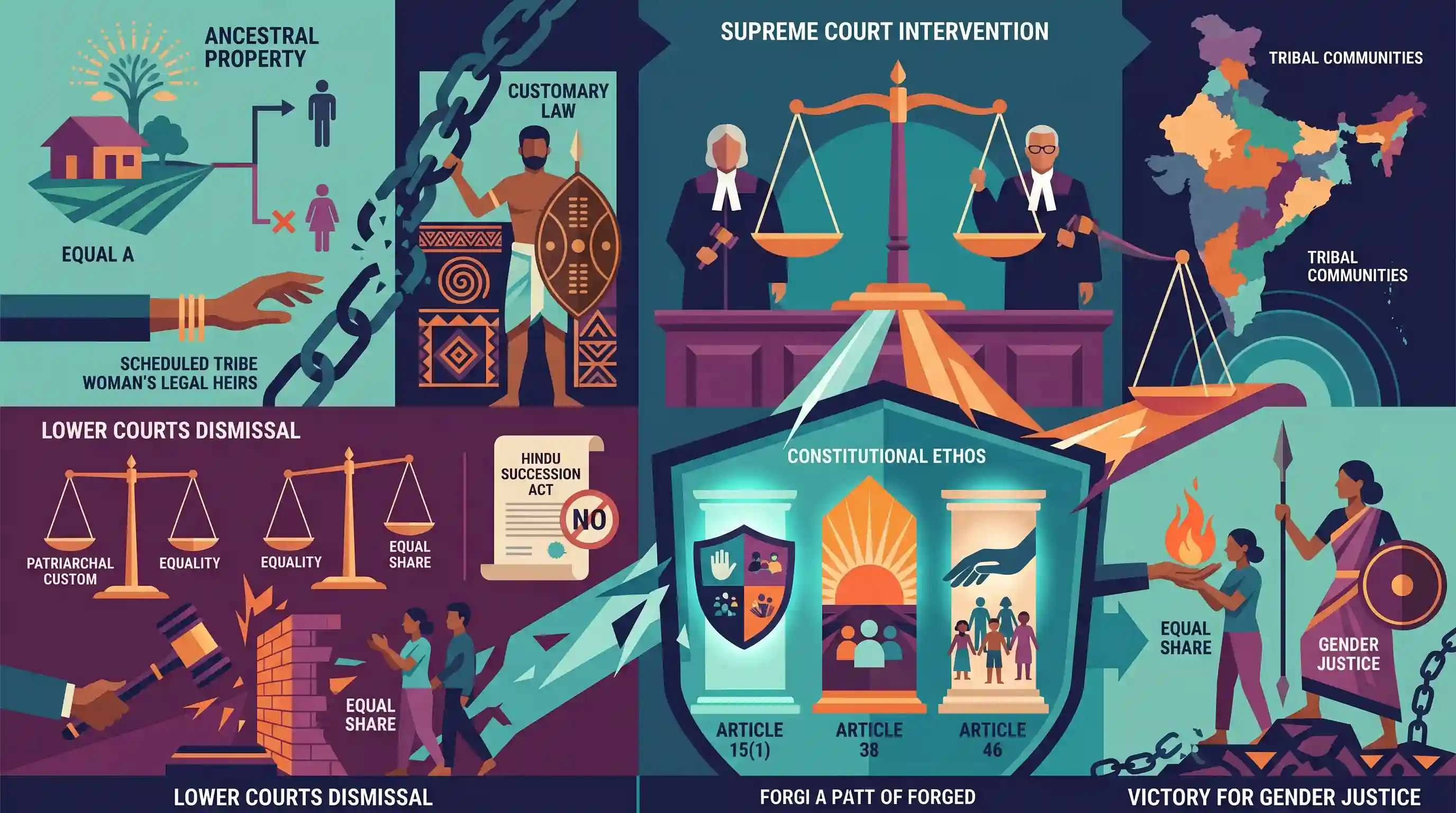
The Supreme Court of India has delivered a landmark ruling upholding the right of a Scheduled Tribe woman's legal heirs to claim an equal share in their maternal grandfather's ancestral property. Lower courts had initially dismissed the claim, citing that Scheduled Tribes are not governed by the Hindu Succession Act and pointing to existing patriarchal customary laws. However, a Bench comprising Justices Sanjay Karol and Joymalya Bagchi overturned this, stating that customs cannot remain static and be used as a refuge to deny constitutional rights. The Court invoked Articles 15(1), 38, and 46 of the Constitution, emphasizing that excluding women from succession violates the right to equality and deepens gender discrimination. The judgment establishes that fundamental rights and constitutional ethos take precedence over discriminatory customary practices, a significant advancement for gender justice within tribal communities.
Key Points
- The Supreme Court upheld the right of a Scheduled Tribe woman's heirs to claim an equal share in her maternal grandfather's ancestral property.
- The Court ruled that denying property rights to women while granting succession to males lacks a rational nexus and violates the constitutional right to equality.
- Justices Sanjay Karol and Joymalya Bagchi invoked Articles 15(1), 38, and 46, highlighting the Constitution's collective ethos against gender discrimination.
- Lower courts had previously rejected the plea based on the non-applicability of the Hindu Succession Act to Scheduled Tribes and reliance on patriarchal customary laws.
- The apex court observed that customs cannot remain "stuck in time" to deprive individuals of their fundamental rights, asserting the supremacy of constitutional principles over discriminatory practices.
Important Terms
Hindu Succession Act, 1956

A statute codifying inheritance among Hindus, Buddhists, Jains, and Sikhs. Section 2(2) explicitly excludes Scheduled Tribes unless notified, often leaving tribal women subject to uncodified patriarchal customs.
UPSC context
GS Paper II (Polity/Social Justice); tests understanding of legal exclusions and the judiciary's role in reforming discriminatory personal laws.
Article 15(1)
A Fundamental Right prohibiting the State from discriminating against any citizen on grounds only of religion, race, caste, sex, or place of birth.
UPSC context
GS Paper II (Fundamental Rights); tests the application of equality principles against systemic or customary gender-based discrimination.
Article 46
A Directive Principle of State Policy (DPSP) requiring the State to promote the educational and economic interests of SCs, STs, and weaker sections while protecting them from social injustice.
UPSC context
GS Paper II (DPSP/Vulnerable Sections); tests the constitutional mandate to protect tribal interests and ensure substantive social justice.
Article 38
A DPSP mandating the State to secure a social order for the promotion of public welfare by ensuring social, economic, and political justice and minimizing inequalities.
UPSC context
GS Paper II (Polity); tests the concept of a 'Welfare State' and judicial interpretation of social justice.
Customary Law
Traditional, uncodified rules and practices accepted as legal requirements within specific communities. In tribal contexts, these often govern inheritance but cannot override modern constitutional guarantees.
UPSC context
GS Paper I (Society) and II (Polity); tests the balance between cultural autonomy and the supremacy of constitutional morality.
Gender Justice
The principle of ensuring equal rights, opportunities, and protection for all genders. In this case, it refers to correcting the historical exclusion of tribal women from property inheritance.
UPSC context
GS Paper II (Social Justice); a recurring theme testing the State's efforts to empower marginalized women through legal and judicial interventions.
Prelims Trap
"The Supreme Court extended the application of the Hindu Succession Act to Scheduled Tribes to ensure gender justice."
The Court did not apply the Hindu Succession Act, as STs remain exempted under Section 2(2). It instead used constitutional principles of equity and equality to override discriminatory customs.
Static Concepts Connected
Are customary laws subject to Fundamental Rights under the Constitution?
- Article 13 Definition: Article 13(3)(a) explicitly includes "custom or usage having in the territory of India the force of law" within the definition of "law".
- Judicial Review: Any customary law that violates Fundamental Rights (like Article 14 or 15) can be declared void by the constitutional courts.
How does the Hindu Succession Act, 1956 treat Scheduled Tribes regarding inheritance?
- Explicit Exemption: Section 2(2) explicitly excludes members of Scheduled Tribes from its provisions, leaving them governed by uncodified customary laws.
- Government Notification: The Central Government possesses the power to notify the application of the Act to specific tribes, though this is rarely exercised.
Cross-Topic Patterns
UCC debate vs. Tribal Autonomy
This judgment fuels the Uniform Civil Code debate, demonstrating that while 5th/6th Schedule tribal autonomy is protected, patriarchal customs denying gender justice increasingly invite judicial intervention.
Harmonious construction of FRs and DPSPs
The Court used DPSPs (Articles 38 & 46) to breathe life into Article 15(1), exemplifying the doctrine of harmonious construction where socio-economic directives reinforce fundamental equality.

Expect a 2026 Prelims question testing the ST exemption in the Hindu Succession Act against Article 13's definition of customary law.
Linked PYQs · 1
Linked PYQs · 1
- 2023MainsGS2
Explain the constitutional perspectives of Gender Justice with the help of relevant Constitutional Provisions and case laws.
