Supreme Court Upholds Deer Relocation from Hauz Khas Park
Source:Indian Express ↗
Why It Matters
It provides a practical example of ecosystem 'carrying capacity' in urban environments, a direct UPSC syllabus topic. It also highlights the roles of environmental bodies (CEC, CZA) and scientific protocols (telemetry, soft release) required in human-wildlife management and animal welfare interventions.
Summary
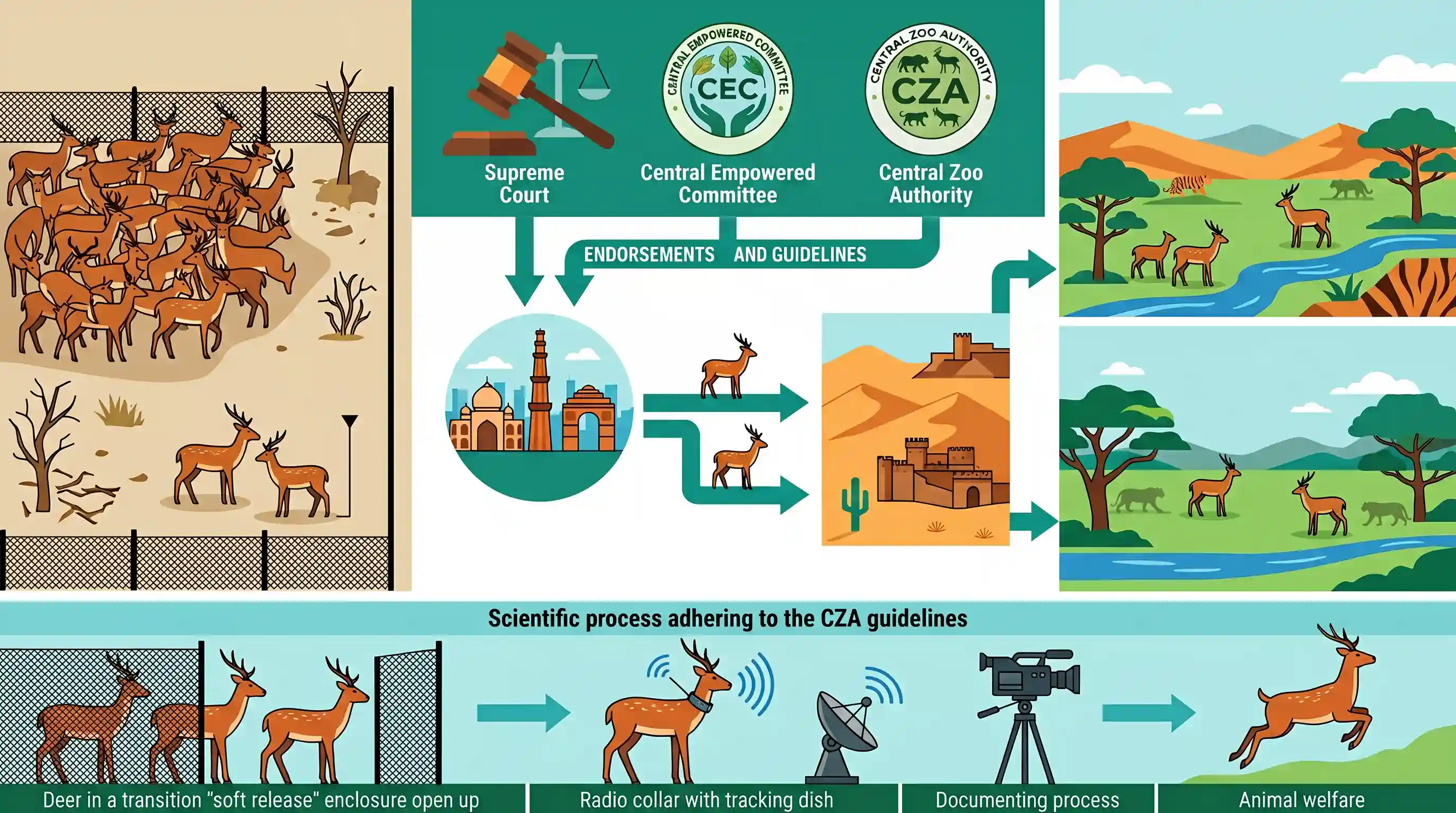
The Supreme Court has endorsed the relocation of hundreds of deer from the A N Jha Deer Park in Hauz Khas, Delhi to the Mukundra Hills and Ramgarh Vishdhari Tiger Reserves in Rajasthan. Accepting recommendations from the Central Empowered Committee (CEC), the Court noted that the deer park lacked the carrying capacity for its current population, leading to issues like inbreeding and inadequate living conditions. The judgment restricts the park to retaining only 38 deer, with any future population growth to be systematically relocated. The court stressed the adherence to Central Zoo Authority (CZA) guidelines, emphasizing scientific methods such as 'soft releases', radio telemetry tracking, and complete video documentation of the translocation process to prioritize animal welfare.
Key Points
- The Supreme Court upheld the decision to relocate excess deer from the A N Jha Deer Park in Hauz Khas, Delhi to tiger reserves in Rajasthan.
- The Court cited the park's severely exceeded carrying capacity and unsuitability as a natural forest environment for the animals' wellbeing.
- A maximum of 38 deer will be retained in Hauz Khas; any future population increase must also be relocated.
- The translocation follows recommendations from the Central Empowered Committee (CEC) and guidelines of the Central Zoo Authority (CZA).
- Scientific protocols, including 'soft release' enclosures, radio telemetry collars for tracking, and mandatory video recording of the operation, were mandated to ensure animal welfare and accountability.
Important Terms
Wildlife (Protection) Act, 1972

Primary Indian legislation enacted to protect wild animals, birds, and plants. It establishes schedules of protection and provides the legal framework for national parks and sanctuaries.
UPSC context
GS Paper 3: Environment. Essential for understanding India's legal conservation framework and protected area categories.
Central Zoo Authority (CZA)
A statutory body established in 1992 under the Wildlife (Protection) Act to oversee, regulate, and specify standards for the management and animal welfare of Indian zoos.
UPSC context
GS Paper 3: Statutory Bodies. Tested under environmental governance and institutional frameworks for biodiversity.
Central Empowered Committee (CEC)
An environmental watchdog created by the Supreme Court in 2002. It was granted statutory status in 2023 to monitor compliance with judicial orders on forest and wildlife conservation.
UPSC context
GS Paper 2/3: Judiciary/Environment. Relevant for judicial activism in environmental protection and recent administrative shifts.
Carrying Capacity
The maximum population size of a species that an ecosystem can sustainably support without degrading its natural resources or environmental integrity.
UPSC context
GS Paper 3: Ecology. A core ecological principle frequently used to justify wildlife management and sustainable development.
Mukundra Hills Tiger Reserve
Rajasthan's third tiger reserve, located near Kota. It encompasses the Darrah, Jawahar Sagar, and Chambal wildlife sanctuaries along the eastern bank of the Chambal River.
UPSC context
GS Paper 1/3: Geography/Conservation. Important for mapping protected areas and understanding regional biodiversity corridors.
Ramgarh Vishdhari Tiger Reserve
India’s 52nd tiger reserve, located in the Bundi district of Rajasthan. It serves as a vital corridor connecting Ranthambore and Mukundra Hills Tiger Reserves.
UPSC context
GS Paper 3: Environment. Noteworthy as a recently designated reserve and a critical link in the tiger landscape.
Prelims Trap
"The Central Empowered Committee (CEC) operates as an ad-hoc committee appointed and controlled directly by the Supreme Court."
The CEC was originally formed by the SC, but in 2023 it was notified as a permanent statutory body under the Environment (Protection) Act, 1986.
Static Concepts Connected
What is the mandate and structure of the Central Zoo Authority (CZA)?
- Statutory origin: Established in 1992 through an amendment to the Wildlife (Protection) Act, 1972.
- Leadership: Chaired by the Union Minister for Environment, Forest and Climate Change.
- Core function: Regulates the functioning of zoos across India, oversees captive breeding, and authorizes the transfer and translocation of captive animals.
What are the geographic markers of Mukundra Hills and Ramgarh Vishdhari Tiger Reserves?
- Mukundra Hills: Located in the Vindhya range (Mukundra and Gargola mountains) and falls under the drainage basin of the Chambal River and its tributaries.
- Ramgarh Vishdhari: Serves as a critical ecological corridor linking Ranthambore Tiger Reserve in the northeast to Mukundra Hills Tiger Reserve in the south.
Cross-Topic Patterns
Cheetah project vs. Deer translocation
Both operations spotlight the 'soft release' protocol, emphasizing phased acclimatization in temporary enclosures (bomas) to reduce wildlife stress before full integration into the wild.
Institutionalizing environmental jurisprudence
The SC relying on the CEC marks the body's transition from an ad-hoc judicial creation (2002) to a formalized statutory body under the Environment (Protection) Act, 1986.

Expect a prelims question testing the CEC's new statutory status under EPA 1986 paired with ecological terms like 'soft release'.
Linked PYQs · 2
Linked PYQs · 2
- 2019MainsGS3
Define the concept of carrying capacity of an ecosystem as relevant to an environment. Explain how understanding this concept is vital while planning for sustainable development of a region.
- 2022PrelimsGS1
With reference to Indian laws about wildlife protection, consider the following statements : 1. Wild animals are the sole property of the government. 2. When a wild animal is declared protected, such animal is entitled for equal protection whether it is found in protected areas or outside. 3. Apprehension of a protected wild animal becoming a danger to human life is sufficient ground for its capture or killing. Which of the statements given above is/are correct?
