Supreme Court Rules on Industry Definition Under New Labour Code
Source:The Hindu ↗
কেন এটি গুরুত্বপূর্ণ
This ruling is a milestone in Indian labour and economic jurisprudence. It directly addresses the transition from the legacy Industrial Disputes Act, 1947 to the modern Industrial Relations Code, 2020. By restricting the 1978 expansive definition of 'industry', the judgment redefines the boundaries of collective bargaining and labour protections in a modern market economy. This is highly relevant for UPSC questions on labour market reforms, judicial precedents, and the socio-economic impacts of privatisation.
সারসংক্ষেপ
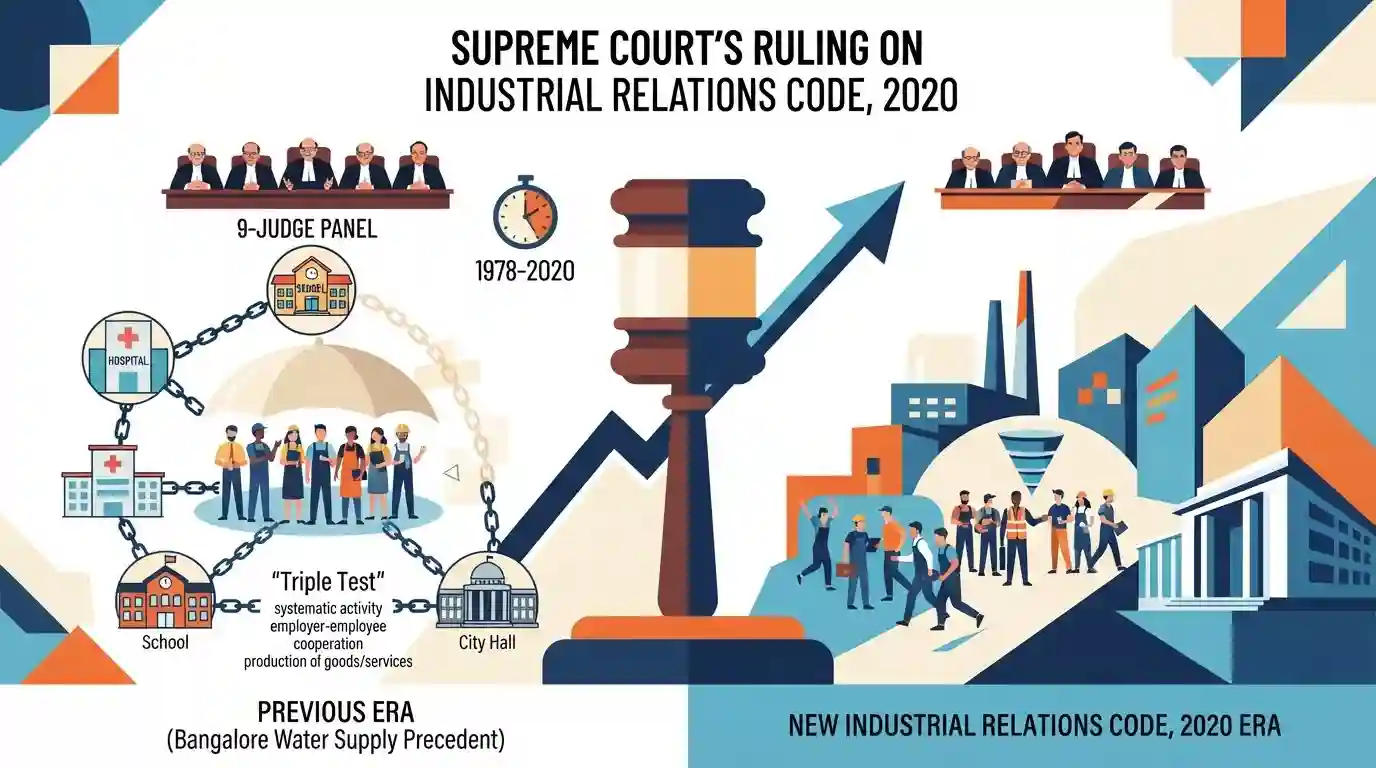
A 9-judge Constitution Bench of the Supreme Court has ruled that the 1978 landmark precedent in the Bangalore Water Supply case—which expansively defined 'industry' to include hospitals, educational institutions, and municipalities—will not apply to the new Industrial Relations Code (IRC), 2020. The majority held that the IRC, 2020 will be interpreted based on its own text and context, effectively confining the worker-friendly 1978 'triple test' to legacy disputes pending from the pre-IRC era. The ruling represents a significant shift from historical welfare-oriented labor jurisprudence to modern economic-reform legislation.
মূল বিষয়
- The Supreme Court's 9-judge Constitution Bench ruled that the landmark 1978 expansive definition of 'industry' will not apply to interpretations under the new Industrial Relations Code (IRC), 2020.
- The 1978 Bangalore Water Supply and Sewerage Board (BWSSB) v. A. Rajappa judgment (authored by Justice V.R. Krishna Iyer) had introduced a 'triple test' (systematic activity, employer-employee cooperation, production of goods/services for human wants) that brought institutions like hospitals, educational bodies, and municipalities within the purview of worker-protection laws.
- The majority opinion, authored by Chief Justice Surya Kant, clarified that Section 2(p) of the IRC, 2020 (which came into force in November 2025) will be interpreted in its own text and context, unburdened by the 1978 precedent. This restricts the 1978 judgment's applicability strictly to pending legacy cases filed under the 1947 Act.
- In a strong dissent, Justice B.V. Nagarathna (supported by Justices Datta and Bhuyan) argued that the reference was unwarranted. She emphasized that post-liberalisation and privatisation, a broad definition of 'industry' is critical to safeguard the rights of workers transitioning from public to private sectors. She upheld the 1978 'Dominant Nature Test'.
- Justice Dipankar Datta highlighted the need for judicial consistency and finality, remarking that 'institutional credibility lies in respecting finality and not in perpetuating doubt'.
- The ruling marks a pivotal shift in Indian labour jurisprudence, decoupling modern economic-market labour reforms from 1970s welfare-oriented judicial interpretations.
গুরুত্বপূর্ণ শব্দ
Industrial Relations Code 2020

A key labor code consolidating laws on trade unions, employment conditions, and dispute settlements, replacing the 1947 Act to modernise industrial relations.
UPSC context
GS Paper III (Economy/Labour Reforms). Tests structural reforms, ease of doing business, and social security.
Industrial Disputes Act 1947
Legacy legislation enacted to investigate and settle industrial disputes, laying down provisions for layoffs, retrenchments, strikes, and dispute resolution.
UPSC context
GS Paper III (Economy). Tests historical labor rights frameworks, welfare-oriented legislation, and reform transitions.
Bangalore Water Supply Case (1978)
A landmark seven-judge Supreme Court ruling that expansively defined "industry" under the 1947 Act, extending statutory protection to employees in diverse welfare sectors.
UPSC context
GS Paper II (Polity/Judiciary). Tests judicial interpretation of welfare rights and legislative-judicial checks and balances.
Triple Test
A judicial test holding that systematic activity, employer-employee cooperation, and production/distribution of goods and services together constitute an "industry" under labor law.
UPSC context
GS Paper II (Judiciary). Tests criteria determining statutory labor protections and evolution of judicial doctrines.
প্রিলিমস ফাঁদ
The 9-judge bench completely overruled the 1978 Bangalore Water Supply judgment, rendering its Triple Test legally obsolete for all pending disputes.
The judgment does not strike down or invalidate the 1978 precedent. It merely restricts its application prospectively, meaning the Triple Test remains active and legally binding for resolving legacy disputes pending under the 1947 Act.
সংযুক্ত স্থির ধারণা
What is the Bangalore Water Supply (1978) Triple Test?
- The Criteria: Establishes that 'industry' exists if there is systematic activity, employer-employee cooperation, and production of goods/services for human wants.
- Profit Motive: Clarified that profit motive, gainful intent, or capital investment are not essential elements to qualify an establishment as an industry.
- Coverage: Brought hospitals, educational institutions, research organizations, and municipal bodies under the welfare protections of the Industrial Disputes Act, 1947.
What are the 4 consolidated Labor Codes of India?
- The Codes: Consolidates existing laws into the Code on Wages, Industrial Relations Code, Social Security Code, and Occupational Safety, Health and Working Conditions Code.
- Core Objective: Aims to rationalize 29 central labor laws to improve ease of doing business while extending social security to unorganized workers.
- Key Reform: Alters statutory thresholds for layoffs, retrenchment, and closure, giving establishments with up to 300 workers more operational flexibility.
আন্তঃবিষয় প্যাটার্ন
Judicial Precedent vs. Legislative Codification
Illustrates the shift where the Supreme Court yields to modern economic statutes, replacing the judicial policy-making of the socialist 1970s.
Welfare State vs. Ease of Doing Business
Examines the tension between Directive Principles of State Policy promoting worker welfare and India's macroeconomic goals for competitive, flexible labor markets.

Analysis of the transition from socialist-era judicial 'triple test' to statutory definitions in IRC 2020 likely for GS-2/3 Mains.
সংযুক্ত PYQ · 2
সংযুক্ত PYQ · 2
- 2024MainsGS3
Discuss the merits and demerits of the four 'Labour Codes' in the context of labour market reforms in India. What has been the progress so far in this regard?
- 2016MainsGS3
How globalization has led to the reduction of employment in the formal sector of the Indian economy? Is increased informalization detrimental to the development of the country?
