Supreme Court Rules Unopposed Election Wins Unconstitutional
Source:Indian Express ↗
Why It Matters
This is a major judicial intervention in India's electoral process that changes how uncontested elections are handled. It strengthens the role of NOTA, deepens democratic accountability, and is highly relevant for GS Paper 2 topics covering the Representation of the People Act and electoral reforms.
Summary
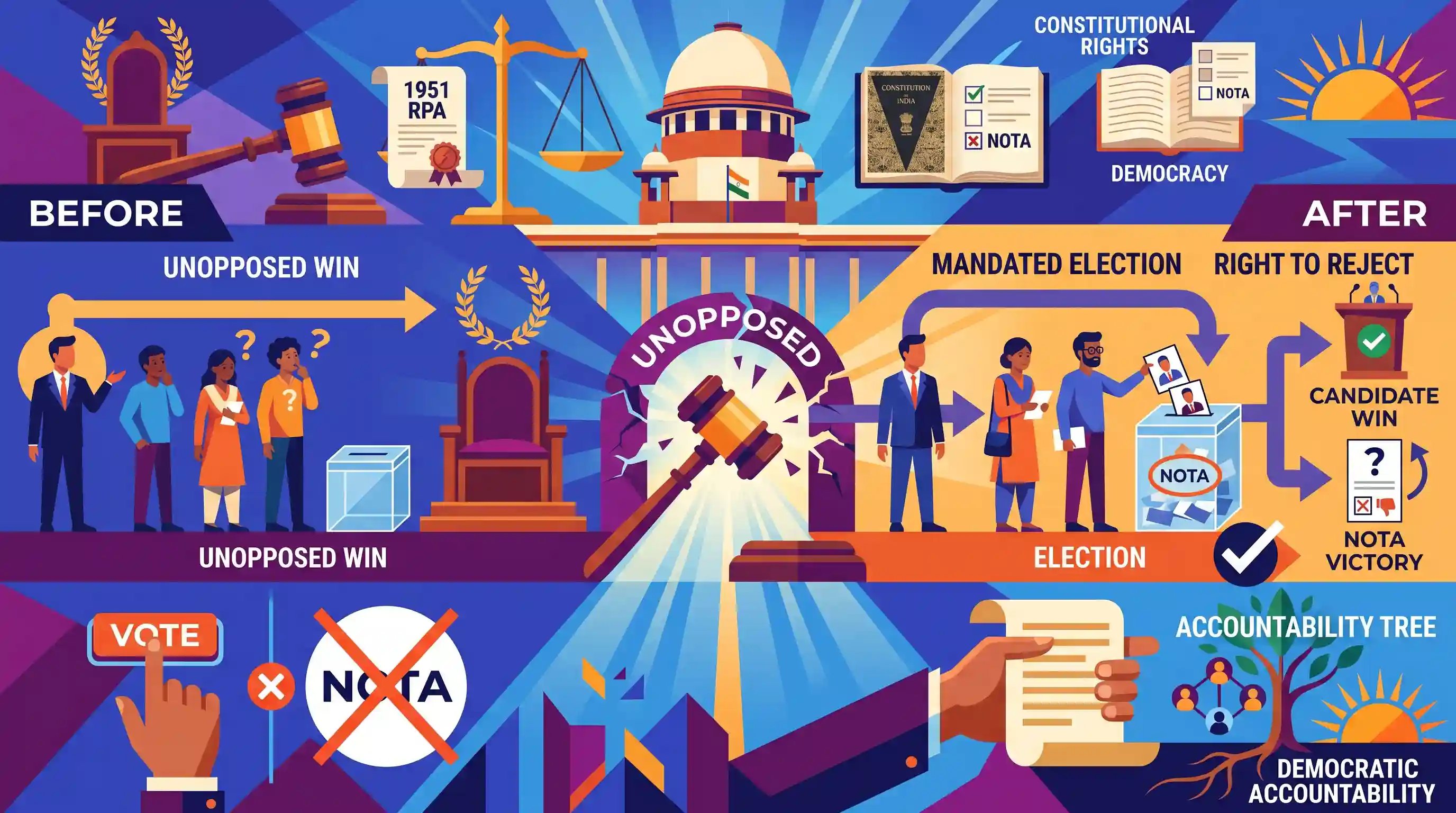
The Supreme Court of India has delivered a landmark judgment declaring unopposed election wins unconstitutional. The Court held that automatically declaring a single remaining candidate as the winner violates the electorate's right to vote, specifically the right to choose the 'None of the Above' (NOTA) option. This ruling overturns the historical practice under the Representation of the People Act, 1951, where Returning Officers could declare uncontested candidates elected without conducting a poll. By mandating elections even for single-candidate races, the Supreme Court has strengthened democratic accountability and reinforced the principle that the right to reject is a fundamental aspect of a voter's freedom of expression.
Key Points
- The Supreme Court ruled that unopposed election wins are unconstitutional because they deprive voters of their right to exercise the NOTA (None of the Above) option.
- The judgment effectively invalidates provisions like Section 53(2) of the Representation of the People Act, 1951, which allowed a single remaining candidate to be declared the winner without a poll.
- The Court reiterated that the right to reject candidates (NOTA) is integral to a voter's freedom of expression under Article 19(1)(a) and the democratic process.
- Going forward, the Election Commission must conduct polling even in constituencies with only one candidate to ascertain the genuine mandate of the electorate.
- This reform aims to prevent political maneuvering that forces uncontested wins and strengthens the democratic requirement of electoral accountability.
Important Terms
Representation of the People Act, 1951

A comprehensive law enacted under Article 327 governing the conduct of elections in India. It details procedures for nominations, polling, and results, including Section 53(2) which historically allowed unopposed candidates to be declared winners without a poll.
UPSC context
GS Paper II (Electoral Reforms). Tests knowledge of the legal framework governing Indian democracy and judicial reviews of statutory provisions.
None of the Above (NOTA)
A ballot option allowing voters to reject all contesting candidates. Recognized by the Supreme Court as a fundamental expressive right, its denial in uncontested elections was the central issue in the ruling against unopposed wins.
UPSC context
GS Paper II (Elections). Crucial for understanding voter rights, the 'right to reject,' and the concept of negative voting in democratic purity.
Supreme Court of India
The highest judicial authority and 'guardian of the Constitution.' It exercises power to strike down laws or practices—like unopposed election wins—that violate fundamental rights, such as the electorate's right to choice and expression.
UPSC context
GS Paper II (Judiciary). Focuses on judicial activism, the protection of fundamental rights, and the balance of power between institutions.
Election Commission of India
The permanent constitutional body (Article 324) responsible for conducting free and fair elections. It manages the electoral cycle and implements judicial mandates, such as ensuring polling occurs even for single-candidate races.
UPSC context
GS Paper II (Constitutional Bodies). Core topic for understanding the administrative integrity and operational mechanics of the Indian electoral system.
Returning Officer
A statutory official appointed for each constituency by the Election Commission. They oversee nominations and counting, and previously held the authority under Section 53(2) to declare uncontested candidates elected without conducting a vote.
UPSC context
GS Paper II (Governance/Elections). Tests understanding of the grassroots administrative machinery and legal duties involved in executing the electoral process.
Article 19(1)(a)
The constitutional provision guaranteeing freedom of speech and expression. The Supreme Court interprets the 'right to vote' and NOTA as expressive acts protected under this article, ensuring voters can signify disapproval.
UPSC context
GS Paper II (Fundamental Rights). Central to debates on civil liberties and the judicial expansion of what constitutes 'freedom of expression.'
Prelims Trap
"The Right to Vote, including the right to exercise NOTA, is a Fundamental Right under the Indian Constitution."
The Right to Vote is a Constitutional (Article 326) and statutory right. However, expressing a choice via NOTA is a Fundamental Right under Article 19(1)(a). Aspirants often conflate the two.
Static Concepts Connected
What is the legal status of NOTA vs the Right to Vote?
- Right to Vote: It is a Constitutional right (Article 326) and a statutory right governed by the Representation of the People Act, 1951.
- Right to Reject (NOTA): The right to cast a negative vote is a Fundamental Right derived from freedom of speech and expression (Article 19(1)(a)) per the PUCL judgment (2013).
- Statutory limits: Under the RPA 1951, NOTA is merely an expression of choice, not a 'candidate'. Currently, if NOTA gets the maximum votes, the candidate with the next highest votes still wins.
Which RPA 1951 section dealt with uncontested elections?
- Section 53(2): Section 53(2) historically allowed Returning Officers to declare a single remaining valid candidate elected unopposed without conducting a poll.
- Current Status: The Supreme Court has effectively invalidated this practice, mandating polls even for single-candidate races to allow the electorate to exercise their right to reject (NOTA).
Cross-Topic Patterns
Article 19(1)(a) expanding voter rights
Just as the Electoral Bonds scheme was struck down under Article 19(1)(a) (voter's right to know), uncontested wins are now invalidated under 19(1)(a) (voter's right to reject). Both judgments drastically expand voter agency.
State Election Commissions vs ECI on NOTA
State Election Commissions (e.g., Maharashtra, Haryana) previously treated NOTA as a 'Fictional Electoral Candidate' to trigger re-elections in local bodies, a reform that the ECI has not yet applied to Lok Sabha/Assembly polls.

Expect a multi-statement 2026 prelims question contrasting the Right to Vote (Art 326) with the fundamental right to NOTA (Art 19(1)(a)).
Linked PYQs · 4
Linked PYQs · 4
- 2024MainsGS2
Examine the need for electoral reforms as suggested by various committees with particular reference to "one nation one election" principle.
- 2022MainsGS2
Discuss the procedures to decide the disputes arising out of the election of a Member of the Parliament or State Legislature under The Representation of the People Act, 1951. What are the grounds on which the election of any returned candidate may be declared void ? What remedy is available to the aggrieved party against the decision ? Refer to the case laws.
- 2017PrelimsGS1
Right to vote and to be elected in India is a
- 2017PrelimsGS1
For election to the Lok Sabha, a nomination paper can be filed by
