Supreme Court Review of UGC Equity and Anti Discrimination Regulations
Source:Indian Express ↗
हे का महत्त्वाचे आहे
It highlights the judicial oversight on systemic discrimination, equity, and inclusion in Indian higher education institutions, directly tying into governance and social justice themes.
सारांश
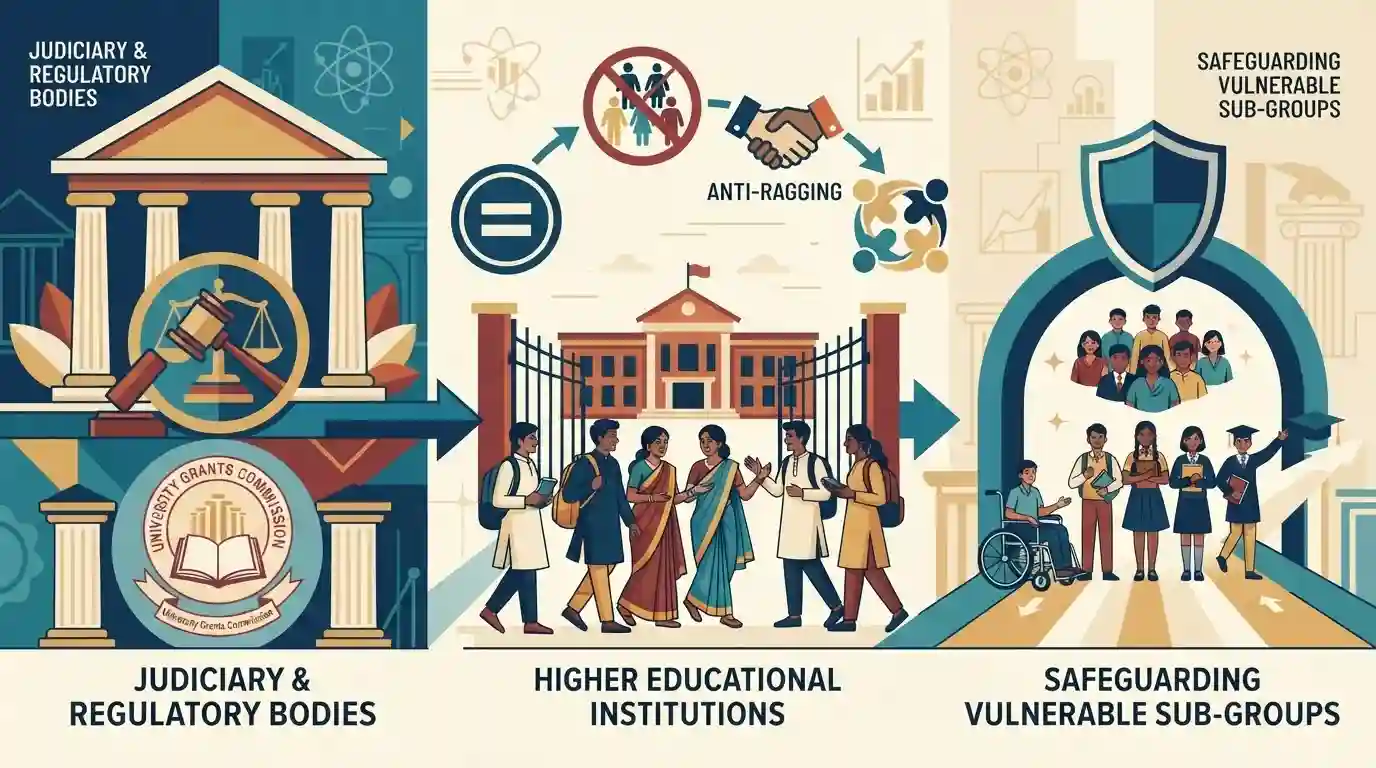
The Supreme Court examined UGC regulations aimed at promoting equity, preventing caste discrimination, and eliminating ragging and segregation in higher educational institutions to safeguard vulnerable student sub-groups.
मुख्य मुद्दे
- The Supreme Court addressed issues related to equity, caste discrimination, and anti-ragging measures in higher educational institutions (HEIs).
- Discussions focused on UGC regulations concerning equity promotion, defining caste, and protecting sub-groups from discrimination on campuses.
- Emphasis was placed on ensuring inclusive environments, preventing segregation, and addressing systemic inequalities in colleges and universities.
महत्त्वाच्या संज्ञा
University Grants Commission (UGC)

Statutory body established under the UGC Act, 1956, tasked with coordinating, determining, and maintaining standards of university education in India.
UPSC context
GS Paper II (Statutory Bodies, Governance, Education Policy). Tests understanding of regulatory bodies governing higher education and institutional accountability.
Supreme Court
Apex judicial body of India empowered under Article 141 to declare laws, resolve constitutional disputes, and exercise judicial review over executive and legislative actions.
UPSC context
GS Paper II (Indian Constitution, Judiciary, Separation of Powers). Tests the court's role in constitutional interpretation, fundamental rights protection, and judicial oversight.
UGC Equity in Higher Education Institutions Regulations
Regulatory framework formulated by the UGC to eliminate discrimination and promote equal opportunities for vulnerable student sub-groups in higher educational institutions.
UPSC context
GS Paper II (Social Justice, Inclusive Education, Vulnerable Sections). Tests policies and institutional mechanisms for preventing caste-based discrimination in campuses.
पूर्वपरीक्षा सापळा
UGC equity regulations apply to all educational institutions across India including schools and coaching centres.
Aspirants often assume UGC equity guidelines apply automatically to all private coaching institutes or schools, whereas they specifically govern Higher Educational Institutions (HEIs) under UGC purview.
संबंधित स्थिर संकल्पना
What constitutional provisions empower the state to promote equity and reservation in higher educational institutions?
- Article 15(4): Article 15(4) empowers the state to make special provisions for the advancement of socially and educationally backward classes, SCs, and STs.
- Article 15(5): Article 15(5) enables special provisions relating to admission of backward classes, SCs, and STs in educational institutions, including private aided and unaided institutions.
- Directive Principles: Article 46 directs the state to promote with special care the educational and economic interests of weaker sections, particularly SCs and STs, protecting them from social injustice.
आंतर-विषय नमुने
Judicial Scrutiny and Article 15(5) Reservations
Judicial enforcement of UGC equity rules intersects directly with Article 15(5) reservations in private and public educational institutions.
Campus Atrocities and PoA Act Implementation
Institutional caste discrimination cases like Abeda Salim Tadvi echo the broader administrative challenges of implementing the Scheduled Castes and the Scheduled Tribes (Prevention of Atrocities) Act in academic spaces.

UGC anti-discrimination frameworks, Article 15/16 jurisprudence, and institutional caste-bias cases will feature as a single multi-statement prelims item.
संबंधित PYQ · 2
संबंधित PYQ · 2
- 2021MainsGS2
Discuss the desirability of greater representation to women in the higher judiciary to ensure diversity, equity and inclusiveness.
- 2023MainsGS2
Explain the constitutional perspectives of Gender Justice with the help of relevant Constitutional Provisions and case laws.
