Supreme Court Examines Two-Child Norm for Local Elections
Source:Indian Express ↗
Why It Matters
It touches upon the constitutional balance between state-driven population policy mandates and democratic rights to representation and political participation in local governance.
Summary
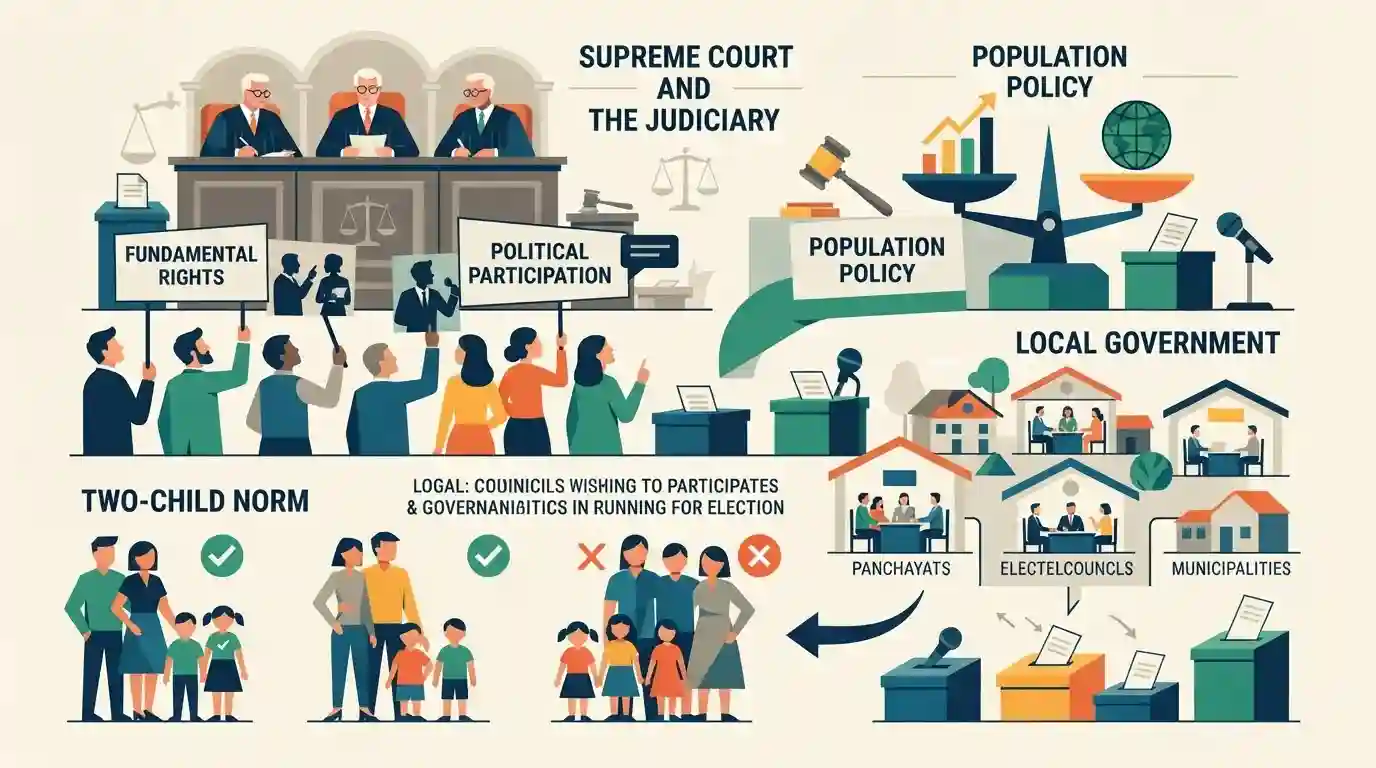
The Supreme Court is hearing petitions challenging the two-child norm imposed by several states as a mandatory qualification for contesting local body elections. The case raises critical questions regarding the balance between population control policy goals and citizens' fundamental rights to political participation, equality, and representation at the grassroots level.
Key Points
- The Supreme Court examines the constitutional validity of the two-child norm as a mandatory qualification for contesting local body elections.
- Petitioners argue that such eligibility criteria disproportionately affect marginalized sections, women, and the poor, acting as a barrier to political representation at the grassroots level.
- States have previously enacted laws mandating family-size criteria to promote population control, triggering debates on rights to political participation vs. public policy objectives.
Important Terms
Two-Child Norm

A mandatory criterion in several state laws disqualifying individuals with more than two children from contesting local body elections (panchayats and municipalities).
UPSC context
UPSC Prelims & Mains (GS Paper II: Polity & Governance - Governance, Executive & Judiciary). Tests understanding of population policies vs. fundamental rights.
Javed v. State of Haryana (2003)
The landmark 2003 Supreme Court judgment that upheld the constitutional validity of the Haryana Panchayati Raj Act's two-child norm for local body elections.
UPSC context
UPSC Prelims & Mains (GS Paper II: Judiciary, Constitutional Interpretation). Important for questions on judicial precedents, fundamental rights, and right to contest.
Total Fertility Rate (TFR)
The average number of children that would be born to a woman over her lifetime if she were to experience the exact current age-specific fertility rates.
UPSC context
UPSC Prelims & Mains (GS Paper I & II: Population Dynamics, Social Empowerment, Demographics). Crucial for demographic dividend and policy evaluation.
Reproductive Autonomy
The constitutional right of individuals to make free, informed, and uncoerced decisions regarding their reproductive lives, body, and family planning without government interference.
UPSC context
UPSC Mains (GS Paper II: Polity & Governance - Right to Life under Article 21, Women's Rights). Essential for evaluating state-imposed restrictions on personal choices.
Prelims Trap
Only Parliament has the constitutional authority to prescribe eligibility and disqualification criteria for contesting any tier of elections in India.
Aspirants often assume candidate qualifications for local bodies are solely determined by Parliament, overlooking that states have specific legislative competence under Entry 5 of the State List.
Static Concepts Connected
What are the constitutional provisions regarding the disqualification of members of local bodies?
- Legislative Competence: State List Entry 5 empowers state legislatures to enact laws relating to local government, including qualifications and disqualifications for panchayats and municipalities.
- Constitutional Basis: Articles 243F and 243VG outline disqualifications for membership of panchayats and municipalities, generally mirroring provisions for state legislatures unless state law adds specific criteria.
- State Laws: Additional disqualifications like the two-child norm are creatures of state legislation rather than direct constitutional mandates, raising judicial review debates.
Cross-Topic Patterns
Local Body Elections & Legislative Competence
State laws legislating candidate disqualifications intersect with Article 243F and Entry 5 List II, testing the boundaries of state legislative competence against fundamental rights.
Population Policy vs. Political Rights
Population control mandates in electoral law mirror debates on universal adult suffrage and socioeconomic equity in grassroots democratic representation.

Two-child norm challenge in local bodies tests the balance between state population policy and Article 21/19 political rights; high UPSC potential.
Linked PYQs · 2
Linked PYQs · 2
- 2019MainsGS2
On what grounds a people's representative can be disqualified under the Representation of Peoples Act, 1951? Also mention the remedies available to such person against his disqualification.
- 2016PrelimsGS1
Consider the following statements: 1. The minimum age prescribed for any person to be a member of Panchayat is 25 years. 2. A Panchayat reconstituted after premature dissolution continues only for the remainder period. Which of the statements given above is/are correct?
