Supreme Court Directs Solid Waste Management Education in Schools
Source:The Hindu ↗
Why It Matters
This directive marks a paradigm shift in environmental governance from administrative top-down mandates to community-driven, bottom-up behavioral change. It underscores the judiciary's role in enforcing civic and constitutional ethics (Article 51A(g)) while stressing that waste management is a shared citizen responsibility, not merely a state service.
Summary
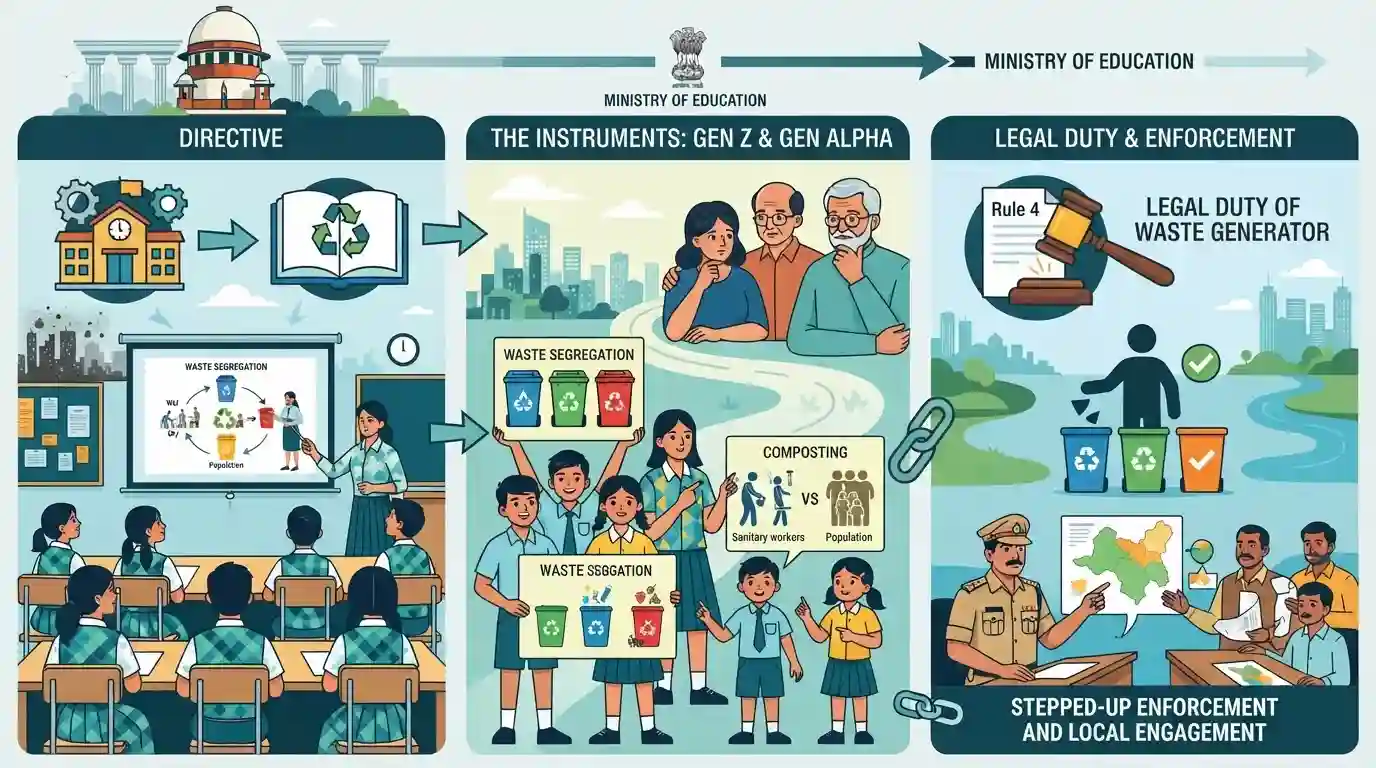
The Supreme Court of India has issued a significant directive to the Department of School and Higher Education to integrate solid waste management (SWM) education into curricula with immediate effect. Recognizing that a tiny class of sanitary workers cannot manage the waste generated by 1.4 billion people, the Court aims to leverage Gen Z and Gen Alpha as 'least coercive' instruments to educate their elders. Highlighting Rule 4 of the Solid Waste Management Rules, the Court stressed that waste segregation is a legal duty of the 'waste generator'. It termed citizen passivity on waste management 'constitutionally unethical' and directed District Collectors to step up enforcement and local engagement.
Key Points
- The Supreme Court directed the Department of School and Higher Education to immediately integrate practical and theoretical knowledge of solid waste management (SWM) into school and college curricula to utilize youth (Gen Z and Gen Alpha) as agents of bottom-up behavioral change.
- The Court called out the widespread public mindset that solid waste management is solely the responsibility of sanitary workers, labeling this passive attitude 'legally incorrect, practically unsustainable, and constitutionally unethical'.
- Rule 4 of the Solid Waste Management (SWM) Rules was heavily emphasized, which casts the legal duty of waste segregation, safe storage, and handover on the 'waste generator' (individuals, households, and establishments) rather than state machinery alone.
- District Collectors are to be vested with powers to actively enforce SWM rules and engage with educational institutions and local households.
- The Court highlighted its previously formed high-level committee (constituted on May 25, 2026) consisting of five Union Secretaries and the Member-Secretary of the CPCB to monitor pan-India SWM infrastructure and implementation.
Important Terms
Solid Waste Management (SWM) Rules, 2026

Notified by the MoEFCC in 2026, superseding the 2016 framework, these rules mandate four-stream source segregation, set digital monitoring guidelines, and strengthen enforcement through District Collectors for bulk and domestic waste generators.
UPSC context
GS Paper III: Environmental Pollution & Degradation; tests understanding of statutory rules, decentralization, waste segregation, and local body governance.
Waste Generator
Any individual, household, establishment, or institution that produces solid waste. Under SWM Rules, generators have a legal duty to segregate waste at source and safely store it before handing it over to collectors.
UPSC context
GS Paper III: Environmental Governance; tests knowledge of civil responsibilities, source segregation mandates, and public accountability under environmental law.
Bulk Waste Generator (BWG)
Entities meeting designated thresholds under the SWM Rules, 2026—such as floor area ≥20,000 sq m, water consumption ≥40,000 litres/day, or generating ≥100 kg/day of waste—mandated to implement onsite scientific waste processing.
UPSC context
GS Paper III: Infrastructure and Environment; tests understanding of corporate/institutional environmental compliance, decentralized waste treatment, and commercial accountability.
Central Pollution Control Board (CPCB)
India's apex statutory authority under the MoEFCC, established under the Water Act, 1974, responsible for coordinating state-level pollution control boards, monitoring environmental quality, and enforcing pollution standards.
UPSC context
GS Paper II & III: Statutory Bodies, Environmental Protection; tests key institutions regulating air, water, and waste management across India.
Ministry of Environment, Forest and Climate Change (MoEFCC)
The central government ministry in India responsible for planning, promoting, and overseeing environmental policies, forest conservation, and the implementation of key legislation like the Environment (Protection) Act, 1986.
UPSC context
GS Paper II: Ministries and Departments; tests policy formulation, international environmental treaty obligations, and central execution of sustainability goals.
Judicial Activism
A philosophy where the judiciary plays a proactive role in enforcing citizens' rights, stepping in to fill policy voids or mandate executive action when other branches of government are deemed passive or non-compliant.
UPSC context
GS Paper II: Judiciary & Separation of Powers; tests the limits of judicial intervention, Public Interest Litigations, and executive-judicial balance in governance.
Prelims Trap
Under the current Solid Waste Management Rules, waste generators are legally mandated to segregate waste into three distinct streams.
The newly implemented SWM Rules 2026 upgraded the previous three-stream segregation (biodegradable, non-biodegradable, domestic hazardous) to a stricter four-stream segregation (Wet, Dry, Sanitary, and Special Care Waste).
Static Concepts Connected
What is the constitutional basis of environmental duty and judicial activism in India?
- Article 51A(g): Mandates every citizen to protect and improve the natural environment, including forests, lakes, rivers, and wildlife.
- Article 48A: Directs the State to endeavor to protect and improve the environment and to safeguard forests and wildlife.
- Article 21: Interpreted by the Judiciary to include the fundamental right to a clean, healthy, and pollution-free environment.
What are the statutory powers of the Central Government under the Environment (Protection) Act, 1986?
- Section 5: Allows the Central Government to issue binding directions, including ordering closure of industries or stopping utility supplies.
- Section 23: Enables the Central Government to delegate its powers and functions under the Act to state governments, collectors, or local authorities.
Cross-Topic Patterns
Nudge theory + environmental governance
Using children as "least coercive instruments" to educate parents represents an organic behavioral "nudge" to address public policy bottlenecks without coercive state action.
Article 142 + executive overreach
Court-mandated school curricula and direct operational instructions to District Collectors highlight how judicial activism addresses administrative gaps in environmental governance.

SWM Rules 2026 (four-stream shift, BWG criteria) and EPA 1986 delegation of power to Collectors likely to feature in a single MCQ.
Linked PYQs · 2
Linked PYQs · 2
- 2019PrelimsGS1
As per the Solid Waste Management Rules, 2016 in India, which one of the following statements is correct?
- 2018MainsGS3
What are the impediments in disposing the huge quantities of discarded solid wastes which are continuously being generated? How do we remove safely the toxic wastes that have been accumulating in our habitable environment?
