Supreme Court Denies Interim Stay on Transgender Persons Amendment Act
Source:Indian Express ↗
हे का महत्त्वाचे आहे
This case highlights the ongoing tension between legislative policy-making and judicial protection of fundamental rights regarding gender identity, equity, and inclusiveness for marginalized communities in India.
सारांश
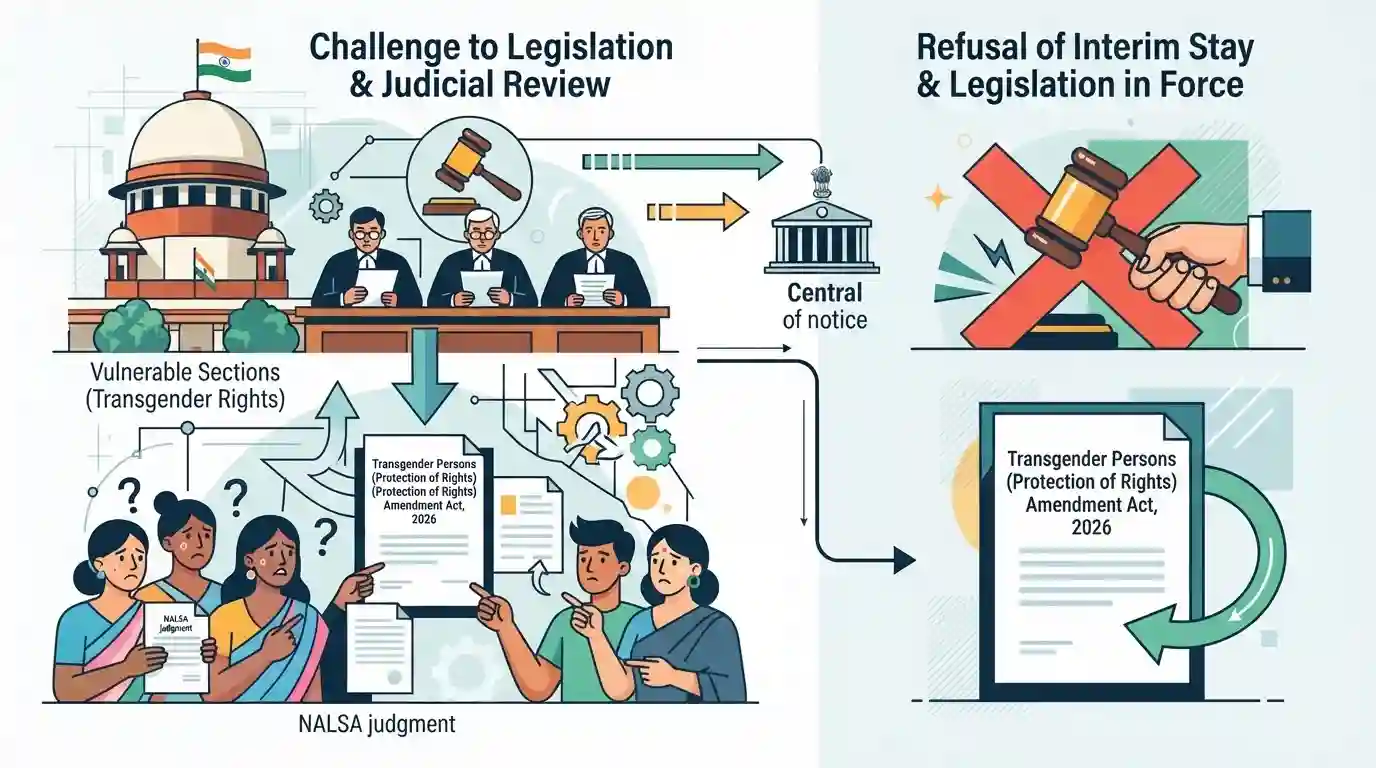
The Supreme Court of India refused to grant an interim stay on the implementation of the Transgender Persons (Protection of Rights) Amendment Act, 2026, while agreeing to examine a petition challenging its constitutional validity. The petitioners contended that the amendment infringes upon privacy and self-determination rights recognized under the NALSA judgment. The Court has issued notice to the Central government, allowing the legislation to remain in force temporarily while the legal challenge proceeds.
मुख्य मुद्दे
- The Supreme Court declined to grant an interim stay on the Transgender Persons (Protection of Rights) Amendment Act, 2026.
- Petitioners challenged certain provisions of the amendment act arguing that they violate fundamental rights and privacy principles established in landmark judgments like NALSA v. Union of India.
- The Court issued notices to the Centre and relevant authorities, seeking their response while keeping the constitutional validity challenge open for detailed hearings.
- The debate centers around self-perceived gender identity versus statutory verification mechanisms proposed by amendments.
महत्त्वाच्या संज्ञा
Transgender Persons (Protection of Rights) Amendment Act, 2026

A 2026 legislative amendment shifting legal gender recognition from self-perception to mandatory medical certification by a designated medical board, drawing constitutional challenges over privacy and self-determination.
UPSC context
Mains GS Paper II (Vulnerable Sections & Governance): Tests understanding of rights, statutory changes, and judicial review of identity legislation.
Transgender Persons (Protection of Rights) Act, 2019
The foundational 2019 legislation prohibiting discrimination against transgender individuals, providing identity certificates, and protecting their welfare across education, employment, and healthcare.
UPSC context
Mains GS Paper II (Social Justice): Evaluates laws safeguarding marginalized communities and implementation gaps relative to judicial guidelines.
Supreme Court of India
The apex judicial body of India vested with the power of judicial review under Article 13 and 32 to examine the constitutional validity of parliamentary legislations.
UPSC context
Mains GS Paper II (Indian Constitution & Judiciary): Tests the doctrine of judicial review, separation of powers, and protection of fundamental rights.
संबंधित स्थिर संकल्पना
What are the key holdings of the Supreme Court in the NALSA v. Union of India (2014) judgment?
- Third Gender Status: Recognized transgender persons as a 'third gender' alongside male and female categories for all legal purposes.
- Right to Self-ID: Affirmed that self-determination of gender is an integral part of personal autonomy and dignity under Article 21.
- Welfare Mandates: Directed Centre and States to take steps for social welfare, reservation in public education/employment, and healthcare.
आंतर-विषय नमुने
Judicial Review + Vulnerable Sections Protection
Judicial review of socio-welfare legislation frequently tests the doctrine of reading down against administrative hurdles in fundamental rights petitions.

Expect a match-the-following or statement-based question linking NALSA (2014) principles to statutory certification procedures.
संबंधित PYQ · 1
संबंधित PYQ · 1
- 2023MainsGS2
Explain the constitutional perspectives of Gender Justice with the help of relevant Constitutional Provisions and case laws.
