Online Gaming Act Constitutional Validity and Supreme Court Transfer
Source:The Hindu ↗
Why It Matters
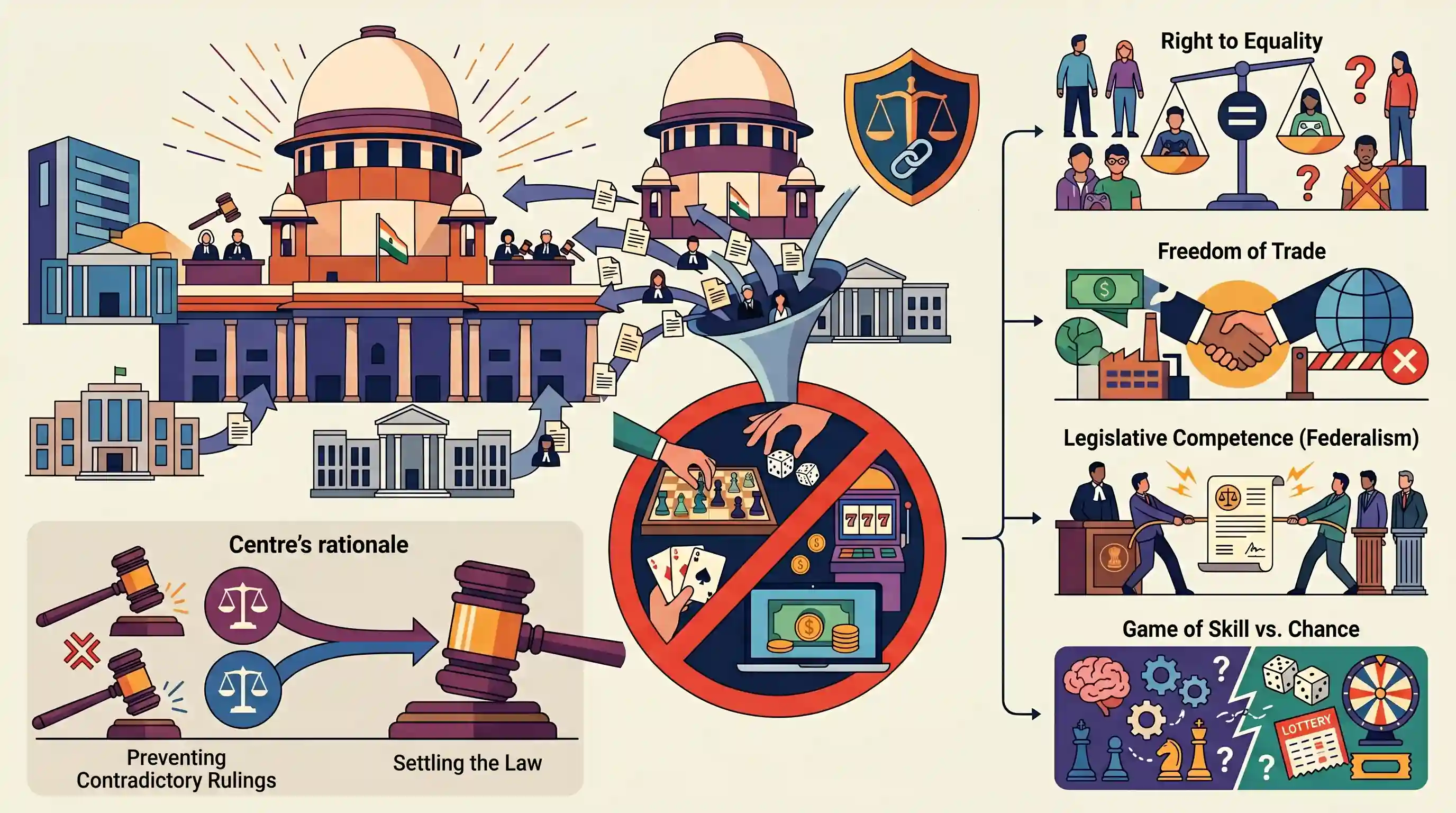
The case highlights the Supreme Court's power to transfer cases to resolve constitutional questions of general importance (Article 139A). It also touches upon the ongoing Centre-State debate over legislative competence regarding online gaming and gambling, and the judicial distinction between games of skill and chance.
Summary
The Supreme Court has decided to transfer multiple pleas challenging the constitutional validity of the Promotion and Regulation of Online Gaming Act, 2025 from various High Courts to itself. The Act broadly prohibits online money games. The Centre argued that a consolidated hearing by the apex court would prevent contradictory rulings and settle the law. The petitions challenge the Act on grounds of violating the right to equality, freedom of trade, legislative competence (federalism), and failing to distinguish between games of skill and chance.
Key Points
- The Supreme Court of India transferred to itself petitions from the Delhi, Karnataka, and Madhya Pradesh High Courts challenging the Promotion and Regulation of Online Gaming Act, 2025.
- The Union Government sought the transfer (under Article 139A) to avoid conflicting judgements and secure a definitive ruling on the Act's constitutional validity.
- The Act prohibits online money games, including related banking services and advertisements.
- Petitioners argue the law violates the right to equality, freedom of expression, federalism (legislative competence), and ignores the established distinction between games of skill and games of chance.
Important Terms
Promotion and Regulation of Online Gaming Act, 2025

A central legislation enacted to prohibit "online money games" (real-money gaming) nationwide while regulating e-sports and social games, effectively criminalizing stakes-based online gaming platforms.
UPSC context
GS Paper II: Government policies, interventions, and regulatory bodies in the digital sector.
Article 139A
A constitutional provision allowing the Supreme Court to withdraw cases involving similar substantial questions of law from High Courts to itself to ensure judicial uniformity.
UPSC context
GS Paper II: Structure, organization, and functioning of the Judiciary; powers of the Supreme Court.
Legislative Competence
The legal authority of Parliament or State Legislatures to enact laws, determined by the distribution of subjects in the Seventh Schedule's three lists.
UPSC context
GS Paper II: Federal structure and distribution of powers between Union and States.
Game of Skill vs. Game of Chance
A judicial test where "games of skill" (predominantly strategy) are protected as legitimate trade, whereas "games of chance" (predominantly luck) are categorized as prohibited gambling.
UPSC context
GS Paper II: Judicial review and interpretation of fundamental rights and business regulations.
Article 19(1)(g)
A fundamental right ensuring citizens the freedom to practice any profession or carry on any occupation, trade, or business, subject to reasonable restrictions.
UPSC context
GS Paper II: Fundamental Rights and their scope/limitations in the context of economic activities.
Prelims Trap
Article 139A empowers the Supreme Court under its Original Jurisdiction to transfer and resolve challenges to Central laws.
Article 139A deals with transferring pending cases (appellate/writ jurisdiction), not Original Jurisdiction. Original Jurisdiction (Article 131) exclusively handles direct disputes between the Centre and States.
Static Concepts Connected
What are the constitutional provisions for transferring cases to the Supreme Court?
- Article 139A: Inserted by the 42nd Amendment (1976), it allows the SC to withdraw and transfer cases pending in one or more High Courts to itself.
- Substantial Question: The cases must involve a substantial question of law of general importance.
- Initiation Process: The SC can act suo motu, or on an application by the Attorney General of India or a party to the case.
How is legislative competence over online gaming divided in the 7th Schedule?
- State List (List II): Entry 34 explicitly places "Betting and gambling" under the jurisdiction of State legislatures.
- Union List (List I): Entry 31 covers "posts, telegraphs, telephones, wireless, broadcasting and other like forms of communication," giving Centre control over digital platforms.
- Residuary Powers: If a new digital domain falls strictly outside the three lists, the Centre can legislate using its residuary powers under Article 248.
Cross-Topic Patterns
Federalism in the Digital Age
The tension between State List "betting" and Union List "communications" mirrors overlapping jurisdiction disputes in data privacy, OTT regulation, and AI governance.
Fundamental Right to Trade vs. Vice
Distinguishing "games of skill" protected by Article 19(1)(g) from "games of chance" parallels constitutional debates on liquor bans, lottery regulations, and crypto-asset restrictions.

Expect a mixed-list mapping question in 2026 linking digital domains (gaming, crypto) to 7th Schedule legislative competence.
Linked PYQs · 5
Linked PYQs · 5
- 2019MainsGS2
From the resolution of contentious issues regarding distribution of legislative powers by the courts, 'Principle of Federal Supremacy' and 'Harmonious Construction' have emerged. Explain.
- 2014PrelimsGS1
The power of the Supreme Court of India to decide disputes between the Centre and the States falls under its
- 2012PrelimsGS1
Which of the following are included in the original jurisdiction of the Supreme Court? 1. A dispute between the Government of India and one or more States 2. A dispute regarding elections to either House of the Parliament or that of Legislature of a State 3. A dispute between the Government of India and a Union Territory 4. A dispute between two or more States Select the correct answer using the codes given below:
- 2024MainsGS2
What changes has the Union Government recently introduced in the domain of Centre-State relations ? Suggest measures to be adopted to build the trust between the Centre and the States and for strengthening federalism.
- 2020MainsGS3
Discuss different types of cyber crimes and measures required to be taken to fight the menace.
