Supreme Court review of retrospective environmental clearances
Source:The Hindu ↗
Why It Matters
The legality of ex post facto environmental clearances represents a classic UPSC conflict between rapid economic development/infrastructure growth and stringent environmental conservation. It also touches upon executive overreach via Office Memorandums and the evolution of environmental jurisprudence by the Supreme Court.
Summary
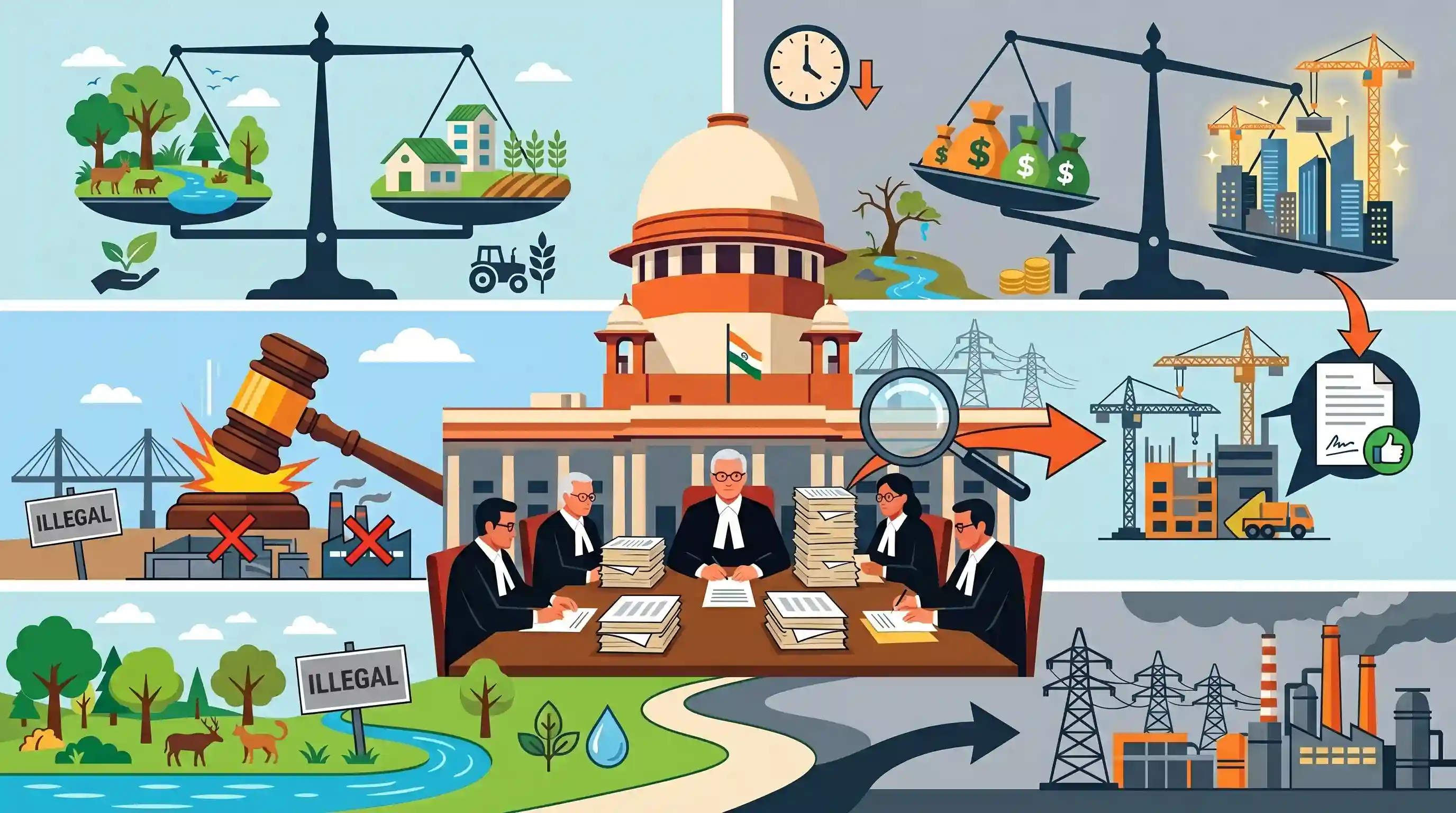
The Supreme Court of India is reopening the debate on the legality of 'ex post facto' (retrospective) environmental clearances for infrastructure projects. The judicial history of this issue has been volatile: a May 2025 ruling declared such clearances illegal, stalling major projects, but was subsequently recalled in November 2025 by a majority bench prioritizing economic investments over strict environmental compliance. A new bench headed by the Chief Justice of India will now specifically examine the legal validity of the Environment Ministry's Office Memorandums (from 2017 and 2021) that facilitate this retrospective approval process, addressing the ongoing tension between sustainable development and economic growth.
Key Points
- The Supreme Court is set to review pleas challenging the 'ex post facto' (retrospective) environmental clearance regime, which allows projects to secure approvals after commencing construction.
- In May 2025, an SC Division Bench struck down this retrospective regime as a 'gross illegality', leading to the suspension of several major infrastructure projects, including airports and hospitals.
- A three-judge SC Bench in November 2025 recalled the May judgment in a 2:1 majority verdict, citing the 'devastating effect' on thousands of crores of investment, though a dissenting judge argued it ignored environmental jurisprudence.
- The upcoming hearing led by CJI Surya Kant will determine the definitive legal validity of the Environment Ministry's 2017 and 2021 Office Memorandums (OMs) that established the ex post facto clearance framework.
Important Terms
Ex Post Facto Environmental Clearance

Retrospective approval granted to projects that began construction or operations without obtaining the mandatory prior environmental permission required under the law.
UPSC context
GS III (Environment); evaluates the tension between economic investment and strict environmental regulatory compliance.
Environmental Impact Assessment (EIA)
A statutory process under the EIA Notification 2006 to evaluate the likely environmental and socio-economic impacts of a proposed project before decision-making.
UPSC context
GS III (Environment); core tool for disaster management, environmental governance, and sustainable infrastructure development.
Sustainable Development
Development that meets present needs without compromising the ability of future generations to meet theirs, balancing economic growth with environmental protection.
UPSC context
GS III (Environment/Economy); the overarching goal of global and national environmental policies.
Office Memorandums (OMs) of 2017 and 2021
Specific executive directives from the Environment Ministry that established a Standard Operating Procedure (SOP) to regularize projects lacking prior environmental clearance.
UPSC context
GS II (Governance); highlights issues of delegated legislation and executive overreach in environmental law.
Precautionary Principle
A legal principle requiring proactive measures to prevent environmental damage even if scientific certainty is lacking, prioritizing environmental protection over economic gain.
UPSC context
GS III (Environment); fundamental doctrine in Indian environmental jurisprudence often cited in judicial reviews.
Vanashakti
A Mumbai-based environmental NGO whose petition led the Supreme Court to strike down the government's ex post facto clearance regime.
UPSC context
GS II (Social Justice/Civil Society); illustrates the role of NGOs and Public Interest Litigation (PIL) in environmental conservation.
Prelims Trap
"The Constitution prohibits ex-post facto environmental clearances under Article 20."
Article 20(1) prohibits retrospective criminal laws, not civil/regulatory approvals. Ex-post facto environmental clearance violates the statutory EIA Notification 2006 (EPA 1986), not Fundamental Rights under Article 20.
Static Concepts Connected
What is the legal basis of Environmental Impact Assessment (EIA) in India?
- Statutory backing: EIA is not a standalone Act; it is issued via notifications under the powers of the Environment (Protection) Act, 1986.
- Prior clearance mandate: The EIA Notification 2006 strictly mandates 'prior environmental clearance' before commencing any construction or site preparation for listed projects.
- Project categorization: Divides projects into Category A (appraised by the Centre/MoEFCC) and Category B (appraised by the State/SEIAA).
What is the Precautionary Principle in Indian environmental jurisprudence?
- Article 21 link: The Supreme Court explicitly read this principle into the Right to Life (Article 21) in the landmark Vellore Citizens Welfare Forum case (1996).
- Core tenet: State authorities must anticipate and prevent environmental degradation. Lack of scientific certainty cannot be used as a reason to postpone preventive measures.
- Burden of proof: The burden of proof rests on the developer to demonstrate that their proposed project is environmentally benign.
Cross-Topic Patterns
Delegated Legislation vs Parent Act
The use of Executive 'Office Memorandums' (OMs) to introduce retrospective clearances tests the limits of delegated legislation, bypassing the legislative scrutiny of the parent Environment (Protection) Act, 1986.
Judicial volatility & Ease of Doing Business
The SC's rapid flip-flop from declaring clearances a "gross illegality" (May) to recalling the judgment (Nov) highlights the ongoing judicial struggle to balance sunk capital with ecological integrity.

Expect a 2026 Mains GS-3 question on whether executive 'Office Memorandums' bypassing EIA 2006 undermine the Precautionary Principle.
Linked PYQs · 3
Linked PYQs · 3
- 2020MainsGS3
How does the draft Environment Impact Assessment (EIA) Notification, 2020 differ from the existing EIA Notification, 2006?
- 2024MainsGS3
What role do environmental NGOs and activists play in influencing Environmental Impact Assessment (EIA) outcomes for major projects in India? Cite four examples with all important details.
- 2022MainsGS2
“The most significant achievement of modern law in India is the constitutionalization of environmental problems by the Supreme Court.” Discuss this statement with the help of relevant case laws.
