Supreme Court to Review Ex Post Facto Environmental Clearances
Source:The Hindu ↗
Why It Matters
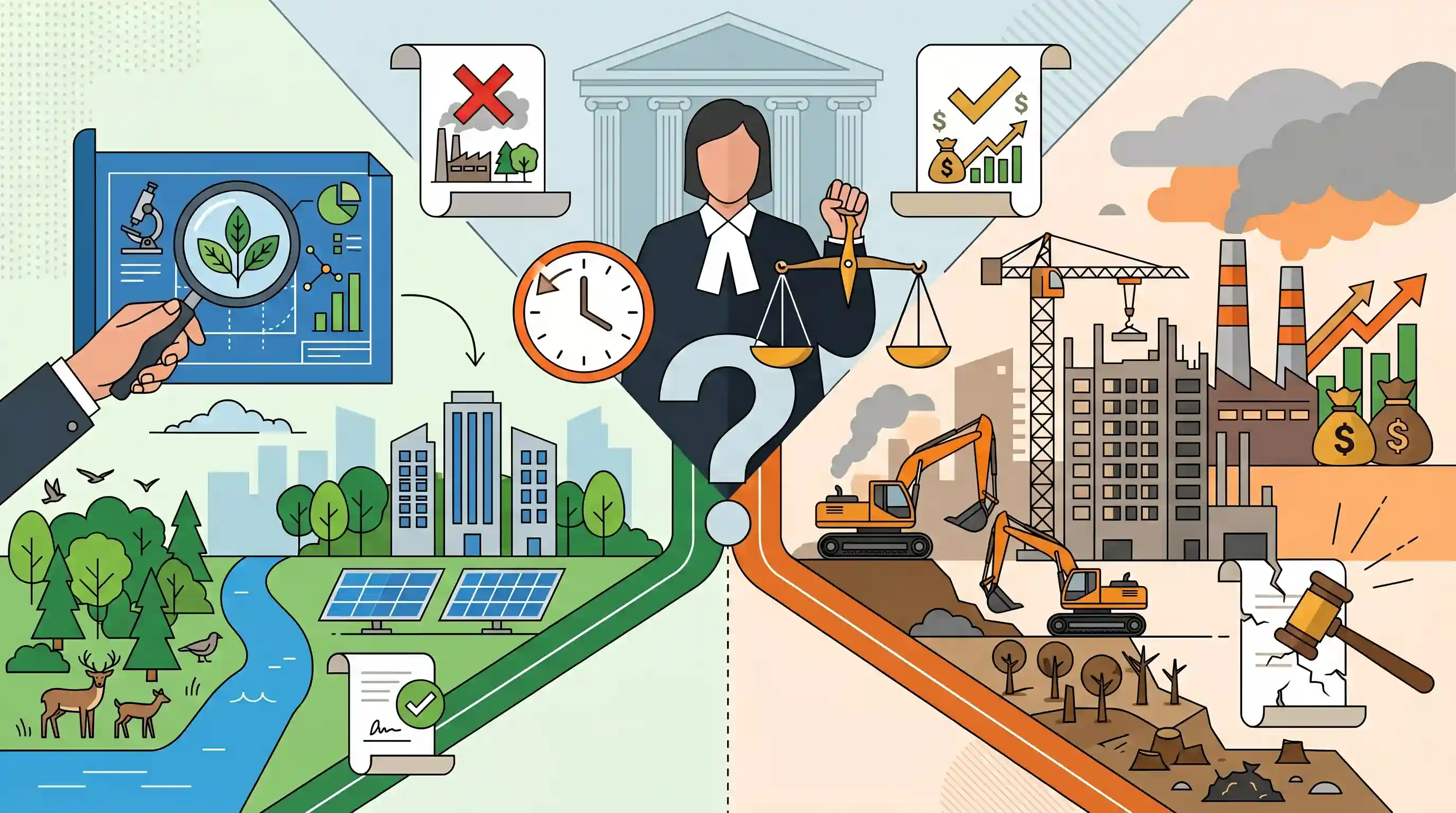
Ex post facto environmental clearance is a highly debated topic in environmental governance. Understanding this issue is vital for Mains GS3 (EIA, Sustainable Development) and GS2 (Judicial Review, Executive Orders), as it questions whether post-facto regularizations undermine the preventive nature of environmental laws or pragmatically save massive economic investments.
Summary
The Supreme Court of India is set to freshly review petitions challenging the Union government's practice of granting "ex post facto" environmental clearances. This mechanism allows projects that commenced without prior environmental approvals to be regularized retrospectively. The apex court has seen conflicting rulings on this issue recently: a May 2025 judgment termed such clearances illegal, while a November 2025 recall order prioritized the severe economic and investment fallout of halting existing projects. The upcoming hearing will scrutinize the legality of the 2017 and 2021 Office Memorandums underlying this clearance regime, reflecting the broader tension between environmental protection and infrastructure development.
Key Points
- The Supreme Court has scheduled a fresh hearing to examine the validity of 'ex post facto' (retrospective) environmental clearances granted to construction and infrastructure projects.
- A May 2025 SC judgment had struck down the Centre's ex post facto clearance regime as a 'gross illegality', halting several public projects like airports and hospitals.
- A subsequent November 2025 three-judge Bench recalled the May order, citing the devastating effects it would have on investments and ongoing infrastructure projects.
- Petitioners, including NGO Vanashakti, argue that the fundamental issue—the legality of the 2017 and 2021 Office Memorandums that allow such retrospective clearances—has not been definitively resolved by the SC.
- The case highlights the complex judicial challenge of balancing strict environmental jurisprudence with economic development and infrastructure needs.
Important Terms
Environment Impact Assessment (EIA) Notification

A statutory process under the Environment (Protection) Act, 1986, requiring developers to evaluate and mitigate a project's potential environmental impacts before seeking government approval.
UPSC context
GS III (Environment); core topic for environmental governance, sustainable development, and regulatory compliance.
Environment (Protection) Act, 1986
India's umbrella legislation enacted to provide a framework for the coordination of central and state authorities in protecting and improving the environment.
UPSC context
GS III (Legislations); foundational law for all environmental regulations and judicial interpretations in India.
Ex-post-facto Environmental Clearance
Retrospective approval granted to projects that commenced construction or operation without obtaining mandatory prior environmental permission, regularizing the violation post-facto.
UPSC context
GS III (Environment); tests the tension between 'polluter pays' principle and economic/infrastructure development.
Office Memorandum (OM)
An administrative instrument used by government ministries to issue instructions or clarify procedures without the formal legislative process of a new notification or amendment.
UPSC context
GS II (Governance); highlights executive rule-making power and the scope of judicial review.
Vanashakti
A prominent Mumbai-based environmental NGO known for litigating against forest encroachment and challenging the legality of industrial clearances in the Supreme Court.
UPSC context
GS II/III (NGOs/Conservation); represents civil society's role in environmental protection through Public Interest Litigation (PIL).
Precautionary Principle
An environmental law principle mandating proactive measures to prevent harm even if scientific certainty is lacking; it prioritizes prevention over retrospective compensation.
UPSC context
GS III/IV (Environment/Ethics); fundamental concept for sustainable development and environmental jurisprudence.
Prelims Trap
"The Environment (Protection) Act, 1986 explicitly permits ex-post facto clearances for strategic and critical infrastructure projects."
Ex-post facto clearance is not a statutory provision. It is an executive bypass created via MoEFCC notifications/memorandums, which is precisely why its legality is being challenged.
Static Concepts Connected
What is the statutory basis of the Environmental Impact Assessment (EIA) in India?
- Statutory Root: EIA norms are notified under the Environment (Protection) Act, 1986, rather than existing as an independent parliamentary act.
- Project Categories: Projects are divided: Category A requires central clearance (MoEFCC), while Category B is assessed by the State EIA Authority (SEIAA).
- Core Stages: The standard process involves Screening, Scoping, Public Consultation, and Appraisal before granting 'prior' environmental clearance.
What is the "Precautionary Principle" in environmental law?
- Core Doctrine: The doctrine that lack of full scientific certainty should not be used as a reason for postponing measures to prevent environmental degradation.
- Constitutional Link: The Supreme Court integrated it into the Right to Life (Article 21) in landmark judgments like the Vellore Citizens Welfare Forum case.
Cross-Topic Patterns
Delegated Legislation vs Statutory Mandate
Using Office Memorandums (OMs) to bypass the 'prior clearance' mandate under the EPA 1986 tests the constitutional limits of delegated legislation and executive rule-making.
Environmental Ethics in Governance
The SC recalling its own order to save public investments and prevent economic disruption reflects a classic GS4 environmental ethics dilemma: strict ecological compliance versus developmental imperatives.

Expect a 2026 Prelims statement contrasting the statutory 'prior EIA' mandate under EPA 1986 with 'ex-post facto' executive exemptions.
Linked PYQs · 3
Linked PYQs · 3
- 2024MainsGS3
What role do environmental NGOs and activists play in influencing Environmental Impact Assessment (EIA) outcomes for major projects in India? Cite four examples with all important details.
- 2020MainsGS3
How does the draft Environment Impact Assessment (EIA) Notification, 2020 differ from the existing EIA Notification, 2006?
- 2021MainsGS3
“Investment in infrastructure is essential for more rapid and inclusive economic growth.” Discuss in the light of India's experience.
