Supreme Court Review of Digital Personal Data Protection Act
Source:The Hindu ↗
Why It Matters
The DPDP Act forms the foundation of India's digital economy and privacy framework. The intersection of the fundamental Right to Privacy (Puttaswamy judgment) with the Right to Information creates a critical constitutional and governance debate over transparency versus privacy, a frequent theme in UPSC Mains GS2.
Summary
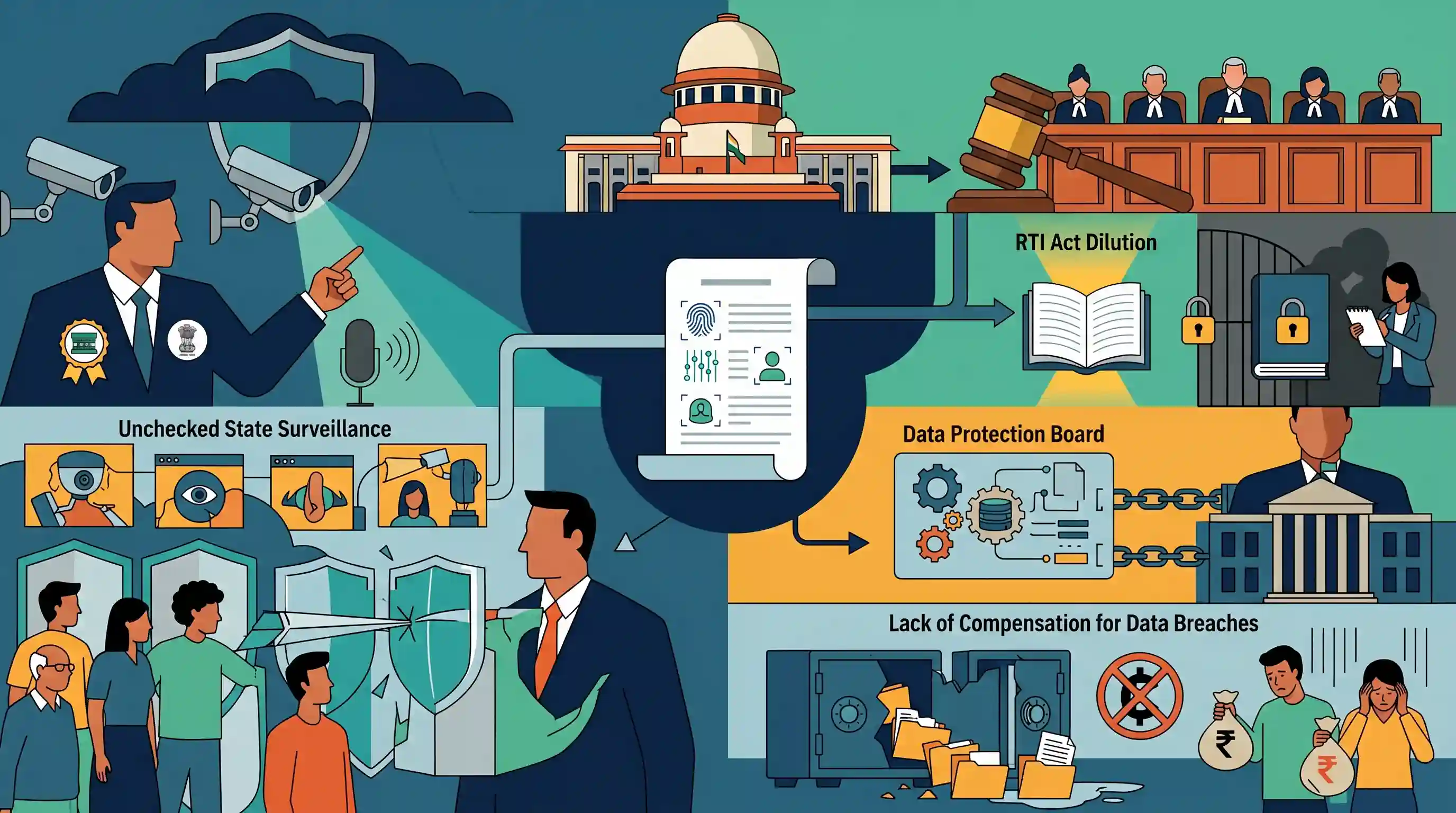
The Supreme Court has agreed to examine petitions challenging the Digital Personal Data Protection (DPDP) Act, 2023, specifically looking into what constitutes 'personal data.' Petitioners argue that the Act enables unchecked state surveillance by exempting the government from data access restrictions under broad terms like 'public order.' Furthermore, the DPDP Act amends the RTI Act to create a blanket ban on the disclosure of personal information, severely diluting public transparency and journalistic access. Other significant concerns include the structural dependence of the Data Protection Board on the Executive and a lack of compensation mechanisms for citizens affected by data breaches.
Key Points
- The Supreme Court of India is examining the scope and definition of "personal data" under the Digital Personal Data Protection (DPDP) Act, 2023.
- Petitioners argue the DPDP Act allows for disproportionate state surveillance by enabling the government to access citizens' data under overbroad categories like "public order."
- The law is criticized for creating a "compensation vacuum," as penalties for data breaches go to the Consolidated Fund of India rather than the victims.
- Section 44(3) of the DPDP Act amends the RTI Act to impose a blanket ban on disclosing "personal information," diluting transparency and protecting public officials from scrutiny.
- The independence of the Data Protection Board is questioned, as it is seen as structurally dependent on the Executive.
Important Terms
Digital Personal Data Protection (DPDP) Act, 2023

India’s primary legislation regulating digital personal data processing, balancing individual privacy rights with lawful data usage while establishing the rights of 'Data Principals' and obligations for 'Data Fiduciaries.'
UPSC context
GS Paper II: Government Policies. Tests understanding of data sovereignty, fundamental privacy rights, and state exemptions in digital governance.
Data Protection Board of India (DPBI)
A statutory, quasi-judicial body established to monitor compliance, adjudicate grievances, and impose financial penalties (up to ₹250 crore) for personal data breaches under the DPDP Act framework.
UPSC context
GS Paper II: Statutory and Quasi-judicial Bodies. Tests knowledge of regulatory oversight and the independence of enforcement authorities from executive influence.
Personal Data
Any information that identifies a natural person. The Supreme Court is currently examining its scope to distinguish between private data and information that should remain accessible for public accountability.
UPSC context
GS Paper II/III: Rights and Cybersecurity. Essential for analyzing the legal boundaries of 'identifiable information' in the context of state surveillance.
Section 8(1)(j) of RTI Act
A transparency provision amended by the DPDP Act to create a blanket ban on disclosing personal information, removing the previous exception that allowed disclosure if justified by larger public interest.
UPSC context
GS Paper II: Transparency & Accountability. Crucial for discussing the legislative conflict between the Right to Information and the Right to Privacy.
Software Freedom Law Center (SFLC.in)
A donor-supported legal services organization and key petitioner in the DPDP challenge, focusing on protecting digital civil liberties, privacy, and free speech through legal activism.
UPSC context
GS Paper II: Role of Civil Society. Tests understanding of how NGOs influence judicial review and public policy concerning technology.
Prelims Trap
The DPDP Act empowers citizens to claim financial compensation directly from data fiduciaries for privacy breaches.
False. The Act creates a 'compensation vacuum'. Monetary penalties (up to ₹250 crore) are deposited entirely into the Consolidated Fund of India, not given to victims.
Static Concepts Connected
What is the 'Proportionality Test' from the K.S. Puttaswamy Judgment (2017)?
- Legality: Any encroachment on the right to privacy must be backed by a valid, existing law.
- Legitimate State Aim: The state action must serve a legitimate state interest, such as public order or national security.
- Proportionality: There must be a rational nexus between the aim and the means adopted, utilizing the least restrictive measure possible.
- Procedural Safeguards: There must be robust procedural guarantees to prevent the abuse of state power.
How did the RTI Act handle personal information prior to the DPDP amendment?
- Original Exemption: It exempted personal information that had no relationship to any public activity or caused unwarranted invasion of privacy.
- Public Interest Override: Crucially, it allowed disclosure if the Public Information Officer determined that larger public interest justified the release.
- Legislative Parity: It mandated that information which cannot be denied to the Parliament or State Legislature cannot be denied to any citizen.
Cross-Topic Patterns
Rights Clash: Article 19 vs Article 21
The DPDP-RTI conflict highlights the classic friction between a citizen's Right to Know (Article 19) and Right to Privacy (Article 21), making it a high-probability debate for Mains GS2.
Regulatory Bodies and Executive Control
The Data Protection Board's structural dependence mirrors recent criticisms of the CEC/EC appointment law and tribunal reforms, reflecting a broader syllabus theme of executive consolidation over regulatory watchdogs.

Expect a 2026 Prelims question testing the DPDP's removal of the 'public interest override' from the RTI Act and the compensation vacuum.
Linked PYQs · 3
Linked PYQs · 3
- 2024MainsGS2
Right to privacy is intrinsic to life and personal liberty and is inherently protected under Article 21 of the constitution. Explain. In this reference discuss the law relating to D.N.A. testing of child in the womb to establish its paternity.
- 2017MainsGS2
Examine the scope of Fundamental Rights in the light of the latest judgement of the Supreme Court on Right to Privacy.
- 2020MainsGS2
Recent amendments to the Right to Information Act will have profound impact on the autonomy and independence of the Information Commission". Discuss.
