Supreme Court To Examine Plea On Central Staff For Vote Counting
Source:The Hindu ↗
Why It Matters
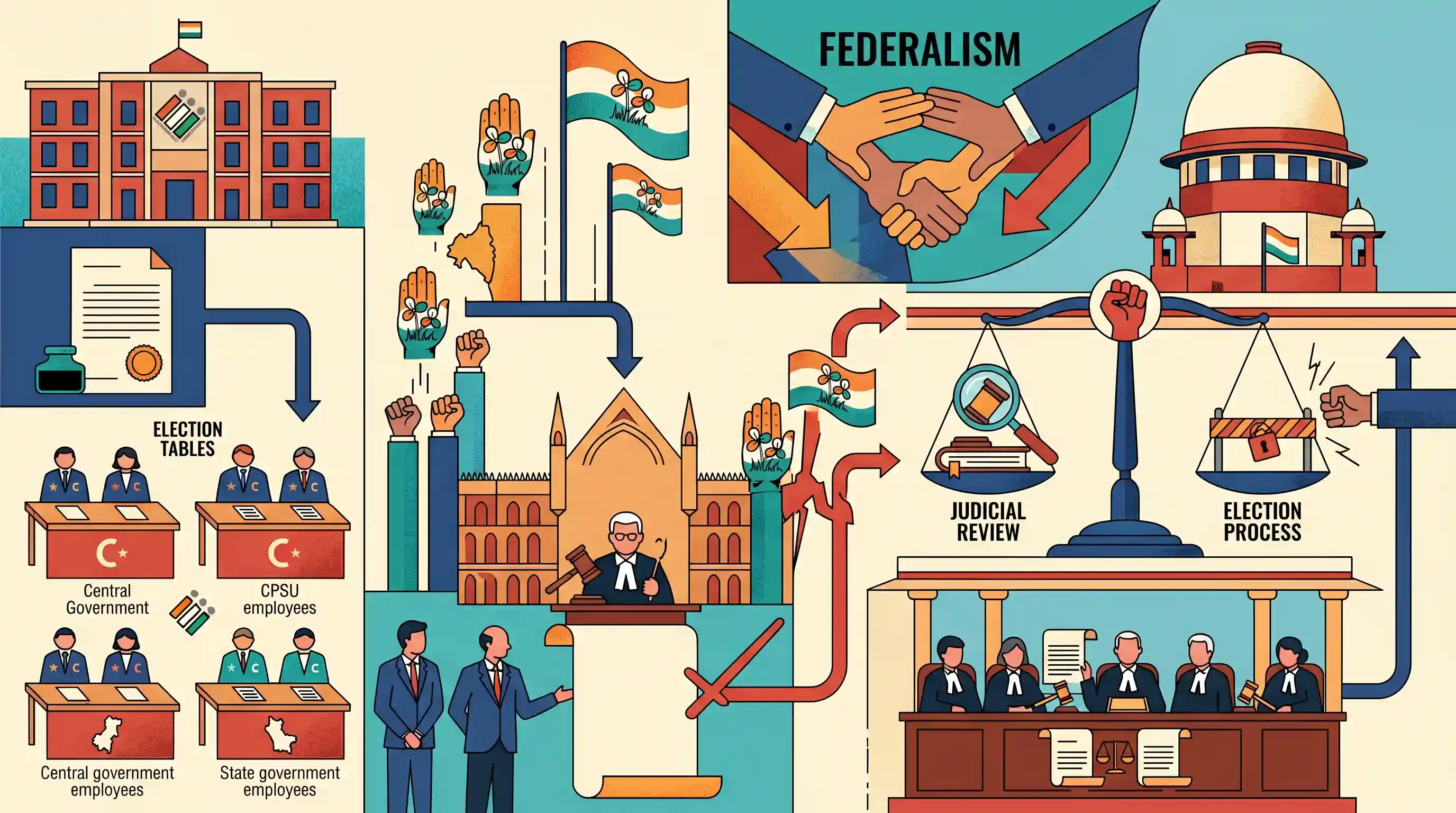
The case tests the extent of the Election Commission's discretionary powers during the election cycle versus the scope of judicial review under Article 226. It highlights the recurring tension over the deployment of Central versus State machinery in elections and the strict boundaries set by Article 329(b) concerning court intervention in active electoral processes.
Summary
The Supreme Court is set to hear an appeal by the Trinamool Congress (TMC) challenging an Election Commission (EC) directive that requires at least one Central government or CPSU employee at each counting table during the West Bengal Assembly elections. The Calcutta High Court had dismissed the plea citing Article 329(b) of the Constitution, which bars judicial interference in the electoral process outside of post-election petitions. However, TMC argues this constitutional bar cannot preclude High Courts from using Article 226 to review executive actions of the EC that are alleged to be arbitrary and violative of federalism by discriminating against State government employees.
Key Points
- The Supreme Court agreed to hear TMC's plea challenging the Election Commission's mandate to deploy Central government or CPSU staff as counting supervisors at every table in West Bengal.
- The Calcutta High Court previously dismissed TMC's petition based on Article 329(b), which prohibits courts from questioning elections except through an election petition filed after the process concludes.
- TMC argues that the bar under Article 329(b) does not override the High Court's writ jurisdiction under Article 226 to scrutinize arbitrary or discriminatory executive orders of the ECI.
- The petition contends the EC's directive casts unconstitutional bias on State employees and violates principles of federalism by favoring Central personnel.
Important Terms
Article 329(b) of the Constitution

Constitutional provision barring courts from questioning election matters once the process begins; challenges must be raised only via an election petition after results are declared.
UPSC context
GS II: Tests the balance between judicial review powers and the finality of the electoral process.
Article 226 of the Constitution
Empowers High Courts to issue writs for enforcing Fundamental Rights or for 'any other purpose,' acting as a tool for judicial review of administrative actions.
UPSC context
GS II: Essential for understanding High Court jurisdiction and its interface with specific constitutional bars.
Article 324 of the Constitution
Vests the superintendence, direction, and control of all elections to Parliament and State Legislatures in the Election Commission of India.
UPSC context
GS II: Key to analyzing the plenary powers and autonomy of constitutional bodies in conducting elections.
Election Commission of India (ECI)
An independent constitutional authority responsible for administering national and state election processes to ensure they are free and fair.
UPSC context
GS II: A staple topic regarding the institutional framework and reform of India's electoral machinery.
Federalism
A basic structure of the Constitution involving the distribution of powers between the Union and States, ensuring mutual independence in their respective spheres.
UPSC context
GS II: Crucial for evaluating Centre-State administrative relations and disputes over central intervention in state processes.
Election Petition
The statutory mechanism and only judicial remedy for challenging the validity of an election result, as mandated under Article 329.
UPSC context
GS II: Fundamental for understanding legal recourse against electoral malpractice under the RPA, 1951.
Prelims Trap
The Supreme Court has original jurisdiction to hear election petitions regarding State Assembly elections.
Original jurisdiction for hearing election petitions under the Representation of the People Act, 1951 lies exclusively with the respective High Courts, not the Supreme Court.
Static Concepts Connected
How does Article 329(b) limit judicial intervention in elections?
- Complete Bar: Prohibits judicial interference in the electoral process from the date of notification until the final declaration of results.
- Election Petitions: Mandates that electoral disputes can only be challenged post-election via an Election Petition filed in the relevant High Court.
- Ponnuswami Precedent: SC ruled in 1952 that High Courts cannot use Article 226 writ jurisdiction to stall or review intermediary election steps.
What is the ECI's authority over civil servants during elections?
- Deemed Deputation: Under the RPA 1951, state and central staff deployed for election duties are deemed to be on deputation to the ECI, falling under its strict disciplinary control.
- Constitutional Mandate: Article 324(6) obligates the President and Governors to provide necessary administrative and police staff to the ECI upon request to conduct polls.
Cross-Topic Patterns
Federalism in Electoral Machinery
The ECI's reliance on mixed Central and State personnel highlights a unique administrative setup, frequently sparking center-state friction over bias, deputation rules, and disciplinary jurisdiction during polls.
Article 324 Plenary Powers vs Judicial Review
The Supreme Court often adjudicates the boundary where the ECI's vast Article 324 powers to ensure "free and fair elections" intersect with judicial review protected by Article 226.

Original jurisdiction of High Courts in election petitions vs the absolute Article 329(b) bar is highly probable for a 2026 Prelims MCQ.
Linked PYQs · 3
Linked PYQs · 3
- 2022MainsGS2
Discuss the procedures to decide the disputes arising out of the election of a Member of the Parliament or State Legislature under The Representation of the People Act, 1951. What are the grounds on which the election of any returned candidate may be declared void ? What remedy is available to the aggrieved party against the decision ? Refer to the case laws.
- 2022MainsGS2
Discuss the role of the Election Commission of India in the light of the evolution of the Model Code of Conduct.
- 2017PrelimsGS1
Right to vote and to be elected in India is a
