Supreme Court Examines Financial Cap on Treatment for Rare Diseases
Source:The Hindu ↗
Why It Matters
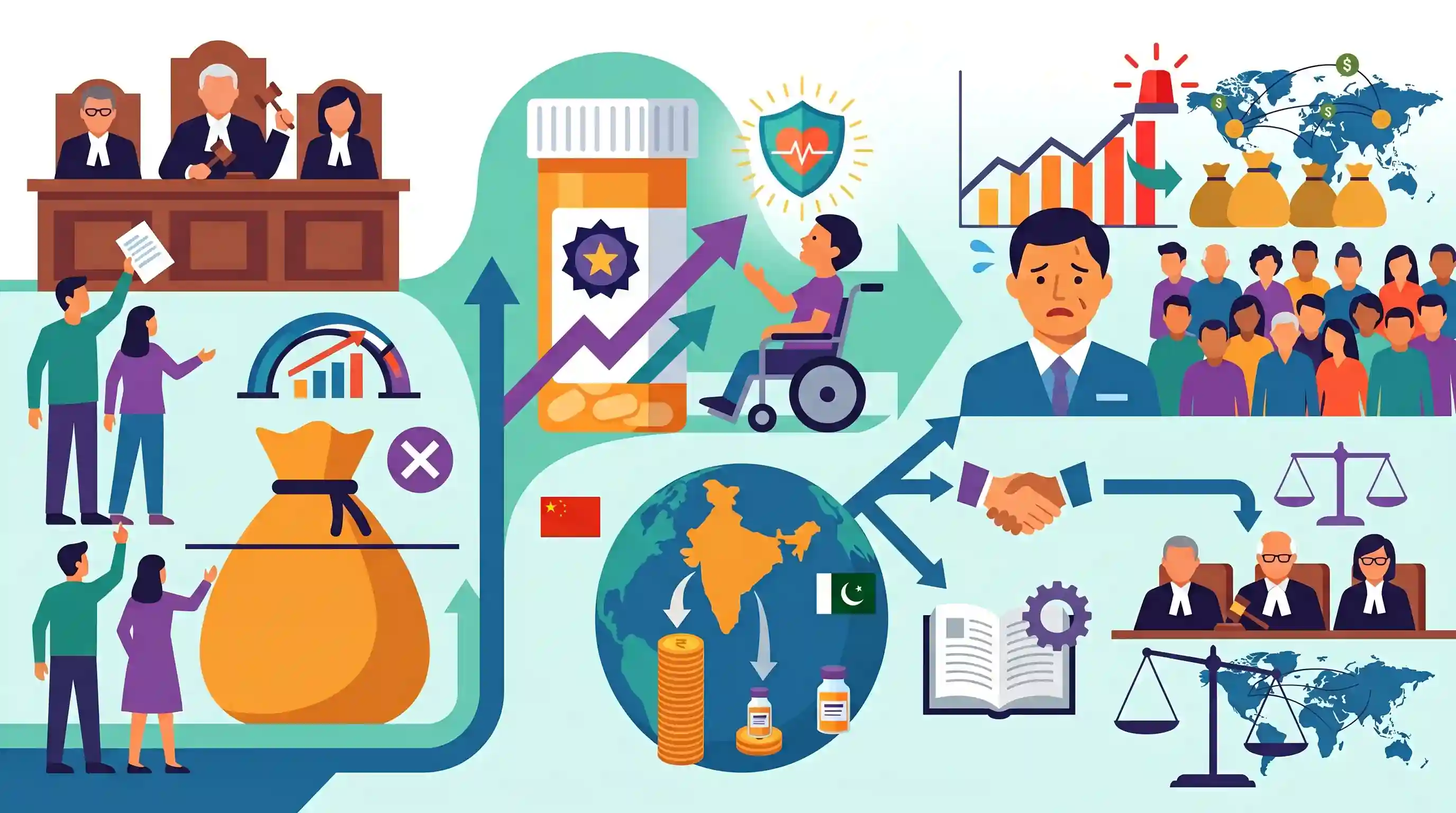
The issue brings into sharp focus the ethical and economic dilemmas of public health financing for rare diseases. It requires balancing the fundamental right to life (Article 21) against finite state resources, while also navigating the complexities of international patent laws, pharmaceutical monopolies, and intellectual property regimes under TRIPS.
Summary
The Supreme Court of India is examining pleas challenging the ₹50 lakh cap on Central government financial assistance for the treatment of rare diseases like Spinal Muscular Atrophy (SMA). The case highlights the tension between the fundamental right to health and the prohibitive costs of patented, life-saving drugs. Petitioners pointed out that the crucial drug, Risdiplam, is vastly cheaper in neighboring countries like China and Pakistan, urging the government to either negotiate better terms or invoke the Patents Act, 1970 to override exorbitant pricing. The Centre argued that eliminating the cap or making individual exceptions would result in an unsustainable financial burden given the large patient population. The Court asked the Centre to consider case-by-case funding exceptions while acknowledging the complexities and international ramifications of aggressive pharmaceutical price controls.
Key Points
- The Supreme Court is reviewing petitions challenging the ₹50 lakh limit on Central assistance for rare disease treatments under the National Policy for Rare Diseases.
- Treatment for rare genetic disorders like Spinal Muscular Atrophy (SMA) is prohibitively expensive; the drug Risdiplam costs ₹6.2 lakh per bottle in India, totaling up to ₹26 crore per patient.
- Petitioners argued that Risdiplam is significantly cheaper in China and Pakistan, urging the government to invoke provisions of the Patents Act, 1970 to lower domestic prices.
- The Centre maintained that granting exceptions to the ₹50 lakh cap would create an unsustainable financial burden due to the high number of patients requiring care.
- The Supreme Court suggested the Centre explore a case-by-case approval process for expenditures beyond the cap while acknowledging that international ramifications complicate drastic price interventions.
Important Terms
National Policy for Rare Diseases (NPRD)

A 2021 framework categorizing rare conditions into three groups and providing financial support up to ₹50 lakh for treatment at designated Centres of Excellence (CoEs).
UPSC context
GS-II: Government Policies & Health. Tests knowledge of healthcare accessibility, policy classification (Group 1-3), and funding mechanisms like Rashtriya Arogya Nidhi.
Patents Act, 1970
The legal framework governing intellectual property in India, specifically allowing the government to override patent monopolies under sections like Compulsory Licensing (Section 84) for public health needs.
UPSC context
GS-III: Intellectual Property Rights (IPR). Tests understanding of the balance between pharmaceutical innovation incentives and the public's right to affordable medicine.
National Rare Diseases Committee (NRDC)
An expert body established to oversee the implementation of the NPRD, 2021, evaluate medical cases, and coordinate drug procurement and crowdfunding for rare disease patients.
UPSC context
GS-II: Governance and Health. Relevant for questions on institutional mechanisms and judicial activism in ensuring the delivery of social welfare policies.
Compulsory Licensing
A legal mechanism under the Patents Act allowing third parties to manufacture patented drugs without the owner's consent if they are unaffordable or unavailable, protecting public health.
UPSC context
GS-III: Science & Tech / IPR. A critical concept for TRIPS flexibility and India's role as the 'pharmacy of the world.'
Centres of Excellence (CoEs)
Specialized hospitals (currently 12) designated by the government for the diagnosis, prevention, and treatment of rare diseases, authorized to receive and utilize central financial assistance.
UPSC context
GS-II: Health Infrastructure. Tests knowledge of the decentralized implementation of national health schemes and tertiary healthcare capacity building.
Right to Health
Interpreted by the judiciary as an integral part of the Right to Life under Article 21, mandating that the state ensures medical care is accessible and affordable.
UPSC context
GS-II: Indian Constitution (Fundamental Rights). Focuses on the judicial evolution of Article 21 and the state's obligation toward vulnerable citizens.
Spinal Muscular Atrophy (SMA)
A rare genetic neuromuscular disorder that causes muscle wasting and weakness, often cited in legal petitions due to the multi-crore cost of life-saving drugs like Risdiplam.
UPSC context
GS-III: Science & Technology. Serves as a case study for genetic disorders, 'orphan drugs,' and the socio-economic challenges of advanced medical therapies.
Prelims Trap
"Financial assistance under the National Policy for Rare Diseases 2021 is exclusively sourced from the government exchequer."
The NPRD 2021 explicitly introduces a digital crowdfunding portal to mobilize voluntary corporate and individual contributions to bridge funding gaps for expensive treatments.
Static Concepts Connected
What are the grounds for issuing a Compulsory License under the Patents Act, 1970?
- Public Need: The reasonable requirements of the public with respect to the patented invention have not been satisfied.
- Affordability: The patented invention is not available to the public at a reasonably affordable price.
- Local Working: The patented invention is not worked in the territory of India.
What are the key pillars of the National Policy for Rare Diseases (NPRD) 2021?
- Disease Categorization: It categorizes rare diseases into three groups based on treatment availability and long-term costs.
- Financial Assistance: Provides financial support up to ₹50 lakh per patient for treatment at designated Centers of Excellence (CoEs).
- Crowdfunding Mechanism: Incorporates a digital portal for voluntary crowdfunding from individuals and corporations to fund prohibitively expensive therapies.
Cross-Topic Patterns
IPR monopolies vs. Article 21
The conflict between pharmaceutical patents and affordable healthcare highlights India's use of TRIPS flexibilities, directly pitting GS3 IPR frameworks against GS2 fundamental rights (Right to Health).
Fiscal limits of Judicial Review
The Centre's defense of the ₹50 lakh cap illustrates the constraints of judicial intervention in policy matters where macroeconomic limits dictate healthcare feasibility.

Expect a multi-statement Prelims question linking NPRD 2021's crowdfunding and ₹50 lakh cap with TRIPS compulsory licensing provisions.
Linked PYQs · 3
Linked PYQs · 3
- 2024MainsGS2
In a crucial domain like the public healthcare system the Indian State should play a vital role to contain the adverse impact of marketisation of the system. Suggest some measures through which the State can enhance the reach of public healthcare at the grassroots level.
- 2014MainsGS3
In a globalized world, Intellectual Property Rights assume significance and are a source of litigation. Broadly distinguish between the terms-Copyrights, Patents and Trade Secrets.
- 2015MainsGS3
India's Traditional Knowledge Digital Library (TKDL), which has a database containing formatted information on more than 2 million medicinal formulations is proving a powerful weapon in the country's fight against erroneous patents. Discuss the pros and cons of making this database publicly available under open-source licensing.
