Aadhaar issuance guidelines for adults and citizenship debate
Source:The Hindu ↗
Why It Matters
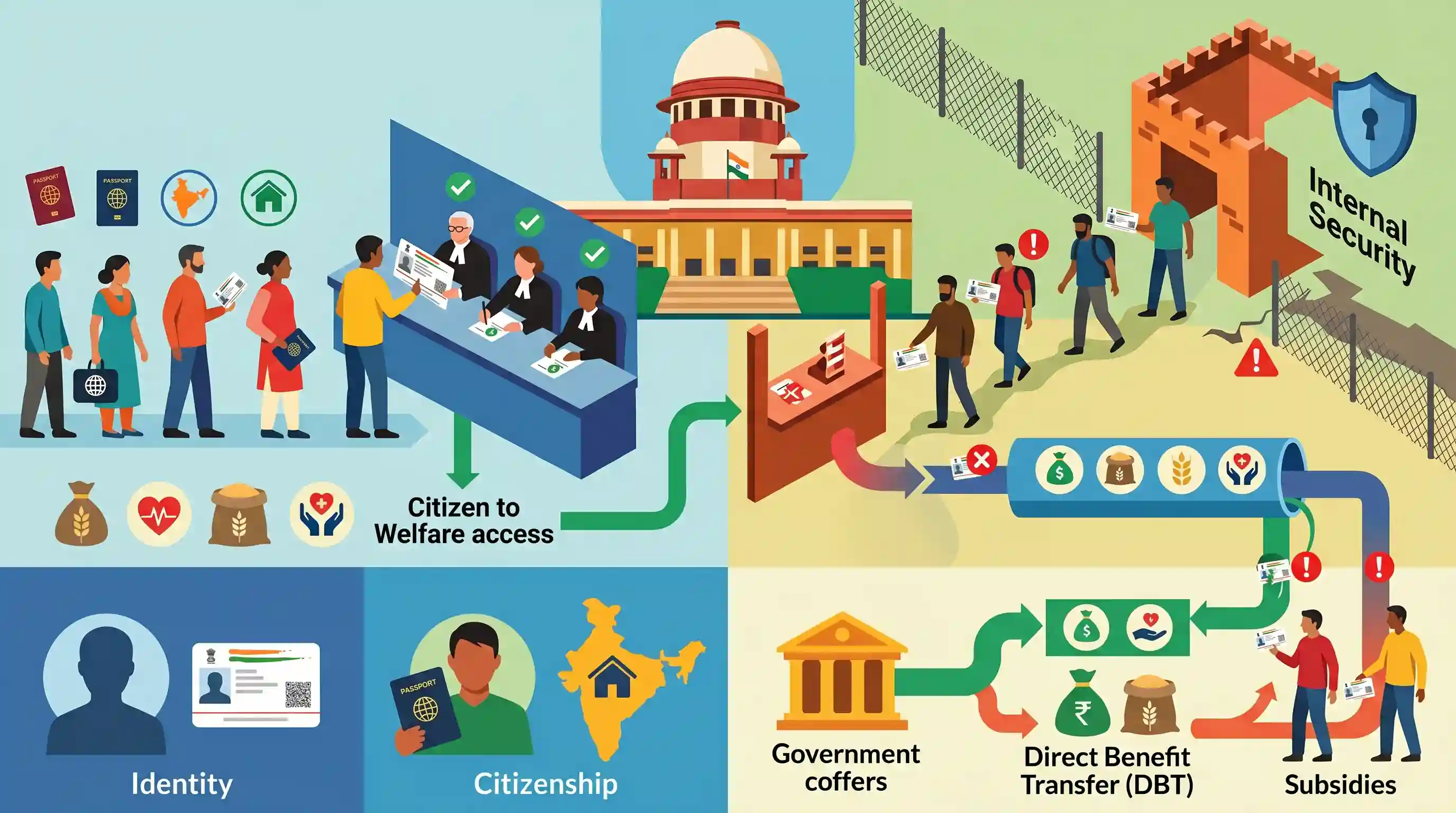
The Aadhaar system is fundamental to India's targeted welfare delivery and Direct Benefit Transfer (DBT). This issue highlights governance loopholes in the issuance of identity documents, reinforcing the recurring UPSC theme regarding Aadhaar's status as a proof of identity (not citizenship), data privacy, and the diversion of public resources by illegal immigrants.
Summary
The Supreme Court is set to hear a Public Interest Litigation (PIL) calling for stringent guidelines in issuing Aadhaar cards to adolescents and adults to prevent foreign infiltrators from obtaining them. The petitioner argues that the UIDAI's current verification process is weak, allowing illegal immigrants to procure Aadhaar cards under the "Indian citizen" category. Because Aadhaar acts merely as a proof of identity rather than citizenship or domicile, this loophole allegedly enables infiltrators to fraudulently access targeted welfare delivery schemes, ration cards, and birth certificates, thereby diverting public resources. The plea challenges the temporal reasonableness of the Aadhaar Act 2016 for failing to effectively distinguish citizens from foreigners.
Key Points
- A PIL in the Supreme Court seeks stricter guidelines for the issuance of Aadhaar cards to adolescents and adults to prevent foreign infiltrators from obtaining Indian identity.
- The petitioner requested UIDAI to issue new Aadhaar cards solely to Indian citizens up to the age of six.
- The PIL highlights the need for display boards at Common Service Centres stating that Aadhaar is strictly a proof of identity, not a proof of citizenship, address, or date of birth.
- The plea alleges that illegal immigrants exploit weak verification processes to procure Aadhaar, which they then use to access public resources, ration cards, and targeted welfare subsidies.
- The petitioner claims that the Aadhaar Act 2016 is currently failing to adequately distinguish between Indian citizens and foreigners, posing a risk to national security and the public exchequer.
Important Terms
Aadhaar Act 2016

The 2016 legislation providing statutory backing to Aadhaar for targeted delivery of subsidies. It clarifies that Aadhaar is proof of residence, not a proof of citizenship or domicile.
UPSC context
GS2 (Governance/Statutory Bodies); tests understanding of resident identification vs. citizenship legalities.
Unique Identification Authority of India (UIDAI)
A statutory authority under the Ministry of Electronics and Information Technology responsible for issuing 12-digit Aadhaar numbers and managing the national biometric database.
UPSC context
GS2 (Statutory Bodies); tests knowledge of implementing agencies for digital identity.
Public Interest Litigation (PIL)
A legal mechanism allowing any public-spirited individual to approach the court for the protection of public interest, particularly for those unable to seek justice themselves.
UPSC context
GS2 (Polity); tests awareness of judicial activism and tools for social justice.
Direct Benefit Transfer (DBT)
A government mechanism to transfer subsidies and benefits directly into beneficiaries' bank accounts using Aadhaar authentication to reduce leakages, intermediaries, and fraud.
UPSC context
GS3 (Economy); tests knowledge of welfare delivery reforms and financial inclusion.
Identity vs Citizenship
The legal distinction where Aadhaar verifies identity/residence under the Aadhaar Act, while citizenship is a political status governed exclusively by the Citizenship Act, 1955.
UPSC context
GS2 (Polity); tests understanding of the legal limits of residency-based documents.
Locus Standi
A legal principle requiring a person to have a sufficient connection to a case to bring a lawsuit; it is significantly relaxed in PILs.
UPSC context
GS2 (Polity/Judiciary); tests understanding of legal standing and procedural justice.
Internal Security
The framework for protecting a nation's borders and citizens; here, specifically addressing how identity document loopholes might facilitate illegal immigration.
UPSC context
GS3 (Security); tests awareness of how administrative vulnerabilities impact national safety.
Prelims Trap
"Aadhaar card constitutes valid proof of Indian citizenship and domicile for availing government subsidies."
Section 9 of the Aadhaar Act 2016 explicitly states that an Aadhaar number is solely a proof of identity, never a proof of citizenship or domicile.
Static Concepts Connected
Who is eligible to obtain an Aadhaar number under the Aadhaar Act, 2016?
- Residency requirement: Any individual who has resided in India for 182 days or more in the 12 months immediately preceding the application.
- Not citizenship: Eligibility is based strictly on residency, meaning foreigners legally residing in India can also hold an Aadhaar card.
- Statutory backing: Governed by the Aadhaar Act 2016 to facilitate the targeted delivery of financial and other subsidies, benefits, and services.
What were the key rulings of the SC in the K.S. Puttaswamy (2018) Aadhaar verdict?
- Section 7 upheld: Mandating Aadhaar is constitutionally valid for welfare schemes and benefits funded by the Consolidated Fund of India.
- Private entities barred: Struck down Section 57; private companies like banks and telecom operators cannot mandate Aadhaar for providing services.
- Money Bill validity: The Supreme Court upheld the legislative passage of the Aadhaar Act as a Money Bill under Article 110.
Cross-Topic Patterns
Aadhaar loopholes and Border Security
The use of Aadhaar by illegal immigrants to access PDS and voter IDs links identity verification failures directly to demographic shifts and border management challenges.
Biometric deduplication vs Document fraud
While UIDAI biometric deduplication prevents multiple IDs per person, it cannot detect fraudulent breeder documents (like fake birth certificates) used during initial enrollment by foreign nationals.

Expect a multi-statement Prelims question combining Aadhaar eligibility (182-day rule) with Section 7 welfare mandates and citizenship laws.
Linked PYQs · 3
Linked PYQs · 3
- 2018PrelimsGS1
Consider the following statements: 1. Aadhaar card can be used as a proof of citizenship or domicile. 2. Once issued, Aadhaar number cannot be deactivated or omitted by the Issuing Authority. Which of the statements given above is/are correct?
- 2024PrelimsGS1
Under which of the following Articles of the Constitution of India, has the Supreme Court of India placed the Right to Privacy ?
- 2015MainsGS3
In what way could replacement of price subsidy with Direct Benefit Transfer (DBT) change the scenario of subsidies in India ? Discuss.
