Aadhaar Issuance to Adults and Proof of Citizenship Legal Debate
Source:The Hindu ↗
Why It Matters
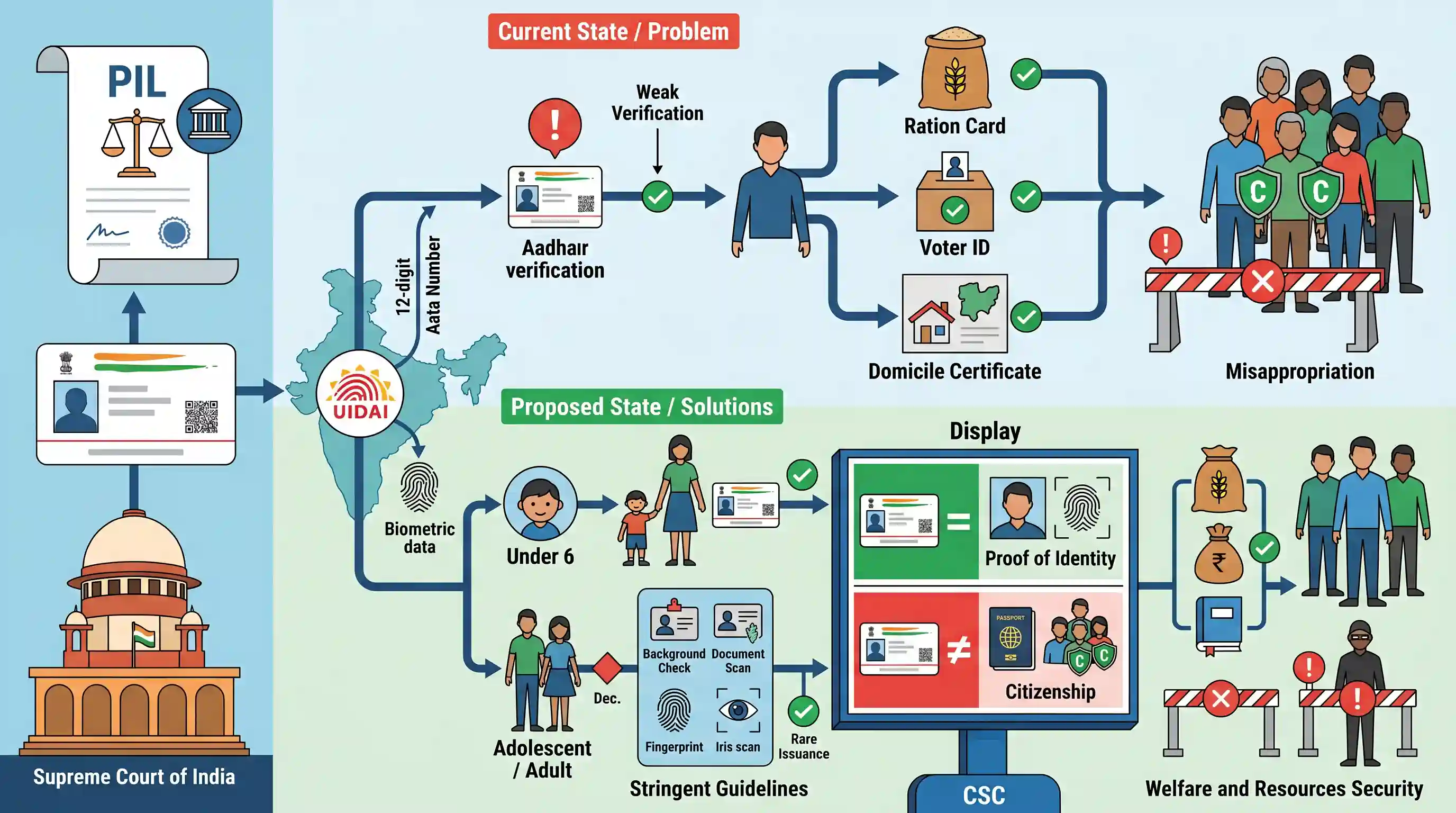
Highlights the critical distinction between proof of identity and proof of citizenship in India. It underscores administrative vulnerabilities in the Aadhaar verification process, which can lead to identity fraud, security risks from illegal immigration, and the diversion of resources meant for targeted welfare delivery.
Summary
A Public Interest Litigation (PIL) filed in the Supreme Court seeks to compel the Unique Identification Authority of India (UIDAI) to implement stringent guidelines for issuing Aadhaar cards to adolescents and adults. The petitioner argues that infiltrators exploit vulnerabilities in the verification process to easily acquire Aadhaar under the 'Indian citizen' category, allowing them to falsely obtain foundational documents like ration cards, domicile certificates, and voter IDs. The plea urges the court to restrict new Aadhaar issuances mostly to children under six and to ensure common service centres explicitly display that Aadhaar is only a proof of identity, not citizenship, to prevent the misappropriation of targeted welfare schemes and public resources.
Key Points
- The Supreme Court is set to hear a PIL seeking stringent guidelines for the UIDAI when issuing Aadhaar cards to adolescents and adults, aiming to prevent infiltrators from posing as Indian citizens.
- The petition requests that new Aadhaar cards be issued primarily to children under six years old.
- It seeks a mandate for common service centres to display boards stating that Aadhaar is solely a proof of identity, not a proof of citizenship, address, or date of birth.
- The PIL alleges that infiltrators exploit weak verification processes to obtain Aadhaar cards under the 'Indian citizen' category, which they then use to acquire ration cards, driving licences, and domicile certificates.
- The plea questions whether the Aadhaar Act 2016 has become "temporally unreasonable" by failing to distinguish between foreigners and Indian citizens, thereby undermining targeted welfare delivery.
Important Terms
Aadhaar Act, 2016

A legislative framework enabling the targeted delivery of subsidies and services using a 12-digit biometric ID. It establishes Aadhaar as proof of identity but explicitly not as proof of citizenship.
UPSC context
GS Paper II: Governance and Welfare Schemes; tests understanding of statutory frameworks and digital identity in service delivery.
Public Interest Litigation (PIL)
A legal mechanism allowing individuals or groups to seek judicial intervention in matters of public interest, relaxing the traditional rule of 'locus standi' to protect the rights of marginalized communities.
UPSC context
GS Paper II: Judiciary and Judicial Activism; critical for understanding legal instruments for social justice.
Unique Identification Authority of India (UIDAI)
A statutory authority under the Ministry of Electronics and Information Technology (MeitY) responsible for issuing Aadhaar numbers, managing the central biometric database, and ensuring identity authentication across India.
UPSC context
GS Paper II: Statutory Bodies; tests knowledge of executive and statutory organizations in digital governance.
Ministry of Electronics and Information Technology (MeitY)
The Union Ministry responsible for IT policy, electronics manufacturing, and overseeing the Aadhaar ecosystem through its administrative control over the UIDAI.
UPSC context
GS Paper II: Government Policies and Interventions; relevant for e-governance and digital infrastructure topics.
Supreme Court of India
The highest judicial body in India under the Constitution, exercising original jurisdiction over writs (Article 32) and hearing matters of public importance like the Aadhaar PIL.
UPSC context
GS Paper II: Structure and Functioning of the Judiciary; essential for questions on constitutional remedies.
Union Ministry of Home Affairs (MHA)
The ministry responsible for internal security, border management, and citizenship matters; it is a party to the Aadhaar PIL regarding concerns over illegal infiltrators.
UPSC context
GS Paper III: Internal Security; tests understanding of agencies involved in national security and citizenship verification.
Prelims Trap
Foreign nationals and illegal migrants are strictly barred from obtaining an Aadhaar card under the Aadhaar Act 2016.
Aadhaar eligibility is based strictly on residency (182 days in the preceding 12 months), not citizenship. Foreigners residing in India legally can obtain an Aadhaar card.
Static Concepts Connected
What are the core residency and citizenship rules under the Aadhaar Act?
- Residency requirement: Applicants (except NRIs with Indian passports) must have resided in India for at least 182 days in the 12 months preceding enrollment.
- Section 9 caveat: Under Section 9, an Aadhaar number shall not confer any right of, or function as proof of, citizenship or domicile.
What is the constitutional doctrine of "temporal unreasonableness"?
- Evolving unconstitutionality: It posits that a statute valid at its enactment may become manifestly arbitrary over time due to changed demographic or security circumstances.
- Article 14 violation: If a law fails to adapt to new realities, it can violate Article 14 by treating unequals equally (e.g., failing to distinguish citizens from infiltrators).
Cross-Topic Patterns
Aadhaar loopholes and Border Security
The misuse of foundational IDs by illegal migrants directly links GS2 Governance with GS3 Internal Security, particularly challenges in border management and demographic shifts in border states.
DBT leaks via inclusion errors
The PIL highlights a systemic inclusion error where non-citizens access welfare schemes intended for vulnerable Indians, diluting the fiscal efficacy of Direct Benefit Transfers (DBT).

Expect a 2026 Prelims statement mixing Aadhaar's 182-day residency rule, NRI exemptions, and Section 9 (not proof of citizenship).
Linked PYQs · 4
Linked PYQs · 4
- 2018PrelimsGS1
Consider the following statements: 1. Aadhaar card can be used as a proof of citizenship or domicile. 2. Once issued, Aadhaar number cannot be deactivated or omitted by the Issuing Authority. Which of the statements given above is/are correct?
- 2023MainsGS2
“Development and welfare schemes for the vulnerable, by its nature, are discriminatory in approach.” Do you agree? Give reasons for your answer.
- 2024MainsGS2
Right to privacy is intrinsic to life and personal liberty and is inherently protected under Article 21 of the constitution. Explain. In this reference discuss the law relating to D.N.A. testing of child in the womb to establish its paternity.
- 2023MainsGS3
What are the internal security challenges being faced by India? Give out the role of Central Intelligence and Investigative Agencies tasked to counter such threats.
