Judicial Accountability In House Inquiry and Judge Removal Process
Source:The Hindu ↗
Why It Matters
This issue highlights the tension between judicial accountability mechanisms (like the in-house inquiry procedure) and constitutional guarantees of judicial independence. It practically demonstrates the complex intersection of the Supreme Court's internal disciplinary measures and Parliament's exclusive power of impeachment under the Constitution and the Judges (Inquiry) Act, 1968.
Summary
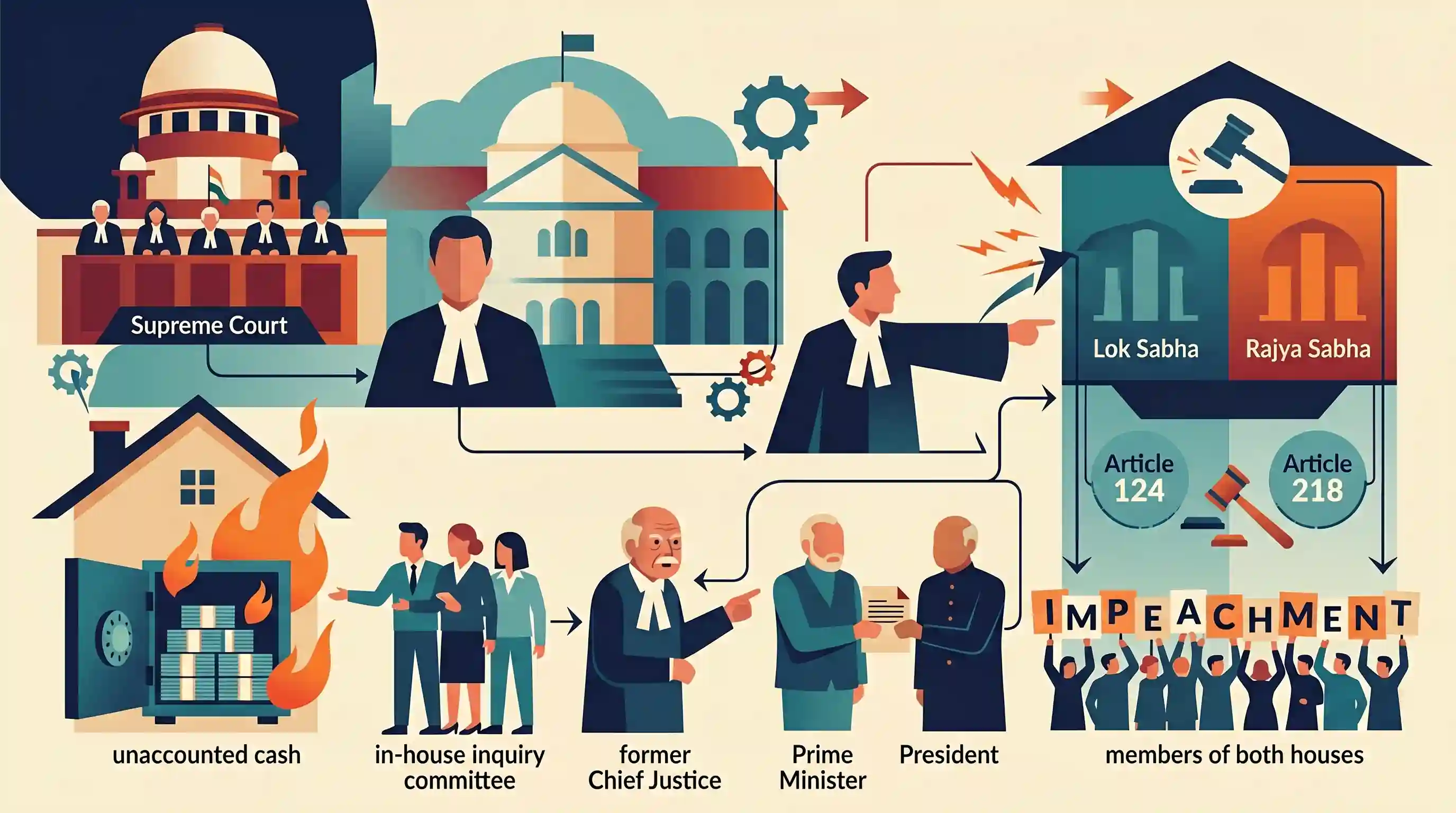
The Supreme Court is scheduled to hear a petition by Allahabad High Court judge Justice Yashwant Varma challenging an in-house inquiry committee's recommendation for his removal. The inquiry was initiated after unaccounted cash was discovered at his Delhi residence following a fire. Former Chief Justice of India Sanjiv Khanna had forwarded the committee's findings to the Prime Minister and President after the judge refused to resign. Justice Varma contends that the internal disciplinary procedure is an extra-constitutional mechanism that violates Parliament's exclusive authority to remove higher judiciary judges under Articles 124 and 218 of the Constitution and the Judges (Inquiry) Act, 1968. Meanwhile, members of both the Lok Sabha and Rajya Sabha have submitted notices to initiate a formal impeachment motion.
Key Points
- The Supreme Court will hear Allahabad High Court judge Justice Yashwant Varma's petition against an in-house committee's recommendation for his removal.
- An in-house inquiry confirmed unaccounted cash was found at Justice Varma's official residence in Delhi following a fire, prompting former CJI Sanjiv Khanna to forward the report to the PM and President.
- Justice Varma argues that the in-house inquiry is an extra-constitutional mechanism that usurps Parliament's exclusive authority to remove judges.
- The removal of judges is constitutionally mandated to be executed by Parliament under Articles 124 and 218, following procedures outlined in the Judges (Inquiry) Act, 1968.
- Simultaneously, Members of Parliament in both the Lok Sabha and Rajya Sabha have initiated a formal removal motion against the judge.
Important Terms
Judges (Inquiry) Act, 1968

A 1968 central legislation regulating the statutory procedure for investigating and proving allegations of 'misbehavior' or 'incapacity' against Supreme Court and High Court judges.
UPSC context
GS Paper 2 (Judiciary); critical for understanding the legal framework governing judicial accountability and the removal process.
Article 124(4)
The constitutional provision stating a Supreme Court judge can only be removed by a Presidential order after an address by each House of Parliament supported by a special majority.
UPSC context
GS Paper 2 (Polity); essential for learning the constitutional safeguards for judicial independence and separation of powers.
Article 218
A constitutional provision that makes the procedure for the removal of Supreme Court judges (under Article 124) applicable to High Court judges.
UPSC context
GS Paper 2 (Judiciary); tests knowledge of uniform accountability standards across the higher judiciary.
In-house Inquiry Procedure
A peer-review mechanism adopted by the Supreme Court in 1999 to investigate allegations against judges internally, balancing institutional integrity with the need to avoid political interference.
UPSC context
GS Paper 2 (Governance); highlights internal disciplinary mechanisms and the debate over 'extra-constitutional' versus statutory procedures.
Impeachment of Judges
The formal, multi-stage constitutional process (colloquially termed) to remove a judge through a special majority in both Houses of Parliament on specific proven grounds.
UPSC context
GS Paper 2 (Polity); central to the concept of legislative checks and balances over the judiciary.
Proved Misbehavior or Incapacity
The two specific, non-defined grounds listed in the Constitution (Article 124) upon which a judge of the higher judiciary may be removed from office.
UPSC context
GS Paper 2/Paper 4; relevant for discussions on the vague thresholds for judicial removal and professional ethics.
Prelims Trap
"The In-House Procedure for evaluating allegations against judges is derived from the Judges (Inquiry) Act, 1968."
The In-House Procedure is a non-statutory, internal mechanism created by the Supreme Court in 1999. The Judges (Inquiry) Act strictly governs the formal Parliamentary impeachment process.
Static Concepts Connected
What is the formal procedure to remove a Supreme Court or High Court judge?
- Constitutional Grounds: Removal must be based exclusively on "proved misbehaviour or incapacity" under Articles 124(4) and 218 of the Constitution.
- Initiation threshold: A removal motion must be signed by at least 100 Lok Sabha MPs or 50 Rajya Sabha MPs to be initiated.
- Statutory Inquiry: The Judges (Inquiry) Act, 1968 mandates a 3-member committee (a Supreme Court judge, a High Court Chief Justice, and a distinguished jurist) to investigate.
- Parliamentary Passage: Requires a special majority in both Houses of Parliament, followed by an official Presidential order.
What is the Supreme Court's In-House Procedure (1999)?
- Non-statutory mechanism: An internal, non-statutory mechanism adopted by the SC to evaluate peer misbehaviour allegations that fall short of impeachable offences.
- Corrective action: If a judge is found guilty by the internal committee but refuses to resign, the CJI can strip them of judicial work.
- Executive referral: The CJI ultimately forwards the committee's adverse report to the Prime Minister and President to initiate formal impeachment.
Cross-Topic Patterns
Judicial Accountability vs. Independence
This conflict mirrors debates over the struck-down National Judicial Appointments Commission (NJAC) and reignites discussions around the necessity of a statutory Judicial Standards and Accountability Bill.
Prior Sanction and Anti-Corruption Laws
Unaccounted cash discoveries invoke the Prevention of Corruption Act. Investigating sitting judges requires specific prior sanctions, blending constitutional judicial immunity concepts with statutory anti-corruption mandates.

Expect a 2026 prelims question contrasting the statutory Judges (Inquiry) Act committee with the Supreme Court's 1999 In-House Procedure.
Linked PYQs · 3
Linked PYQs · 3
- 2019PrelimsGS1
Consider the following statements: 1. The motion to impeach a Judge of the Supreme Court of India cannot be rejected by the Speaker of the Lok Sabha as per the Judges (Inquiry) Act, 1968. 2. The Constitution of India defines and gives details of what constitutes 'incapacity and proved misbehaviour' of the Judges of the Supreme Court of India. 3. The details of the process of impeachment of the Judges of the Supreme Court of India are given in the Judges (Inquiry) Act, 1968. 4. If the motion for the impeachment of a Judge is taken up for voting, the law requires the motion to be backed by each House of the Parliament and supported by a majority of total membership of that House and by not less than two-thirds of total members of that House present and voting. Which of the statements given above is/are correct?
- 2025MainsGS2
"Constitutional morality is the fulcrum which acts as an essential check upon the high functionaries and citizens alike...." In view of the above observation of the Supreme Court, explain the concept of constitutional morality and its application to ensure balance between judicial independence and judicial accountability in India.
- 2023MainsGS2
“Constitutionally guaranteed judicial independence is a prerequisite of democracy.” Comment.
