Supreme Court Sets May 5 for Final Hearings on CAA Petitions
Source:The Hindu ↗
Why It Matters
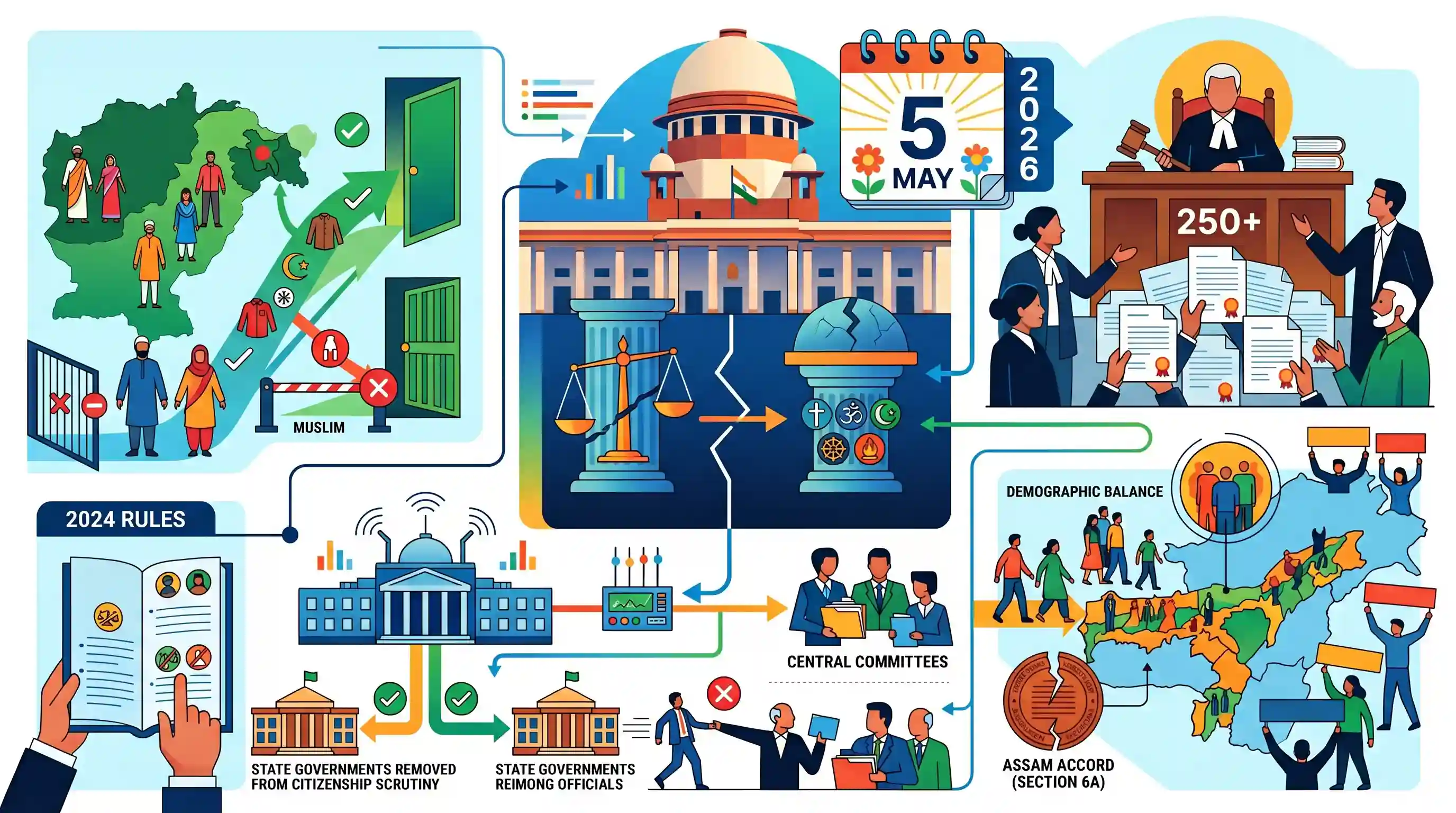
The CAA challenge is one of the most critical constitutional litigations of the decade, directly testing the bedrock principles of secularism and Article 14 (Right to Equality). The issue overlaps with federalism (Centre-State friction over implementing the rules) and regional geopolitics/demographics in the North-East (Assam Accord, Sixth Schedule areas), making it a highly probable topic for Mains GS-2 and Prelims Polity questions.
Summary
The Supreme Court of India is scheduled to hear over 250 petitions challenging the constitutional validity of the Citizenship (Amendment) Act (CAA), 2019, and the recently notified CAA Rules, 2024, starting May 5, 2026. A broad coalition of petitioners, including political parties, MPs, and advocacy groups, contend that the law violates the basic structure of the Constitution—specifically secularism and the Right to Equality—by offering a fast-tracked citizenship path exclusively to non-Muslim illegal migrants from Afghanistan, Bangladesh, and Pakistan. Furthermore, the petitions raise regional concerns that the CAA threatens Assam's demography and contradicts the Assam Accord (Section 6A of the Citizenship Act). Finally, the 2024 Rules are under fire for allegedly diluting federalism by removing state governments from the citizenship scrutiny process, delegating it entirely to Central committees.
Key Points
- The Supreme Court is set to commence final hearings on May 5, 2026, for over 250 petitions challenging the Citizenship (Amendment) Act, 2019, and its 2024 Rules.
- Petitioners argue the CAA violates fundamental constitutional principles, including secularism and the Right to Equality (Article 14), by making religion a basis for citizenship and excluding Muslims.
- The law fast-tracks naturalization (5 years instead of 11) for non-Muslim migrants from Pakistan, Afghanistan, and Bangladesh who arrived before December 31, 2014, without requiring them to prove religious persecution.
- Assam-specific petitions contend that the CAA contradicts Section 6A of the Citizenship Act, 1955 (which set a March 25, 1971 cut-off) and threatens the state\'s demography, noting it exempts Sixth Schedule and Inner Line Permit areas.
- The CAA Rules of 2024 are challenged for allegedly overriding federalism; they bypass State government scrutiny and rely entirely on Central government-appointed District Level and Empowered Committees.
Important Terms
Citizenship (Amendment) Act, 2019 (CAA)

A law providing fast-tracked citizenship to non-Muslim minorities (Hindus, Sikhs, Buddhists, Jains, Parsis, Christians) from Afghanistan, Bangladesh, and Pakistan who entered India on or before December 31, 2014.
UPSC context
GS Paper II: Significant Provisions and Basic Structure. Tests understanding of Article 14 (Equality), secularism, and classification based on religious persecution.
Citizenship Act, 1955
The foundational legislation governing the acquisition (birth, descent, registration, naturalization, incorporation) and termination of Indian citizenship, enacted under Article 11 of the Constitution.
UPSC context
GS Paper II: Constitutional and Statutory provisions. Essential for understanding how citizenship laws have evolved through major amendments (1986, 2003, 2019).
CAA Rules, 2024
Administrative guidelines notified in 2024 to implement the CAA. They create a digital application process overseen by Central committees, significantly reducing the role of State governments in citizenship scrutiny.
UPSC context
GS Paper II: Federal structure and Executive rules. Tests knowledge of Centre-State relations and the delegation of administrative powers.
National Register of Citizens (NRC)
A register of all legal Indian citizens mandated by a 2003 amendment to the 1955 Act. It aims to identify and document legal residents to detect illegal immigrants.
UPSC context
GS Paper II: Governance and Security. Vital for topics on North-East demographics, the Assam Accord, and border management issues.
Bengal Eastern Frontier Regulation, 1873
A 19th-century regulation that established the 'Inner Line Permit' (ILP) system to protect tribal identities. Areas under this regulation are exempt from the provisions of the CAA.
UPSC context
GS Paper II: Welfare of vulnerable sections and Tribal areas. Important for understanding regional legal exemptions and the Sixth Schedule.
Prelims Trap
Applicants must provide documentary proof of religious persecution to acquire citizenship under CAA.
The 2019 Act and 2024 Rules require proof of entry before Dec 31, 2014, and minority status, but they do NOT mandate documentary proof of individual religious persecution.
Static Concepts Connected
Which geographical areas are completely exempted from the application of the CAA 2019?
- Sixth Schedule Areas: Tribal areas of Assam, Meghalaya, Tripura, and Mizoram (AMTM) are excluded from the CAA's purview.
- Inner Line Permit: States governed by the Bengal Eastern Frontier Regulation, 1873—Arunachal Pradesh, Nagaland, Mizoram, and Manipur—are also exempt.
- Settlement Restriction: Migrants acquiring citizenship under the CAA cannot permanently settle or purchase land in these protected regions.
Under the Constitution, who exercises jurisdiction over Citizenship and naturalization?
- Union Subject: Citizenship, naturalization, and aliens fall exclusively under Entry 17 of the Union List (Seventh Schedule).
- Parliamentary Supremacy: Article 11 empowers Parliament to make any provision with respect to the acquisition and termination of citizenship.
- Executive Delegation: Traditionally, the Centre delegated application processing to State officials (District Collectors), a practice altered by the new CAA Rules.
Cross-Topic Patterns
CAA vs. Assam Accord Cut-offs
Section 6A sets March 25, 1971, as Assam's cut-off date, while the CAA extends it to Dec 31, 2014. The recent SC verdict upholding Section 6A intensifies this demographic friction.
Administrative Federalism and Centralization
The 2024 CAA Rules bypass State machinery (District Collectors) in favor of Central committees. This reflects a broader trend of the Union government centralizing previously delegated administrative powers.

A complex Prelims question combining CAA geographical exemptions (6th Schedule/ILP) and the recent SC verdict on Section 6A is highly likely.
Linked PYQs · 5
Linked PYQs · 5
- 2024MainsGS2
Discuss India as a secular state and compare with the secular principles of the US constitution.
- 2021MainsGS2
Analyze the distinguishing features of the notion of Right to Equality in the Constitutions of the USA and India.
- 2024MainsGS2
What changes has the Union Government recently introduced in the domain of Centre-State relations ? Suggest measures to be adopted to build the trust between the Centre and the States and for strengthening federalism.
- 2015PrelimsGS1
The provisions in Fifth Schedule and Sixth Schedule in the Constitution of India are made in order to
- 2023MainsGS2
Explain the significance of the 101st Constitutional Amendment Act. To what extent does it reflect the accommodative spirit of federalism?
