Supreme Court Examines Plea for Intersex Persons Distinct Status
Source:The Hindu ↗
কেন এটি গুরুত্বপূর্ণ
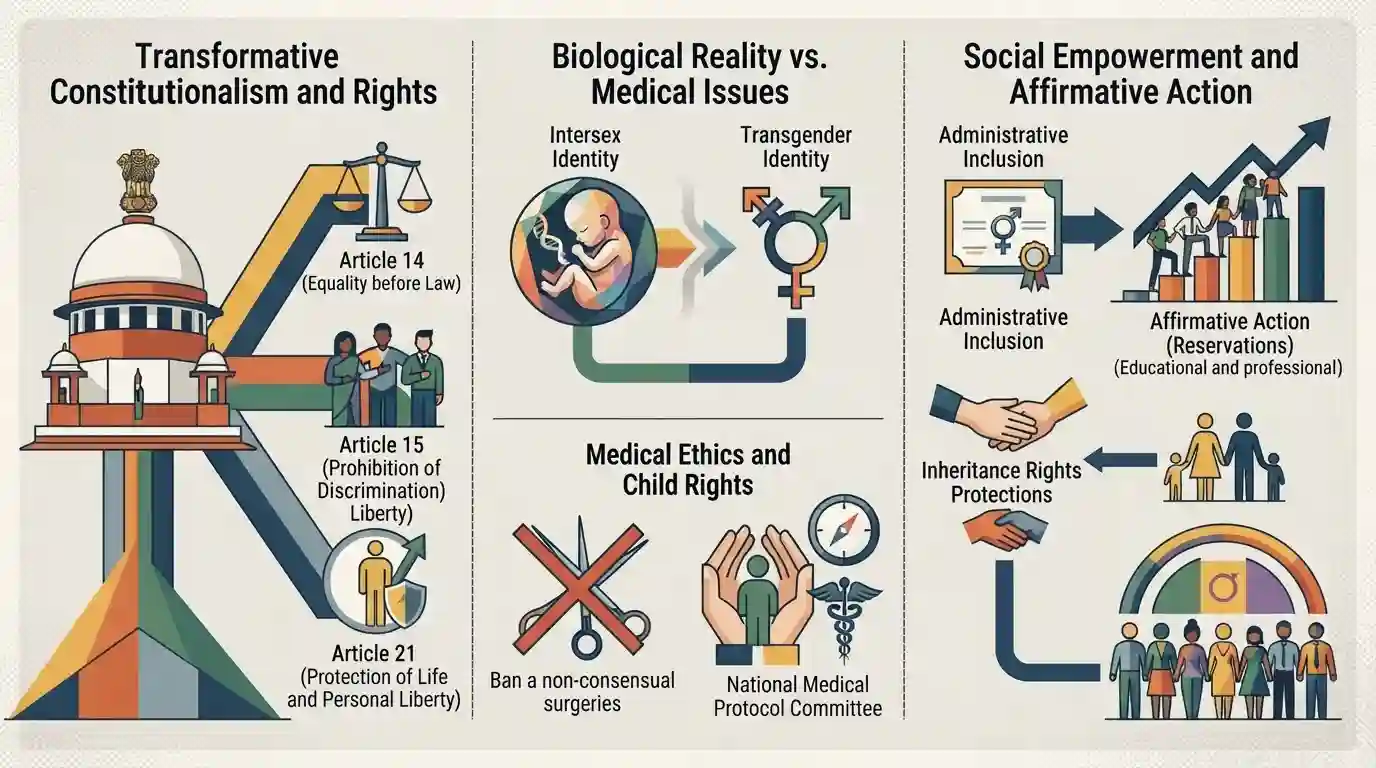
This development is a crucial milestone in Indian social justice and transformative constitutionalism. By seeking to separate intersex rights from transgender identity, it addresses the biological realities of sex characteristics and demands robust legal and medical safeguards. The focus on banning cosmetic infant surgeries addresses a major blindspot in child rights, bodily integrity, and medical ethics, directly linking bodily autonomy to Article 21 (Right to Life and Personal Liberty).
সারসংক্ষেপ
The Supreme Court of India, led by Chief Justice Surya Kant, has sought responses from the Union government and State governments regarding a petition to declare intersex individuals as a distinct class. Filed by advocate Shamshravish Rein, the petition emphasizes that being intersex—defined by congenital variations in sex characteristics or differences of sex development (DSD)—is a biological reality at birth, distinct from transgender identity development. The plea highlights severe challenges faced by intersex children, including forced medical surgeries, social abandonment, and administrative exclusion. It demands a nationwide ban on non-consensual, medically unnecessary surgeries, the establishment of a National Medical Protocol Committee for Intersex Care, provisional gender-neutral birth entries, inheritance rights protections, and affirmative action (reservations) under the framework of Articles 14, 15, and 21 of the Indian Constitution.
মূল বিষয়
- The Supreme Court of India issued notices to the Centre and States on a petition seeking to recognize intersex persons (born with congenital variations in sex characteristics or Differences of Sex Development) as a distinct and identifiable class.
- The petitioner distinguishes intersex status as a biological and congenital reality present at birth, separate from transgender identity, which is a matter of personal identity development post-puberty.
- A critical demand is a nationwide ban on medically unnecessary, irreversible, and non-consensual cosmetic genital surgeries on intersex infants and children, unless required for life-threatening conditions.
- The petition calls for the creation of a National Medical Protocol Committee for Intersex Care and a protocol to secure informed consent.
- The lack of legal and distinct recognition is argued to violate fundamental rights under Article 14 (equality), Article 15 (non-discrimination), and Article 21 (dignity, bodily autonomy, and identity).
- The plea seeks comprehensive reforms, including provisional neutral birth entries, updated identity documentation, inheritance rights clarity, dignified terminology, and reservation in education and public employment.
গুরুত্বপূর্ণ শব্দ
Article 14

A fundamental right under the Indian Constitution ensuring equality before the law and equal protection of the laws to all persons within India, prohibiting arbitrary state action.
UPSC context
GS Paper II (Polity): Core fundamental right testing equality, reasonable classification, and protection against discrimination or arbitrary state action.
Article 15
A fundamental right under the Indian Constitution prohibiting the State from discriminating against any citizen on grounds only of religion, race, caste, sex, place of birth, or any of them.
UPSC context
GS Paper II (Social Justice): Essential for questions on discrimination, affirmative action, and protections for marginalized or vulnerable sections of society.
Article 21
A cornerstone fundamental right guaranteeing that no person shall be deprived of their life or personal liberty except according to procedure established by law, encompassing dignity and bodily autonomy.
UPSC context
GS Paper II (Polity): Covers judicial expansion of rights, including privacy, bodily integrity, and medical self-determination for marginalized communities.
National Medical Protocol Committee for Intersex Care
A proposed statutory committee petitioned to regulate and prohibit non-consensual, medically unnecessary cosmetic and "normalization" surgeries on intersex infants and children in India.
UPSC context
GS Paper II & III: Relevant to medical ethics, healthcare regulatory frameworks, and protecting child rights against harmful clinical practices.
Supreme Court of India
The apex judicial body in India and the ultimate custodian of the Constitution, possessing original, appellate, and advisory jurisdiction to enforce fundamental rights.
UPSC context
GS Paper II (Judiciary): Core topic covering judicial activism, public interest litigation, and transformative constitutionalism in protecting vulnerable citizens.
প্রিলিমস ফাঁদ
The Transgender Persons (Protection of Rights) Act, 2019 maintains a strict statutory distinction between transgender individuals and those with intersex variations.
Section 2(k) of the Transgender Persons (Protection of Rights) Act, 2019 legally conflates 'persons with intersex variations' under the 'transgender' definition, making this statement false.
সংযুক্ত স্থির ধারণা
What is 'Transformative Constitutionalism' in the context of the Indian Judiciary?
- Core Philosophy: It views the Constitution as a dynamic instrument to drive social progress, eradicate systemic inequality, and progressively realize human rights.
- Judicial Interpretation: Requires courts to interpret fundamental rights expansively, protecting marginalized groups not explicitly named in the original text (e.g., NALSA, Navtej Johar).
- Focus Areas: Prioritizes human dignity, systemic reform, and substantive equality over literal or conservative adherence to historical legal texts.
What is the scope of Article 15 regarding non-discrimination?
- Explicit Prohibitions: Prohibits the State from discriminating against citizens on grounds of religion, race, caste, sex, or place of birth.
- Expanded Scope: The Supreme Court has interpreted 'sex' to include gender identity, sexual orientation, and congenital physical variations.
- Special Provisions: Article 15(3) allows the State to make special provisions for women and children, enabling targeted welfare policies.
আন্তঃবিষয় প্যাটার্ন
Bioethics vs Pediatric Autonomy
Intersections between medical ethics (GS-4) and child rights (GS-2) are highlighted when parental proxy consent clashes with a child's constitutional right to bodily integrity.
Cooperative Federalism in Healthcare
Implementing intersex protections tests Centre-State relations, as central laws govern birth registrations, while health and medical administration fall under the State List.

Expect a 2026 question on the constitutional distinction between biological sex variations (intersex) and self-determined gender identity.
সংযুক্ত PYQ · 4
সংযুক্ত PYQ · 4
- 2023MainsGS2
Explain the constitutional perspectives of Gender Justice with the help of relevant Constitutional Provisions and case laws.
- 2024PrelimsGS1
Under which of the following Articles of the Constitution of India, has the Supreme Court of India placed the Right to Privacy ?
- 2021PrelimsGS1
'Right to Privacy' is protected under which Article of the Constitution of India?
- 2024MainsGS1
Despite comprehensive policies for equity and social justice, underprivileged sections are not yet getting the full benefits of affirmative action envisaged by the Constitution. Comment.
