Impact of mandatory practice rule on judicial vacancies and diversity
Source:Indian Express ↗
Why It Matters
The criteria for judicial appointments directly impact the efficiency of the justice delivery system and the social diversity of the bench. Addressing vacancies and pendency in subordinate courts is crucial for ensuring access to justice.
Summary
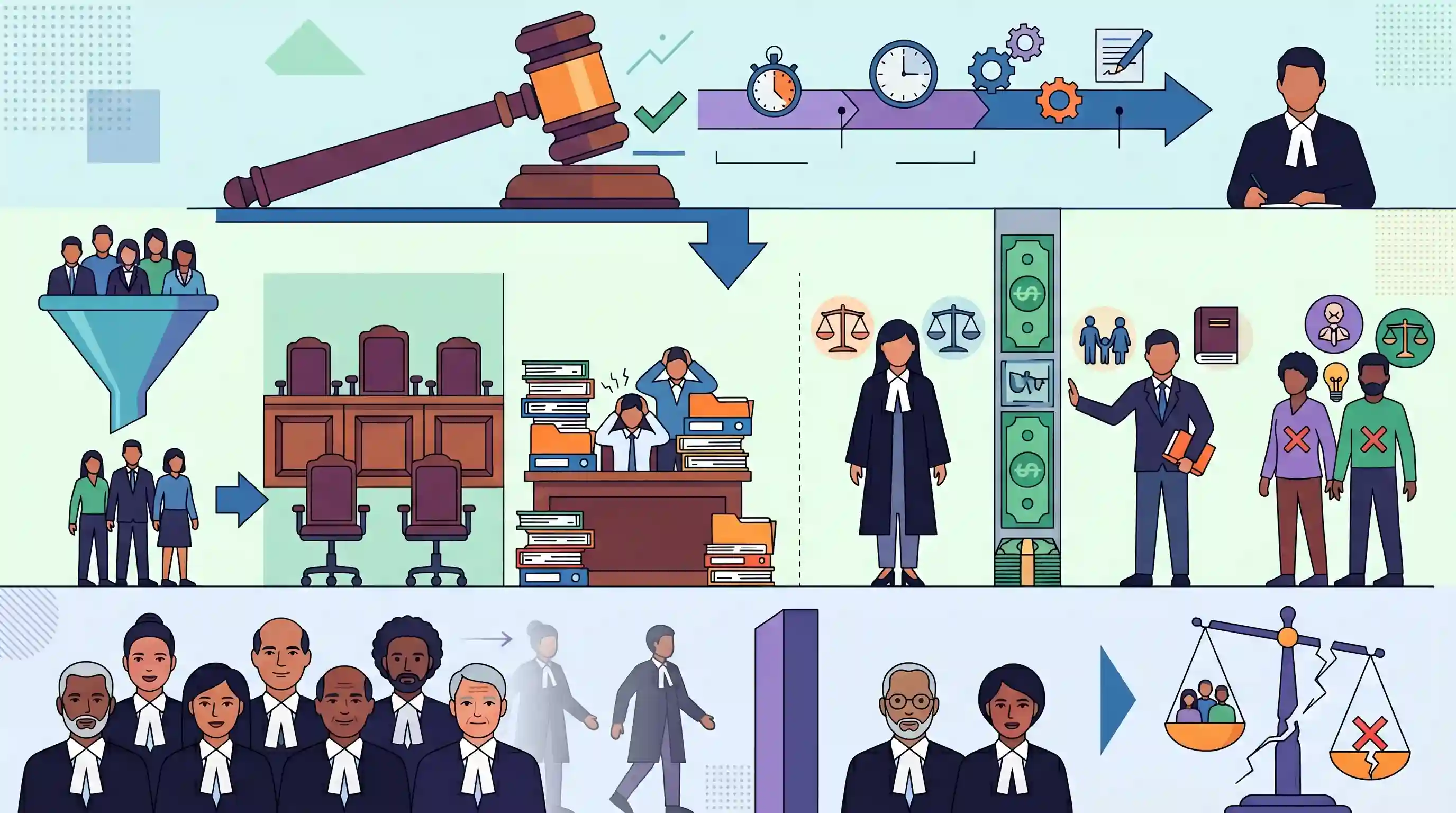
The Supreme Court is evaluating a proposal to mandate a three-year minimum legal practice requirement for eligibility to the civil judge (junior division) examination. Such a move threatens to narrow the candidate pool significantly, leading to increased vacancies and worsening the already high pendency of cases in subordinate courts. Furthermore, due to the poor financial remuneration typical in early-stage litigation, this requirement would disproportionately exclude women, first-generation lawyers, and candidates from marginalized backgrounds, thereby undermining efforts to improve diversity and inclusivity in the Indian judiciary.
Key Points
- The Supreme Court is considering whether to mandate a three-year minimum legal practice requirement for candidates taking the civil judge (junior division) exam.
- Imposing this experience requirement could restrict the applicant pool, leaving many lower judiciary vacancies unfilled and thereby worsening case pendency.
- Early-stage litigation often provides very low remuneration, making a mandatory three-year practice period financially unviable for many law graduates.
- The requirement would disproportionately exclude women, first-generation lawyers, and candidates from marginalized communities, negatively impacting diversity within the judiciary.
Important Terms
Civil Judge (Junior Division)

The entry-level judicial officer in the subordinate judiciary, recruited through state-level exams to adjudicate civil and criminal matters at the grassroots level.
UPSC context
GS Paper-II (Judiciary); tests knowledge of judicial recruitment and the impact of eligibility criteria on justice delivery.
Subordinate Judiciary
The hierarchy of courts below the High Courts, including District and Sessions Courts, which handle the majority of India's legal disputes.
UPSC context
GS Paper-II (Polity); central to discussions on case backlogs, judicial vacancies, and access to justice.
Judicial Pendency
The backlog of unresolved legal cases in the court system, often leading to delays that strain the "Right to Speedy Trial."
UPSC context
GS Paper-II (Governance); a critical metric for evaluating the efficiency and accessibility of the Indian legal system.
First-Generation Lawyer
A legal professional without a family history in law, often facing significant structural and financial barriers during early-career litigation.
UPSC context
GS Paper-II (Social Justice); highlights the need for inclusivity and socio-economic diversity within the legal profession and bench.
Supreme Court of India
The apex judicial body and final court of appeal in India, serving as the ultimate interpreter and guardian of the Constitution.
UPSC context
GS Paper-II (Constitutional Bodies); essential for understanding judicial review, separation of powers, and the hierarchy of justice.
Social Justice
The principle of ensuring fair and equitable representation and rights for all, particularly marginalized groups like women, SC/ST, and OBCs.
UPSC context
GS Paper-I & II; relevant to judicial diversity and how institutional rules impact inclusive representation in state organs.
Litigation
The process of resolving disputes through the court system; active courtroom experience is increasingly being debated as a mandatory judicial prerequisite.
UPSC context
GS Paper-II (Judiciary); tests understanding of practical legal experience versus academic qualification for judicial appointments.
Prelims Trap
The Constitution of India explicitly mandates a minimum of three years of legal practice for appointment as a Civil Judge (Junior Division).
The Constitution does not specify a 3-year rule for junior civil judges. Article 234 leaves the rules to the Governor, consulting the State PSC and High Court.
Static Concepts Connected
How are District Judges and other subordinate judicial officers appointed in India?
- District Judges: Appointed by the Governor in consultation with the High Court (Article 233). Requires a minimum of 7 years of practice as an advocate.
- Other Judicial Officers: Appointed by the Governor after consultation with the State Public Service Commission and the respective High Court (Article 234).
- Administrative Control: Under Article 235, the High Court holds administrative control over district courts and courts subordinate thereto.
What is the constitutional provision for the All India Judicial Service (AIJS)?
- Article 312: Parliament can create AIJS if the Rajya Sabha passes a resolution supported by two-thirds of members present and voting (Article 312).
- Scope of AIJS: The AIJS cannot include posts inferior to that of a District Judge, as per constitutional amendments.
- Current Status: It remains unimplemented due to a lack of consensus among State Governments and High Courts over language barriers and federalism concerns.
Cross-Topic Patterns
Judicial Diversity & the Glass Ceiling
The financial barrier of unpaid junior litigation mirrors broader GS2 themes where strict 'experience mandates' disproportionately filter out women and marginalized communities, reinforcing institutional glass ceilings.
Pendency crisis vs Alternative Dispute Resolution
Subordinate courts hold over 85% of India's backlog. Restricting entry and increasing vacancies could force a stronger push toward Lok Adalats, Gram Nyayalayas, and ODR to bypass lower court bottlenecks.

Expect a comparative Prelims question testing Article 233 (District Judges) vs Article 234 (Civil Judges) alongside AIJS provisions.
Linked PYQs · 2
Linked PYQs · 2
- 2021MainsGS2
Discuss the desirability of greater representation to women in the higher judiciary to ensure diversity, equity and inclusiveness.
- 2017MainsGS2
Critically examine the Supreme Court's judgement on 'National Judicial Appointments Commission Act, 2014' with reference to appointment of judges of higher judiciary in India.
