Temple Management Does Not Equate to Ownership Rules Supreme Court
Source:Indian Express ↗
Why It Matters
The judgment clarifies vital civil law principles regarding the burden of proof in property disputes and establishes a firm legal distinction between the administration/management of religious institutions and the actual ownership of their assets.
Summary
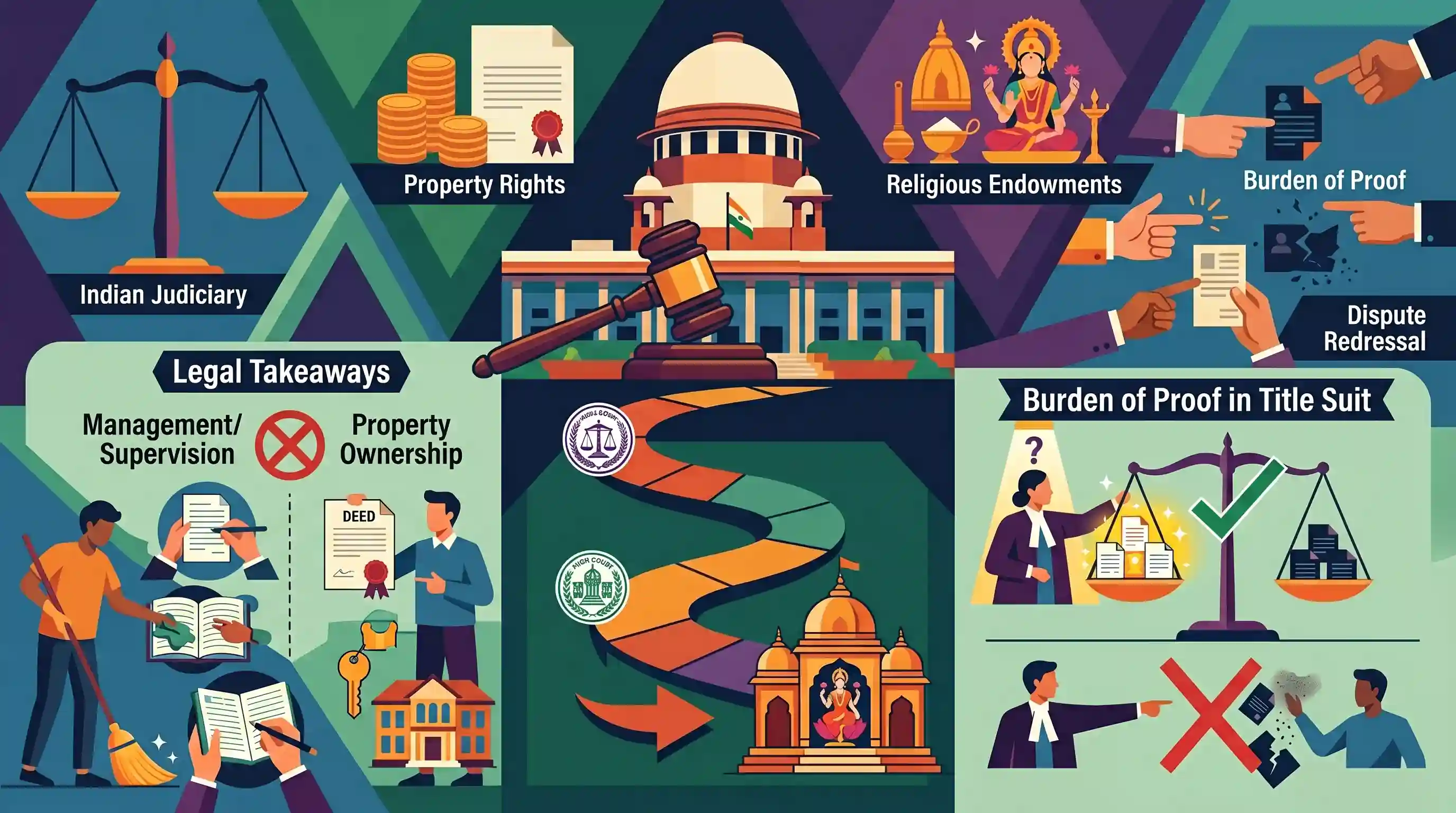
The Supreme Court has resolved a five-decade-old legal battle over the 'Moorti Swarup Shri Govardhan Nath Ji' temple in Kota, Rajasthan. Reversing earlier rulings by the trial court and the Rajasthan High Court, the apex court dismissed a civil suit filed by a religious society claiming ownership of the temple property. The Court established two main legal takeaways: first, that management or supervision of a temple cannot be conflated with property ownership; and second, in a suit for declaration of title, the burden of proof lies entirely on the plaintiff to establish a clear title, rather than relying on the weaknesses of the defendant's claims.
Key Points
- The Supreme Court ruled that managing or supervising a religious institution does not equate to ownership of its properties.
- In a civil suit for declaration of title, the burden of proof lies entirely on the plaintiff; they cannot succeed merely based on the weakness of the defendant's case.
- The Court referenced the precedent set in Union of India vs Vasavi Co-op. Housing Society Limited regarding burden of proof.
- The respondent society failed to produce any deed of dedication or document of endowment to prove ownership, leading to the dismissal of their suit.
Important Terms
Supreme Court of India

The apex judicial body of India, established under Article 124, serving as the final court of appeal and the guardian of the Constitution.
UPSC context
GS Paper II: Structure and functioning of the Judiciary; its role in resolving property and religious disputes.
Burden of Proof
The legal obligation on a party to provide sufficient evidence to prove their claim; under Indian law, the plaintiff must prove their case independently.
UPSC context
GS Paper II: Legal principles and the Indian Evidence Act, crucial for understanding judicial trials.
Suit for Declaration of Title
A civil legal action under Section 34 of the Specific Relief Act, 1963, seeking formal judicial recognition of a person’s legal status or property ownership.
UPSC context
GS Paper II: Statutory provisions related to civil law and property rights litigation.
Religious Endowment
Property or assets dedicated to a religious or charitable purpose, often managed by trustees or societies under specific state or central laws.
UPSC context
GS Paper I & II: Art & Culture (Temple management) and Governance (Charitable institutions).
Gautam Gaur Hitkarak Sabha
The Rajasthan-based society that initiated the legal battle claiming ownership and managerial control over the Moorti Swarup Shri Govardhan Nath Ji temple.
UPSC context
GS Paper II: Case studies involving civil societies and their legal standing in property disputes.
Rajasthan High Court
The highest judicial authority in Rajasthan, whose 2007 decision favoring the society was overturned by the Supreme Court in 2026.
UPSC context
GS Paper II: State Judiciary and its relationship with the appellate jurisdiction of the Supreme Court.
Prelims Trap
"In civil suits, if a defendant fails to prove ownership, the property title automatically transfers to the plaintiff."
The Supreme Court explicitly ruled that the burden of proof lies entirely on the plaintiff; they cannot win merely on the weakness of the defendant's case.
Static Concepts Connected
How does the Constitution govern the property rights of religious denominations?
- Article 26(c): Guarantees religious denominations the right to own and acquire movable and immovable property.
- Article 26(d): The right to administer such property must be exercised "in accordance with law", meaning state property and registration laws apply over religious customs.
- Article 300A: Property remains a constitutional right. Mere supervision of a temple or appointing priests does not legally establish ownership without valid deeds.
What is the foundational rule of the 'Burden of Proof' in civil litigation?
- Plaintiff's Burden: Under Indian evidence laws, the burden to prove a fact rests entirely on the person asserting the legal right or title (the plaintiff).
- Independent Evidence: A plaintiff must independently succeed on the strength of their own primary evidence (e.g., a deed of endowment), independent of the defendant's defensive gaps.
Cross-Topic Patterns
Article 26 vs. Secular Property Law
The distinction between managing religious affairs and owning property underscores how secular, statutory property rights override customary management claims lacking documentary endowment.
Judicial Pendency in Civil Land Disputes
Five-decade property disputes highlight systemic judicial delays, reinforcing the contemporary push for conclusive land titling (DILRMP) and alternative dispute redressal mechanisms.

Expect a Prelims statement testing if managing a religious denomination's affairs (Art 26) automatically confers property ownership.
Linked PYQs · 1
Linked PYQs · 1
- 2024MainsGS2
Public charitable trusts have the potential to make India's development more inclusive as they relate to certain vital public issues. Comment.
