Supreme Court Directs ECI on Voter Verification Documents
Source:The Hindu ↗
Why It Matters
This development is crucial for GS-II as it touches upon the mandate and limits of the Election Commission of India under Article 324, the legal distinction between proof of identity (Aadhaar) and citizenship, and issues relating to the preparation of electoral rolls under the Representation of the People Act, 1950.
Summary
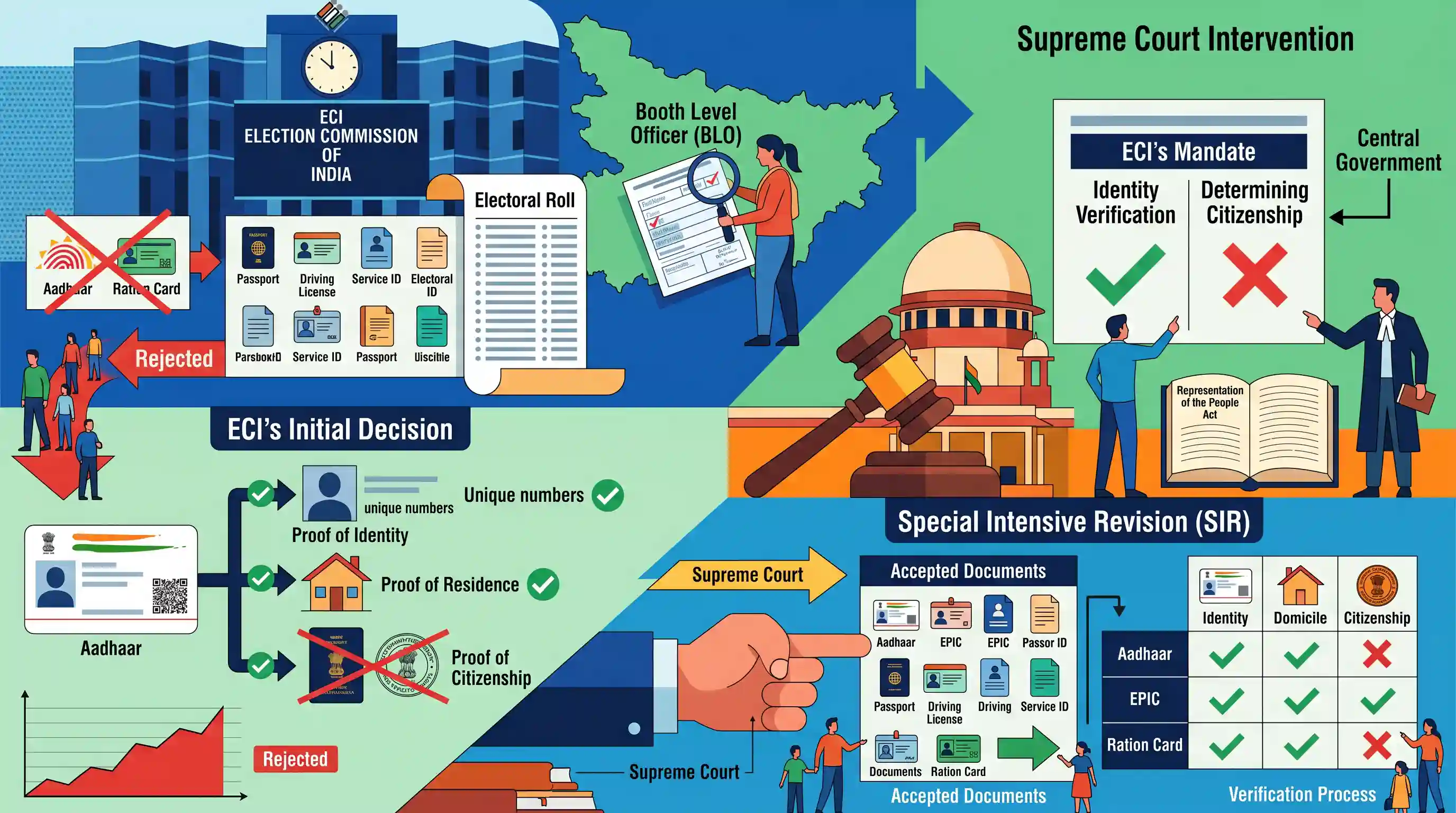
The Supreme Court of India directed the Election Commission of India (ECI) to consider including Aadhaar, EPIC, and ration cards as valid documents for verifying voters during the Special Intensive Revision (SIR) of electoral rolls in Bihar. The ECI had omitted Aadhaar from its list of 11 approved documents because it serves as proof of identity and residence, rather than citizenship. However, the Court and petitioners emphasized that the ECI's mandate under the SIR is identity verification, not determining citizenship—a power vested in the central government. This case underscores the distinction between identity, domicile, and citizenship in India's electoral and governance frameworks.
Key Points
- The Supreme Court has asked the Election Commission of India (ECI) to consider allowing Aadhaar, EPIC, and ration cards for voter verification during the Special Intensive Revision (SIR) of electoral rolls in Bihar.
- The ECI had initially excluded Aadhaar from its list of 11 acceptable documents, arguing that Aadhaar proves identity and residence, not citizenship.
- The Supreme Court noted that the primary purpose of the SIR is to verify voter identity, making Aadhaar a relevant document.
- Petitioners highlighted that determining citizenship is the exclusive domain of the central government, not the ECI, referencing the Aadhaar Act's explicit provision that Aadhaar does not prove citizenship.
Important Terms
Election Commission of India (ECI)

A permanent autonomous constitutional body (Article 324) responsible for the superintendence, direction, and control of India's entire electoral process, including the preparation and revision of electoral rolls.
UPSC context
GS Paper II: Constitutional Bodies. Crucial for understanding electoral governance, independence of institutions, and Article 324 powers.
Representation of the People Act, 1950
A statutory framework governing the allocation of seats, delimitation of constituencies, and qualifications for voters. It provides the legal basis for preparing and periodically revising electoral rolls (voter lists).
UPSC context
GS Paper II: Salient features of the Representation of People's Act. Tests knowledge of electoral administration and voter eligibility.
Aadhaar Act, 2016
A statutory document (under the 2016 Act) serving as proof of identity and residence for residents. Section 9 explicitly states it does not confer citizenship or domicile rights.
UPSC context
GS Paper II: Governance/Rights Issues. Tests the distinction between identity and citizenship and the judicial interpretation of statutory limits.
Special Intensive Revision (SIR)
A comprehensive, house-to-house verification drive conducted by the ECI to thoroughly update and correct electoral rolls, usually ahead of major elections to remove duplicates and ineligible entries.
UPSC context
GS Paper II: Electoral Reforms. Relevant for understanding proactive measures taken by the ECI to ensure electoral integrity and inclusivity.
EPIC (Electors Photo Identity Card)
The official identity document issued by the ECI to registered voters. While it serves as proof of identity and age, voting rights depend on the individual’s presence in the electoral roll.
UPSC context
GS Paper II: Elections. Practical aspect of voter identification and the legal distinction between holding an ID and being an elector.
Registration of Electors Rules, 1960
The procedural rules framed under RPA 1950 that detail the operational framework for the preparation, publication, and revision of electoral rolls, including the handling of claims and objections.
UPSC context
GS Paper II: Electoral Administration. Tests the technical/procedural understanding of how constitutional mandates for "clean" voter rolls are implemented.
Prelims Trap
The Election Commission determines citizenship status to remove non-citizens from electoral rolls during Special Intensive Revisions.
While RPA 1950 disqualifies non-citizens from voting, determining citizenship is the exclusive statutory domain of the Central Government under the Citizenship Act, not the ECI.
Static Concepts Connected
How does RPA 1950 differ from RPA 1951 regarding electoral management?
- RPA 1950: Focuses on the preparation and revision of electoral rolls, delimitation of constituencies, allocation of seats, and qualifications of voters.
- RPA 1951: Regulates the actual conduct of elections, qualifications/disqualifications for MPs/MLAs, election disputes, and corrupt practices.
What is the legal standing of Aadhaar regarding citizenship and domicile?
- Identity only: Section 9 of the Aadhaar Act 2016 explicitly states that an Aadhaar number only proves identity and residence, not citizenship or domicile.
- Citizenship Authority: Under Article 11 and the Citizenship Act 1955, only the Central Government (Ministry of Home Affairs) has the authority to determine Indian citizenship.
Cross-Topic Patterns
Aadhaar-Voter ID linking debate
Connects to the Election Laws (Amendment) Act 2021, which empowered electoral officers to seek Aadhaar for authenticating entries, raising persistent privacy vs. electoral purity questions.
NRC and Identity vs Citizenship divide
The ECI's dilemma mirrors broader governance issues seen in Assam's NRC, where separating legal citizens from mere residents with government-issued identity cards remains highly contentious.

Expect a 2026 multi-statement question distinguishing ECI's electoral roll mandate (RPA 1950) from the Union's exclusive citizenship powers.
Linked PYQs · 3
Linked PYQs · 3
- 2018PrelimsGS1
Consider the following statements: 1. Aadhaar card can be used as a proof of citizenship or domicile. 2. Once issued, Aadhaar number cannot be deactivated or omitted by the Issuing Authority. Which of the statements given above is/are correct?
- 2022MainsGS2
Discuss the role of the Election Commission of India in the light of the evolution of the Model Code of Conduct.
- 2021PrelimsGS1
With reference to India, consider the following statements : 1. There is only one citizenship and one domicile. 2. A citizen by birth only can become the Head of State. 3. A foreigner once granted the citizenship cannot be deprived of it under any circumstances. Which of the statements given above is/are correct?
