Supreme Court Directives on Protection of Women Advocates
Source:The Hindu ↗
Why It Matters
Highlights the Supreme Court's proactive application of suo motu powers in cases of egregious domestic violence, alongside the practical intervention of NALSA in providing immediate financial relief, directly overlapping with GS-2 themes on statutory bodies and social justice.
Summary
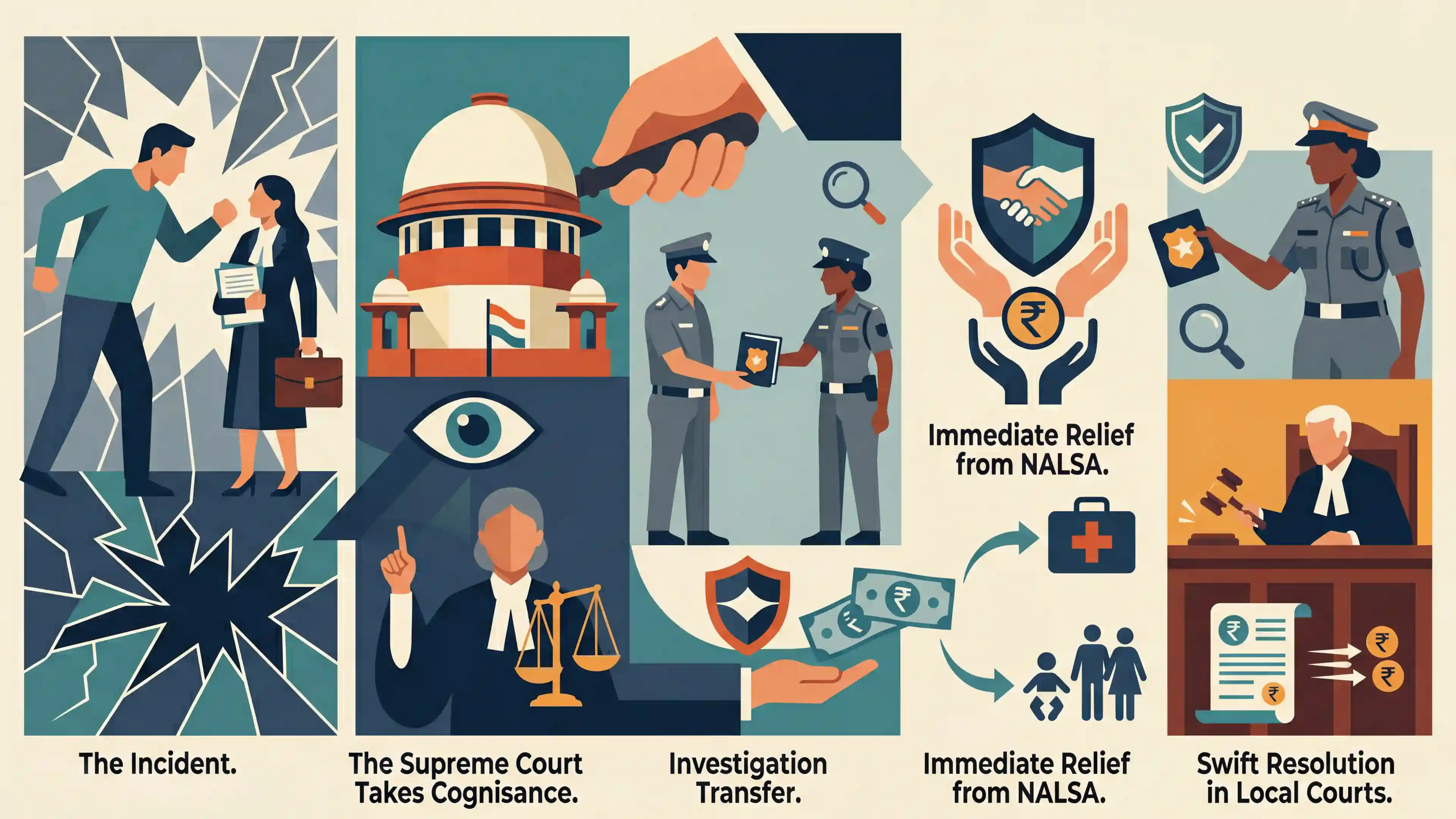
The Supreme Court of India took suo motu cognisance of an incident involving the severe assault of a woman advocate by her husband. Addressing concerns over victim safety and fair process, the Court directed the Delhi Police to transfer the investigation to a senior woman police officer. In a significant application of its authority to guarantee social justice, the Court additionally directed the National Legal Services Authority (NALSA) to release ₹3 lakh as interim relief for the victim's medical treatment and child care, and urged swift resolution of maintenance claims by the local courts.
Key Points
- The Supreme Court exercised suo motu cognisance over the assault of a woman advocate by her husband, underscoring the judiciary's proactive role in securing women's safety.
- The Court directed that a senior woman police officer (ACP or DCP rank) handle the investigation to ensure a fair and sensitive inquiry.
- NALSA was ordered to provide an interim assistance of ₹3 lakh to the victim to cover immediate medical expenses and child care.
- A lower court was instructed to expedite hearings concerning the victim's long-term maintenance, emphasizing a holistic approach to securing justice.
Important Terms
Supreme Court of India

The apex judicial body in India under Article 124, serving as the final court of appeal and guardian of the Constitution with original, appellate, and advisory jurisdictions.
UPSC context
GS Paper 2; Judiciary. Tests knowledge of judicial powers, independence, and its role in protecting fundamental rights.
National Legal Services Authority (NALSA)
A statutory body established under the Legal Services Authorities Act, 1987, to provide free legal services to weaker sections and organize Lok Adalats for amicable dispute resolution.
UPSC context
GS Paper 2; Social Justice. Focuses on Article 39A mandates and statutory bodies ensuring access to justice for the marginalized.
Suo Motu Cognisance
A Latin term meaning 'on its own motion,' referring to the court's power to initiate legal proceedings independently without a formal petition from an aggrieved party.
UPSC context
GS Paper 2; Judiciary. Evaluates the proactive reach of higher courts and their role in addressing urgent public interest issues.
Judicial Activism
A judicial philosophy where judges take a proactive role in shaping public policy and protecting rights, often interpreting the Constitution beyond strict literal text to ensure justice.
UPSC context
GS Paper 2; Indian Polity. Critical for analyzing the separation of powers and the judiciary's role in social reform.
Maintenance (Legal)
Financial support provided to a spouse or dependent who is unable to support themselves, typically claimed under Section 125 of the CrPC/BNSS or personal laws.
UPSC context
GS Paper 2; Social Justice/Women Issues. Relates to gender justice and the legal obligations within family and criminal law.
Interim Relief
A temporary judicial order granted during the pendency of a case to preserve the status quo or protect a party's rights until a final decision is reached.
UPSC context
GS Paper 2; Civil/Criminal Justice. Tests understanding of procedural fairness and the court's power to prevent irreparable harm.
Prelims Trap
NALSA is a constitutional body established directly under Article 39A to provide free legal aid.
NALSA is a statutory body created under the Legal Services Authorities Act, 1987. Article 39A is the directive principle (DPSP) that mandates free legal aid, but does not constitutionally establish the body itself.
Static Concepts Connected
What is the mandate and structure of NALSA?
- Statutory backing: Established under the Legal Services Authorities Act, 1987 to give effect to the DPSP under Article 39A (equal justice and free legal aid).
- Leadership: The Chief Justice of India serves as Patron-in-Chief. The second senior-most Supreme Court Judge is the Executive Chairman.
- Eligibility: Free legal services are guaranteed to women, children, SC/STs, victims of trafficking, industrial workmen, and persons with disabilities regardless of income.
What are the SC's powers for complete justice?
- Article 142: Allows the Supreme Court to pass any decree or order necessary for doing "complete justice" in any pending cause or matter.
- Suo Motu reach: Frequently combined with Article 32 to proactively address gross rights violations or institutional failures without waiting for formal adversarial petitions.
Cross-Topic Patterns
Victim Compensation & BNSS transition
The evolution of victim compensation from Section 357A CrPC to Section 396 of the BNSS integrates structural criminal justice reforms with gender-based violence remediation.
Article 15(3) & Administrative Justice
Directing female officers to handle sensitive investigations is a practical application of Article 15(3), permitting affirmative state provisions for women beyond mere legislative reservations.

Expect a linked Prelims question on NALSA's statutory beneficiaries paired with the newly enacted BNSS victim compensation framework.
Linked PYQs · 5
Linked PYQs · 5
- 2023MainsGS2
Who are entitled to receive free legal aid? Assess the role of the National Legal Services Authority (NALSA) in rendering free legal aid in India.
- 2013PrelimsGS1
With reference to National Legal Services Authority, consider the following statements : 1. Its objective is to provide free and competent legal services to the weaker sections of the society on the basis of equal opportunity. 2. It issues guidelines for the State Legal Services Authorities to implement the legal programmes and schemes throughout the country. Which of the statements given above is/are correct?
- 2020PrelimsGS1
In India, Legal Services Authorities provide free legal services to which of the following type of citizens? 1. Person with an annual income of less than ₹ 1,00,000 2. Transgender with an annual income of less than ₹ 2,00,000 3. Member of Other Backward Classes (OBC) with an annual income of less than ₹ 3,00,000 4. All Senior Citizens Select the correct answer using the code given below:
- 2024MainsGS2
Explain the reasons for the growth of public interest litigation in India. As a result of it, has the Indian Supreme Court emerged as the world's most powerful judiciary ?
- 2023MainsGS2
Explain the constitutional perspectives of Gender Justice with the help of relevant Constitutional Provisions and case laws.
