Supreme Court Suo Motu Action on Dog Bites and Rabies
Source:The Hindu ↗
Why It Matters
This development highlights the judiciary's proactive approach (suo motu cognisance) in addressing urgent public health and municipal governance crises, particularly the complex issue of stray dog management and rabies prevention in urban areas.
Summary
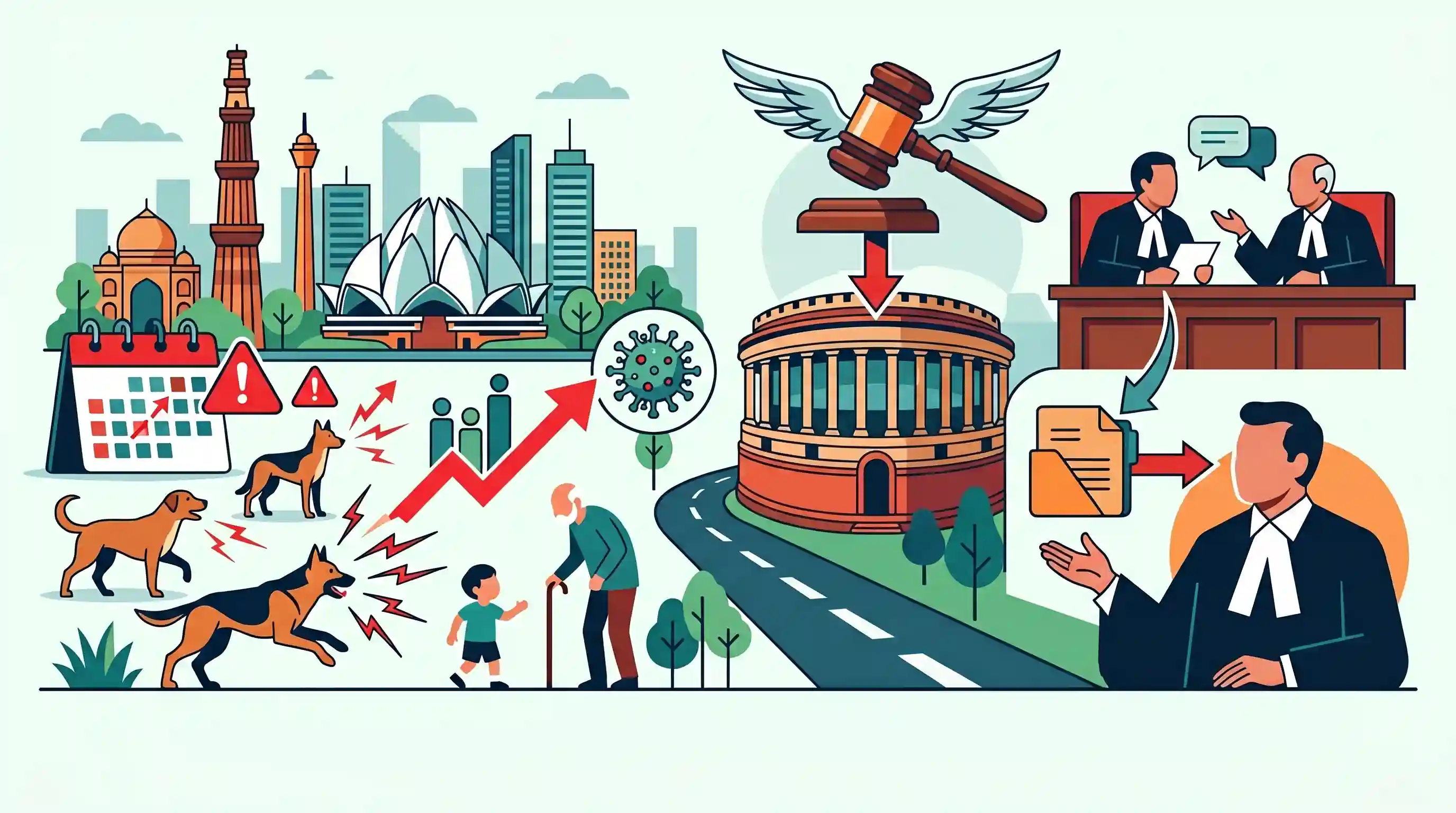
The Supreme Court of India has taken suo motu cognisance of alarming reports concerning an increase in dog bites leading to rabies in the Delhi region. A Bench comprising Justices J.B. Pardiwala and R. Mahadevan took note of the severe threat posed to public health, especially to children and the elderly, and directed that the matter be placed before the Chief Justice of India for further appropriate action.
Key Points
- The Supreme Court took suo motu cognisance of a disturbing media report highlighting a surge in dog bites and resulting rabies cases in and around Delhi.
- The Bench noted that the incidents are particularly impacting vulnerable populations, including children and the elderly.
- The issue underscores concerns regarding urban public health, municipal governance, and the management of stray dog populations.
- The matter has been forwarded to the Chief Justice of India for the issuance of appropriate orders.
Important Terms
Suo Motu Cognisance

The Supreme Court's power to initiate legal proceedings on its own initiative, without a formal petition or complaint from an aggrieved party.
UPSC context
GS Paper 2: Judiciary. Tests knowledge of judicial independence, proactive justice, and the expansion of the court's jurisdiction.
Judicial Activism
The proactive role of the judiciary in protecting the fundamental rights of citizens and addressing public policy gaps through innovative interpretations of the law.
UPSC context
GS Paper 2: Executive vs Judiciary. Evaluates the balance of power and the court's role in social change.
Animal Birth Control (ABC) Rules, 2023
Regulations under the Prevention of Cruelty to Animals Act, 1960, governing the humane sterilization and immunization of community dogs to manage their population.
UPSC context
GS Paper 2 & 3: Governance and Animal Husbandry. Focuses on policy implementation for zoonotic disease control.
Supreme Court of India
The highest judicial court in India, established under Part V, Chapter IV of the Constitution, serving as the final interpreter of law.
UPSC context
GS Paper 2: Constitutional Bodies. Essential for understanding the federal structure and judicial review powers.
Public Health
The collective state of health and well-being of a population, managed through government policy, disease prevention, and community efforts.
UPSC context
GS Paper 2: Social Justice/Health. Tests knowledge of the government's role in addressing health crises like rabies.
Separation of Powers
Constitutional doctrine ensuring the three branches of government—Executive, Legislature, and Judiciary—operate within their distinct spheres to prevent overreach.
UPSC context
GS Paper 2: Basic Structure. Critical for analyzing the limits of judicial intervention in administrative matters.
Prelims Trap
"The Animal Birth Control Rules, 2023 authorize municipalities to permanently relocate aggressive stray dogs to designated animal shelters."
The 2023 Rules strictly prohibit the mass relocation of stray dogs. They classify them as "community animals" and mandate a "catch-sterilise-vaccinate-release" protocol back to their original areas.
Static Concepts Connected
How does the "Master of the Roster" doctrine govern the Supreme Court's functioning?
- Exclusive Authority: The Chief Justice of India (CJI) holds the exclusive administrative prerogative to constitute Benches and allocate cases among judges.
- Suo Motu Allocation: Even if individual Supreme Court judges take suo motu cognisance of an issue, the matter must be placed before the CJI for formal bench assignment.
- Institutional Discipline: It is an established administrative convention designed to maintain institutional discipline and ensure the smooth functioning of the apex court.
What are the key epidemiological and management characteristics of Rabies in India?
- Viral Pathogen: Rabies is a zoonotic viral disease caused by the Lyssavirus, directly affecting the central nervous system.
- Fatality vs Prevention: It is nearly 100% fatal once clinical symptoms appear, yet completely preventable through timely post-exposure prophylaxis (vaccination).
- Elimination Target: Under the National Action Plan for Dog Mediated Rabies Elimination (NAPRE), India targets zero human deaths by 2030 using a multi-sectoral approach.
Cross-Topic Patterns
Urban Governance & Schedule 12
Stray dog management highlights the capacity deficits of municipal bodies under the 74th Amendment (Schedule 12), linking recurring public health crises to structural weaknesses in local urban governance.
Zoonoses and 'One Health' framework
Rabies elimination heavily relies on the 'One Health' model, integrating human medicine, veterinary science, and environmental management—a framework increasingly vital in India's pandemic preparedness and zoonotic disease strategies.

A 2026 Prelims question could merge the Animal Birth Control Rules 2023 with the 'One Health' approach, testing the ban on dog relocation.
Linked PYQs · 3
Linked PYQs · 3
- 2024MainsGS2
Explain the reasons for the growth of public interest litigation in India. As a result of it, has the Indian Supreme Court emerged as the world's most powerful judiciary ?
- 2020MainsGS2
Judicial Legislation is antithetical to the doctrine of separation of powers as envisaged in the Indian Constitution. In this context justify the filing of large number of public interest petitions praying for issuing guidelines to executive authorities.
- 2024MainsGS2
In a crucial domain like the public healthcare system the Indian State should play a vital role to contain the adverse impact of marketisation of the system. Suggest some measures through which the State can enhance the reach of public healthcare at the grassroots level.
