Supreme Court Suo Motu Cognisance on Patented Drug Prices
Source:The Hindu ↗
কেন এটি গুরুত্বপূর্ণ
This issue represents a classic intersection of fundamental rights (Article 21) and economic policy (Intellectual Property/Patents). It provides a strong case study for GS-2 (Judicial functioning, PILs, and Public Health) and GS-3 (IPR and issues relating to patented drug pricing).
সারসংক্ষেপ
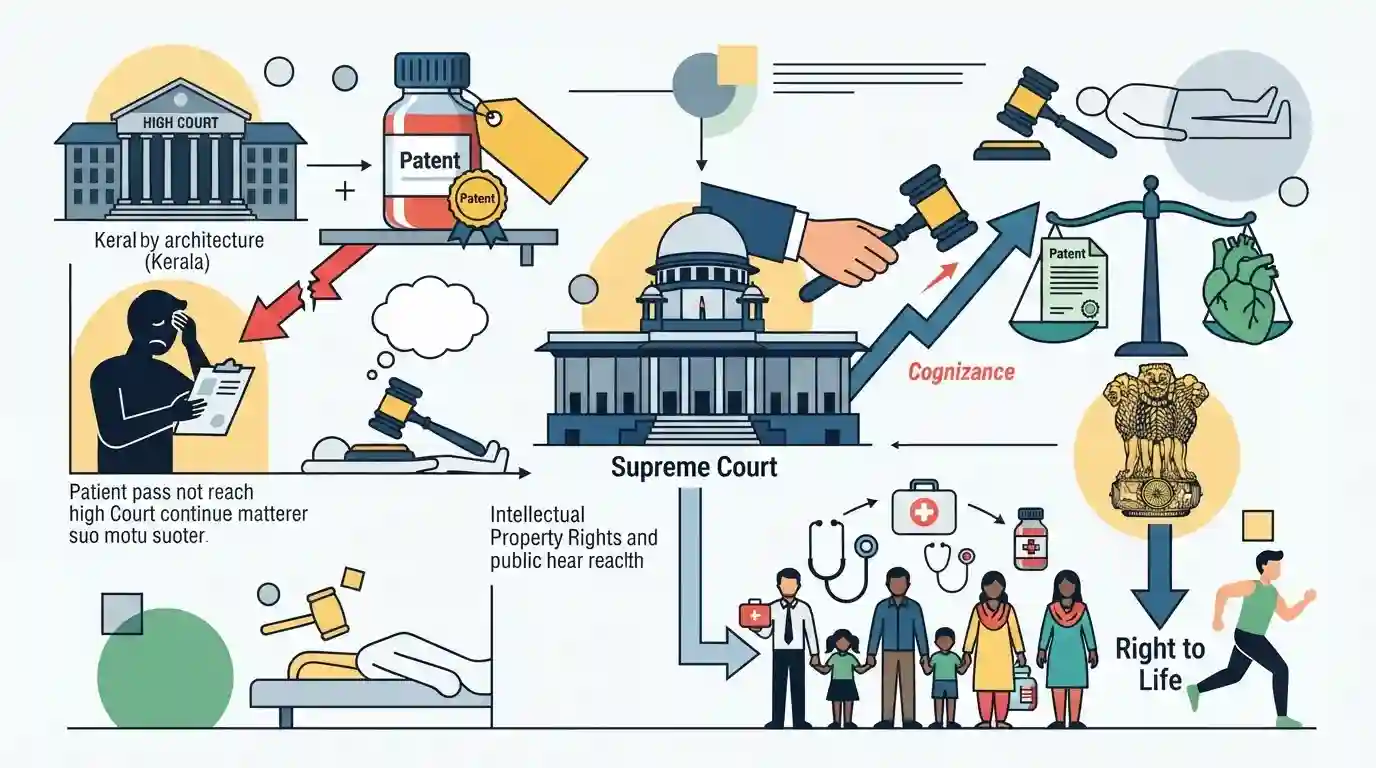
The Supreme Court of India has taken suo motu cognisance of a case concerning the exorbitant pricing of patented life-saving medicines, which restricts access to essential healthcare. The issue originated from a plea in the Kerala High Court by a cancer patient who later passed away, prompting the High Court to continue the matter suo motu. Stressing that issues touching upon the right to life under Article 21 require urgent judicial expediency, the Supreme Court has urged the Chief Justice of the Kerala High Court to ensure the prompt disposal of the case. The development highlights the tension between intellectual property rights (patents) and public health imperatives, as well as the judiciary's active role in protecting fundamental rights.
মূল বিষয়
- The Supreme Court has taken suo motu cognisance of an issue regarding public access to affordable life-saving medicines.
- The case stems from a plea originally filed in the Kerala High Court by a breast cancer patient protesting the exorbitant pricing of patented cancer drugs; she passed away during the proceedings.
- Following her death, the Kerala High Court transformed the plea into a suo motu case titled 'In Re Exorbitant Pricing of Life Saving Patented Medicines'.
- The Supreme Court emphasized the need for judicial expediency in matters concerning the fundamental right to life (Article 21).
- The apex court has requested the Chief Justice of the Kerala High Court to ensure the swift disposal of the ongoing matter.
গুরুত্বপূর্ণ শব্দ
Suo Motu Cognisance

A specialized legal power allowing constitutional courts to initiate legal proceedings on their own motion without a formal petition, often acting as a safety valve to address fundamental rights violations or governance deficits.
UPSC context
GS Paper 2 (Indian Polity). Important for understanding judicial activism, PILs, and court powers under Articles 32 and 226.
Article 21 (Right to Life)
A fundamental constitutional provision guaranteeing that no person shall be deprived of their life or personal liberty except according to law. The Supreme Court expansively interprets this to include the right to affordable healthcare.
UPSC context
GS Paper 2 (Fundamental Rights). Crucial for questions on judicial interpretations of human rights and public health access.
Compulsory Licensing
A mechanism under the Patents Act, 1970, that permits the government to authorize third parties to manufacture generic versions of a patented product without the patent holder's consent, typically during public health emergencies.
UPSC context
GS Paper 3 (Intellectual Property Rights). Relevant for issues balancing pharmaceutical patents with affordable domestic healthcare access.
Public Interest Litigation (PIL)
A legal framework allowing citizens or courts to take up cases concerning public grievances or rights violations, relaxing the traditional rule of locus standi to ensure justice for marginalized groups.
UPSC context
GS Paper 2 (Judiciary). Frequently tested regarding judicial activism, access to justice, and the enforcement of fundamental rights.
Supreme Court of India
The apex judicial authority under the Constitution, tasked with safeguarding fundamental rights, settling inter-state disputes, and ensuring the constitutional validity of laws through its expansive powers like judicial review.
UPSC context
GS Paper 2 (Indian Judiciary). Foundational topic covering its jurisdiction, independence, and overarching constitutional role in governance.
Kerala High Court
The highest judicial body in Kerala. Like other High Courts, it possesses expansive writ jurisdiction under Article 226 to protect fundamental rights and correct administrative injustices within its territorial limits.
UPSC context
GS Paper 2 (State Judiciary). Highlights the role of High Courts in constitutional remedies and suo motu public interest interventions.
প্রিলিমস ফাঁদ
The government cannot issue a compulsory license for a patented medicine unless a private generic manufacturer first applies for it.
Under Section 92, the Central Government can directly issue a notification to trigger compulsory licensing suo motu during emergencies, bypassing private application requirements.
সংযুক্ত স্থির ধারণা
What are the key mechanisms for Compulsory Licensing (CL) under India's Patents Act?
- Section 84: Allows private entities to apply after three years if public demands or affordable pricing criteria remain unmet.
- Section 92: Empowers the Central Government to trigger compulsory licensing suo motu during national emergencies or extreme urgency.
- TRIPS Flexibilities: Aligns with WTO rules allowing member nations to prioritize domestic public health over strict patent enforcement.
How does Section 100 of the Patents Act, 1970 enable government intervention?
- Government Use: Empowers the Centre to use or manufacture patented inventions specifically 'for the purposes of government'.
- Royalty Negotiation: Requires the state to pay royalties to the patentee, though prior consent or commercial negotiation is bypassed.
আন্তঃবিষয় প্যাটার্ন
TRIPS flexibilities + Right to Health
India's defense of generic manufacturing under Article 21 constantly intersects with its WTO commitments, shaping global South health diplomacy.
Judicial activism + Price control
The Supreme Court using Article 21 to scrutinize patent pricing tests the constitutional boundary between judicial review and executive trade policy.

Expect a multi-statement question testing the legal distinction between Section 84 and Section 92 of the Patents Act, 1970.
সংযুক্ত PYQ · 5
সংযুক্ত PYQ · 5
- 2024MainsGS2
Explain the reasons for the growth of public interest litigation in India. As a result of it, has the Indian Supreme Court emerged as the world's most powerful judiciary ?
- 2023MainsGS2
“The Constitution of India is a living instrument with capabilities of enormous dynamism. It is a constitution made for a progressive society.” Illustrate with special reference to the expanding horizons of the right to life and personal liberty.
- 2024MainsGS3
What is the present world scenario of intellectual property rights with respect to life materials? Although, India is second in the world to file patents, still only a few have been commercialized. Explain the reasons behind this less commercialization.
- 2014MainsGS3
In a globalized world, Intellectual Property Rights assume significance and are a source of litigation. Broadly distinguish between the terms-Copyrights, Patents and Trade Secrets.
- 2024PrelimsGS1
Under which of the following Articles of the Constitution of India, has the Supreme Court of India placed the Right to Privacy ?
