Supreme Court Suo Motu Cognisance of Chambal Sand Mining
Source:The Hindu ↗
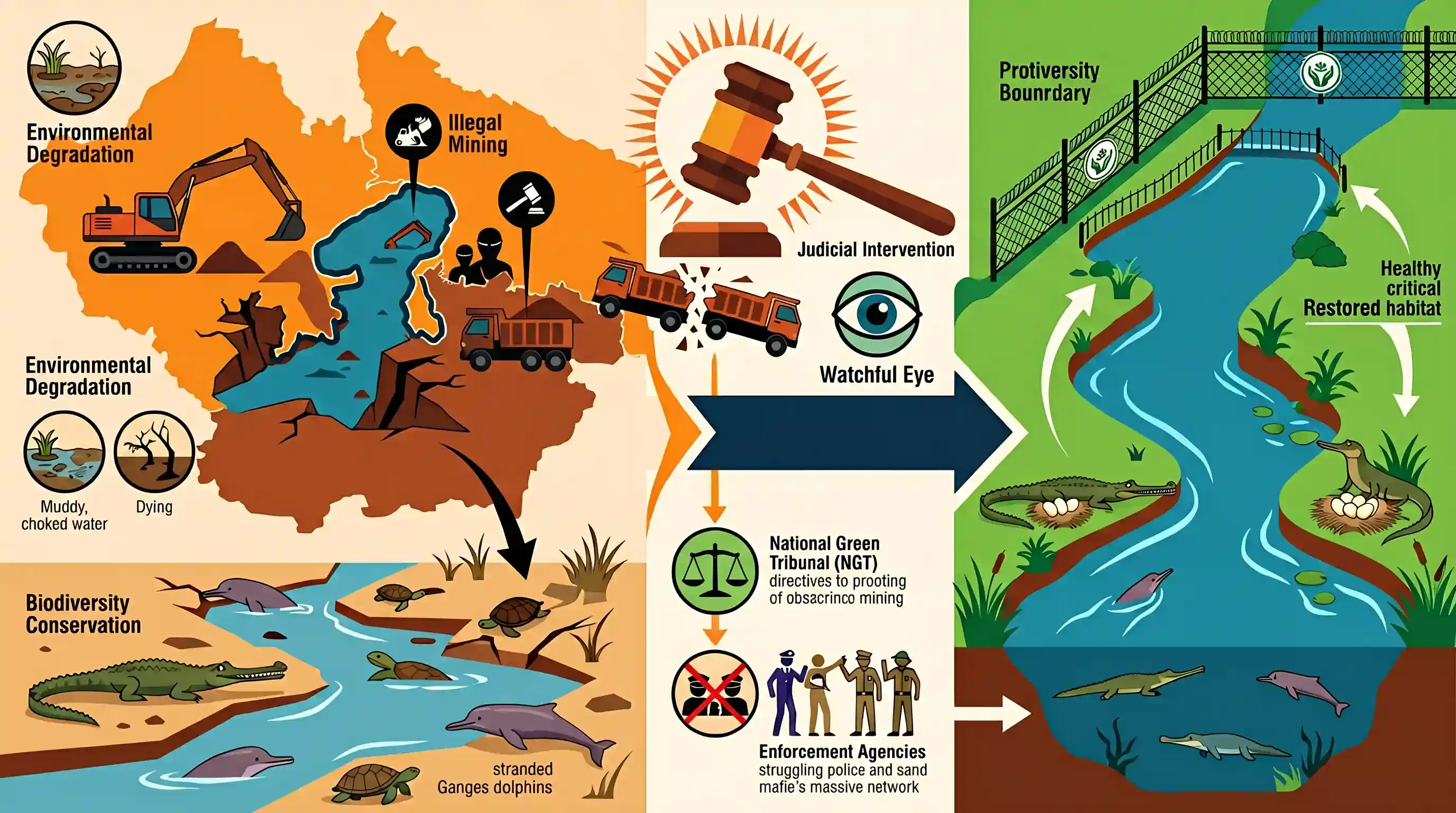
Why It Matters
This article covers the intersection of environmental conservation, illegal resource extraction, and judicial activism. It is highly relevant for GS3 (Environment & Ecology) and GS2 (Governance/Judiciary), specifically concerning the protection of critically endangered species (like the gharial) and the ecological impacts of sand mining on river systems.
Summary
The Supreme Court has taken suo motu cognisance of illegal sand mining in the National Chambal Sanctuary, a critical habitat for the critically endangered gharial and other vulnerable riverine species. Spread across Rajasthan, Madhya Pradesh, and Uttar Pradesh, the sanctuary's ecology and water-retaining morphology are being systematically degraded by organised sand mafias. The intervention follows earlier directives from the National Green Tribunal, highlighting the severe challenges enforcement agencies face in curbing illicit mining activities that threaten India's diverse aquatic biodiversity.
Key Points
- The Supreme Court of India took suo motu cognisance of rampant illegal sand mining in the National Chambal Sanctuary, recognizing the severe threat to its fragile lotic ecosystem.
- The sanctuary, a tri-state riverine protected area across Rajasthan, Madhya Pradesh, and Uttar Pradesh, is the primary breeding spot for critically endangered gharials.
- Organised sand mining mafias operate aggressively, using unregistered vehicles and exploiting exposed sand banks throughout the year, which degrades nesting habitats and alters river morphology.
- The National Green Tribunal (NGT) had previously directed authorities to monitor the issue following a comprehensive conservation plan that identified sand mining as the sanctuary\'s biggest threat.
- Alongside gharials, the sanctuary supports rich biodiversity including Gangetic River Dolphins, the endangered Red Crowned Roof Turtle, and Marsh Crocodile Muggers.
Important Terms
National Chambal Sanctuary

A 600km tri-state (MP, RJ, UP) riverine protected area along the Chambal River. It is the primary habitat for the critically endangered gharial and the endangered Ganges river dolphin.
UPSC context
GS-III Environment; tests knowledge of riverine ecosystems, tri-state conservation, and specific protected area habitats.
Gharial (Gavialis gangeticus)
A fish-eating crocodile with a long, narrow snout. It is listed as 'Critically Endangered' (IUCN) and in Schedule-I (Wildlife Protection Act, 1972), signifying the highest level of legal protection.
UPSC context
GS-III Environment; common Prelims topic regarding conservation status, endemic species, and habitat threats.
National Green Tribunal (NGT)
A statutory body established under the NGT Act, 2010, for the expeditious disposal of cases related to environmental protection, forest conservation, and enforcement of legal rights.
UPSC context
GS-II Polity & GS-III Environment; tests statutory bodies and specialized judicial mechanisms for environmental governance.
Suo Motu Cognisance
The power of a court (Articles 32 and 142 for Supreme Court) to initiate legal proceedings on its own motion without a formal petition from an aggrieved party.
UPSC context
GS-II Polity; relates to 'Judicial Activism' and the court's role as the guardian of fundamental rights.
Illegal Sand Mining
The unauthorized extraction of sand from riverbeds, causing ecological damage like erosion and habitat loss. It is often linked to organized crime and administrative failure.
UPSC context
GS-III Environment & Internal Security; tests resource management, organized crime (sand mafias), and environmental degradation.
Prelims Trap
Sand is a major mineral regulated by the Centre, and Gharials are endemic strictly to the Chambal sanctuary.
Sand is a 'minor mineral' regulated entirely by State governments under the MMDR Act. Additionally, Gharials also exist in the Gandak, Girwa, and Son rivers.
Static Concepts Connected
What are the 3 crocodilian species native to India and their IUCN statuses?
- Gharial (Cr): Critically Endangered. Strictly freshwater, fish-eating species. Primary breeding population is in Chambal, but also found in Gandak and Girwa.
- Mugger (Vu): Vulnerable. Hole-nesting species found in freshwater lakes, slow-moving rivers, and marshes across the Indian subcontinent.
- Saltwater Crocodile (LC): Least Concern. Apex predator found in estuarine habitats, mangroves, and coastal areas (Bhitarkanika, Sundarbans, Andaman & Nicobar).
How is sand mining legally regulated in India?
- Minor Mineral Status: Sand is classified as a minor mineral under Section 3(e) of the Mines and Minerals (Development and Regulation) Act, 1957.
- State Jurisdiction: State governments hold complete administrative and regulatory control to frame rules for minor mineral extraction and to curb illegal mining.
- Environmental Clearance: The Supreme Court has mandated that environmental clearance is compulsory for all sand mining projects, regardless of the lease area size.
Cross-Topic Patterns
Sand mining as a Minor Mineral
Intersects geography and polity. UPSC previously tested sand's minor mineral status; the focus now shifts to state-level enforcement challenges against river morphology degradation.
Article 21 and Environmental Jurisprudence
The SC’s suo motu action highlights the continuous constitutionalization of environmental protection under Article 21, bridging the gap where specialized bodies like NGT face enforcement limits.

Expect a multi-statement question combining Gharial/Dolphin IUCN statuses, Chambal's tri-state geography, and state-level sand mining rules.
Linked PYQs · 4
Linked PYQs · 4
- 2017PrelimsGS1
If you want to see gharials in their natural habitat, which one of the following is the best place to visit?
- 2015PrelimsGS1
Which one of the following is the national aquatic animal of India?
- 2019MainsGS3
Coastal sand mining, whether legal or illegal, poses one of the biggest threats to our environment. Analyze the impact of sand mining along the Indian coasts, citing specific examples.
- 2022MainsGS2
“The most significant achievement of modern law in India is the constitutionalization of environmental problems by the Supreme Court.” Discuss this statement with the help of relevant case laws.
