सुप्रीम कोर्ट ने वकीलों को ED समंस पर स्वतः संज्ञान लिया
स्रोत:द हिंदू ↗
क्यों मायने रखता है
The issue highlights a critical conflict between the investigative powers of executive agencies like the ED and the functional autonomy of the legal profession. It raises important constitutional and governance questions regarding judicial oversight, the rights of defense counsel, and the necessity of preserving a fearless legal system to ensure fair trials and the rule of law.
सारांश
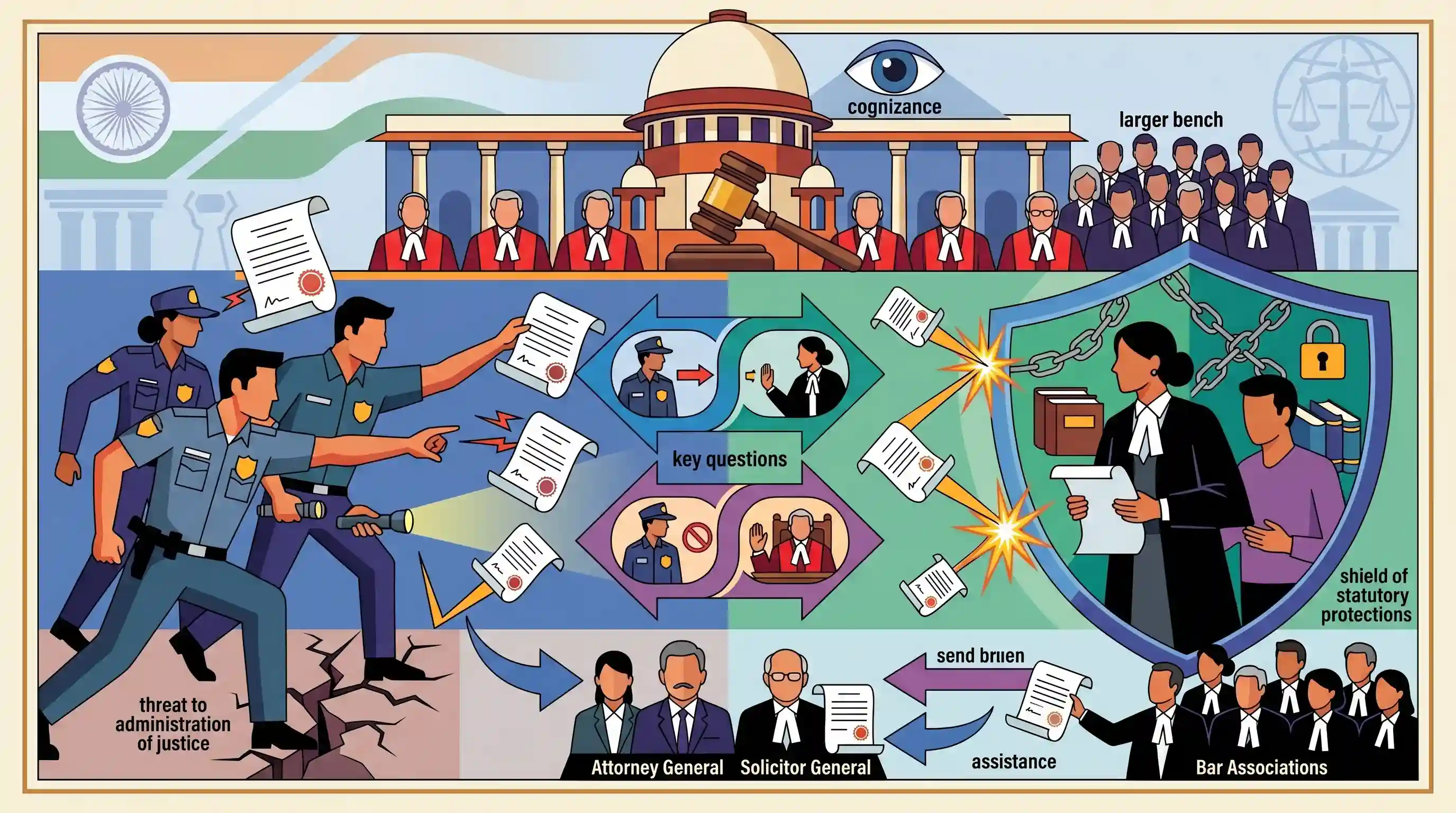
The Supreme Court of India took suo motu cognizance of instances where the Directorate of Enforcement (ED) and other investigative agencies issued summons to advocates over legal advice provided to their clients. Terming such actions a threat to the administration of justice, the Court emphasized that advocates enjoy statutory protections and privileges that enable them to perform their duties without fear. The Bench framed key questions concerning whether probe agencies can directly summon legal professionals and if judicial oversight is required in such cases. The issue has been referred to a larger Bench headed by Chief Justice B.R. Gavai, with the Court seeking assistance from the Attorney General, Solicitor General, and top bar associations.
मुख्य बिंदु
- The Supreme Court took a suo motu case regarding the Directorate of Enforcement (ED) issuing summons to senior advocates for providing professional legal advice to clients.
- A Bench led by Justice KV Viswanathan observed that permitting investigative agencies to summon defense counsel directly undermines the autonomy of the legal profession and poses a threat to the administration of justice.
- The Court framed critical questions on whether probe agencies can summon lawyers over professional advice and whether such actions require judicial oversight.
- यह मामला मुख्य न्यायाधीश बी.आर. गवई की अध्यक्षता वाली तीन न्यायाधीशों की पीठ को संदर्भित किया गया है।
- The Court highlighted that legal professionals have statutory protections and privileges to discharge their duties fearlessly as officers of the court.
महत्वपूर्ण शब्द
Suo Motu Cognizance

The court's power to take notice of an issue on its own motion without a formal petition or complaint from an aggrieved party.
UPSC context
GS Paper II (Judiciary); tests understanding of judicial activism and the apex court's proactive role.
Directorate of Enforcement (ED)
A specialized financial investigation agency under the Ministry of Finance that enforces the PMLA, FEMA, and Fugitive Economic Offenders Act.
UPSC context
GS Paper II (Statutory Bodies) and Paper III (Internal Security); focuses on executive overreach and money laundering.
Advocate-Client Privilege
A legal principle (Section 132, Bharatiya Sakshya Adhiniyam) protecting confidential communications between a lawyer and client from forced disclosure by investigative agencies.
UPSC context
GS Paper II (Judiciary/Rights); vital for the 'Right to Fair Trial' and professional autonomy of the Bar.
भारत के महान्यायवादी
The Union Government’s chief legal advisor and primary lawyer in the Supreme Court, appointed by the President under Article 76.
UPSC context
GS Paper II (Constitutional Bodies); covers the role, privileges, and duties of the highest law officer.
Bar Council of India (BCI)
A statutory body created under the Advocates Act, 1961, responsible for regulating legal practice, professional ethics, and legal education standards in India.
UPSC context
GS Paper II (Statutory Bodies); examines the regulation of professional conduct and judicial administration.
Solicitor General of India
The second-highest law officer in India; a statutory post that assists the Attorney General in representing the government in judicial proceedings.
UPSC context
GS पेपर II (शासन व्यवस्था); कार्यपालिका में संवैधानिक और वैधानिक कानूनी भूमिकाओं के बीच अंतर स्पष्ट करता है।
Supreme Court of India
The highest judicial body in India, established under Article 124, serving as the final court of appeal and guardian of the Constitution.
UPSC context
GS Paper II (Judiciary); central to questions on the separation of powers and judicial independence.
प्रारंभिक ट्रैप
Attorney-client privilege is an absolute fundamental right under Article 22, shielding all lawyer-client communications.
Attorney-client privilege is a statutory right (Evidence Act/BSA), not a fundamental right, and explicitly excludes communications made to commit future crimes or fraud.
संबंधित अवधारणाएँ
What is Attorney-Client Privilege under Indian law?
- Statutory Basis: Governed by Section 126 of the Evidence Act (now Section 132 of BSA 2023), prohibiting advocates from disclosing confidential client communications made during engagement.
- Key Exceptions: The privilege is not absolute; it explicitly excludes any communications made in furtherance of an illegal purpose, crime, or fraud post-engagement.
- Not a Fundamental Right: While Article 22(1) grants the right to legal representation, the specific privilege of non-disclosure is a statutory, not constitutional, guarantee.
What are the powers of the ED under Section 50 of PMLA?
- सिविल न्यायालय की शक्तियाँ: The ED can summon any person to give evidence or produce records during an investigation, wielding powers akin to a civil court.
- साक्ष्यात्मक मूल्य: Unlike standard police confessions, statements recorded under Section 50 of the PMLA are admissible as evidence in a court of law.
- Separation from Arrest: The Supreme Court has clarified that the power to summon under Section 50 does not automatically include the power to arrest, which falls under Section 19.
अंतर-विषय पैटर्न
PMLA Powers vs. Constitutional Rights
The ED's expansive Section 50 summons powers often clash with Article 21 (liberty) and Article 22 (legal representation), driving continuous constitutional scrutiny by the Supreme Court.
Transition to Bharatiya Sakshya Adhiniyam
This issue highlights the active transition of legal principles, like attorney-client privilege, from Section 126 of the colonial IEA 1872 to Section 132 of the new Bharatiya Sakshya Adhiniyam (BSA).

Expect a multi-statement question on PMLA Section 50 powers juxtaposed against statutory privileges and Article 22 rights in 2026.
संबद्ध PYQ · 3
संबद्ध PYQ · 3
- 2023MainsGS2
“Constitutionally guaranteed judicial independence is a prerequisite of democracy.” Comment.
- 2025MainsGS2
“The Attorney General of India plays a crucial role in guiding the legal framework of the Union Government and ensuring sound governance through legal counsel.” Discuss his responsibilities, rights and limitations in this regard.
- 2020MainsGS2
Judicial Legislation is antithetical to the doctrine of separation of powers as envisaged in the Indian Constitution. In this context justify the filing of large number of public interest petitions praying for issuing guidelines to executive authorities.
