Supreme Court Directs Stricter Penal Action Against River Polluters
Source:livelaw ↗
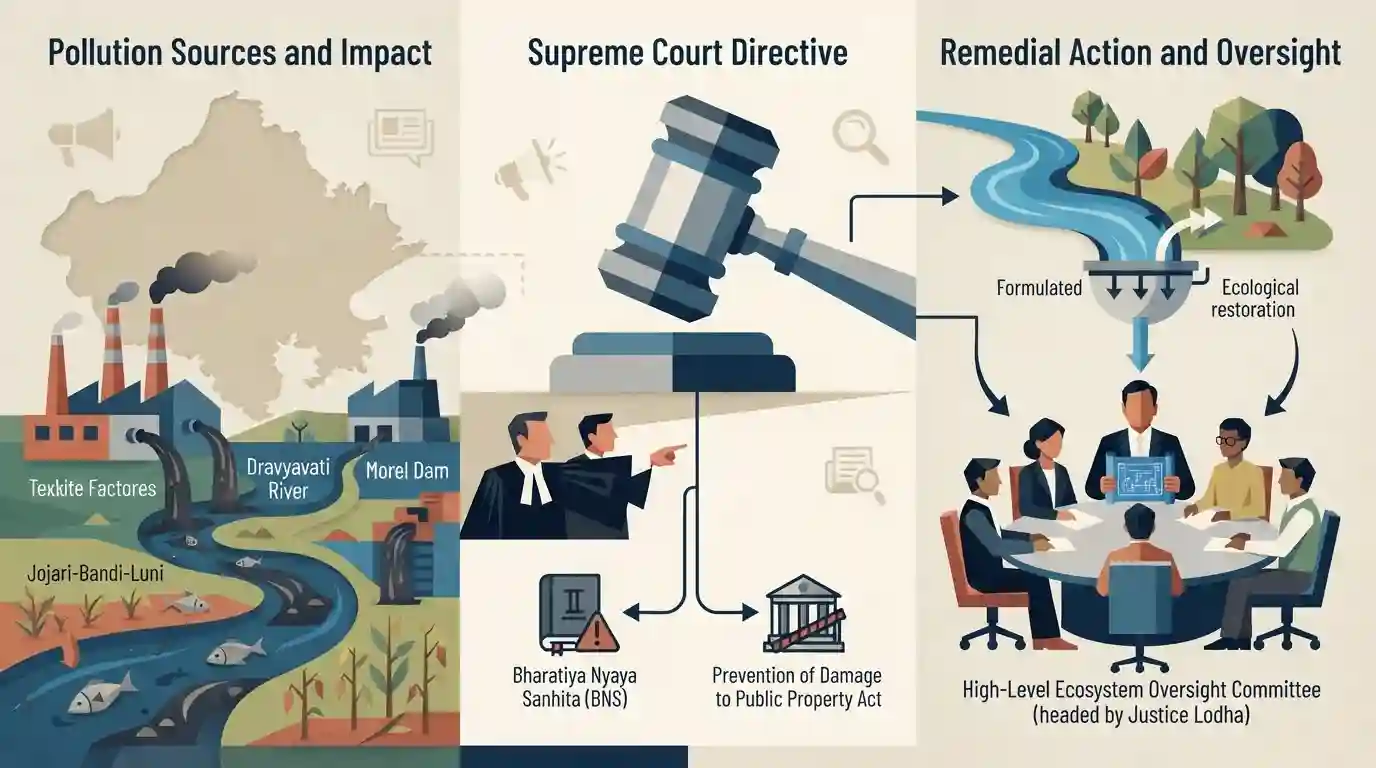
Why It Matters
Water scarcity and river pollution (especially in semi-arid regions like Rajasthan's Luni Basin) are critical socio-economic and geographical issues for RAS Prelims. The intervention by the Supreme Court involving new criminal laws (BNS) adds legal and governance dimensions.
Summary
The Supreme Court of India has taken strict cognizance of widespread river pollution in Rajasthan, specifically targeting the highly polluted Jojari-Bandi-Luni river system. Warning that administrative leniency would not be tolerated, the bench led by Justice Abhay S Oka directed the state government to invoke graver offences under the Bharatiya Nyaya Sanhita (BNS) and the Prevention of Damage to Public Property Act against polluters releasing untreated effluents. Highlighting severe pollution in the Dravyavati river and Morel Dam from textile industries, the apex court ordered the formation of a High-Level Ecosystem Oversight Committee headed by Justice Sangeet Lodha to formulate a remedial blueprint.
Key Points
- The Supreme Court voiced serious concern over the extreme pollution of rivers and water bodies in Rajasthan, particularly noting the severe degradation of the Jojari, Bandi, and Luni river systems.
- The Bench directed the Rajasthan government to consider invoking stricter penal provisions under the Bharatiya Nyaya Sanhita (BNS) and the Prevention of Damage to Public Property Act against chronic polluters, rather than relying solely on the Water Act.
- The Court ordered the constitution of a High-Level Ecosystem Oversight Committee, headed by former Rajasthan High Court judge Justice Sangeet Lodha, to prepare a comprehensive blueprint for restoring the affected river systems.
- Reports indicated that untreated industrial effluents from textile industries are severely polluting the Dravyavati River in Sanganer and the Morel Dam in Lalsot, creating agricultural and health crises in these regions.
Important Terms
Bharatiya Nyaya Sanhita, 2023

India's new criminal code replacing the IPC. It includes stringent provisions (like Sections 272 and 326) criminalizing malignant acts likely to spread dangerous diseases and acts of mischief damaging public drainage and irrigation works.
UPSC context
GS Paper 2 & 3. Highlights the use of criminal liability to prosecute severe industrial pollution and ecological crimes.
Prevention of Damage to Public Property Act, 1984
A central legislation that penalizes deliberate acts of mischief causing destruction to public property. The Supreme Court recently advocated its use against polluters illegally discharging untreated effluents into state-owned rivers.
UPSC context
GS Paper 2 & 3 (Governance/Environment). Crucial for understanding statutory tools available to hold polluters accountable for degrading public resources.
Water (Prevention and Control of Pollution) Act
Enacted in 1974, this foundational law aims to prevent water pollution and restore water quality. It established the Central and State Pollution Control Boards, equipping them with powers to regulate polluting industries.
UPSC context
GS Paper 3 (Environment). A core environmental statute critical for UPSC questions on India's legal framework for water conservation.
Central Pollution Control Board (CPCB)
A statutory organization established under the Water Act, 1974. It serves as the apex national authority for setting water and air quality standards, advising the government, and coordinating state boards.
UPSC context
GS Paper 3 (Environment). Frequently tested in Prelims and Mains regarding its statutory mandate and role in environmental governance.
Rajasthan State Pollution Control Board
A state-level statutory body responsible for implementing environmental laws in Rajasthan. It monitors industrial effluents, grants clearances, and drafts technical action plans to mitigate local water and air pollution.
UPSC context
GS Paper 3 (Environment). Relevant for topics on state-level institutional mechanisms, regulatory compliance, and tackling localized river pollution crises.
Prelims Trap
Water pollution offences can only be prosecuted under specific environmental laws like the Water Act, 1974, excluding general penal codes.
The Supreme Court directed invoking the general Bharatiya Nyaya Sanhita (BNS) and Public Property Damage Act, categorizing river pollution as public property destruction.
Static Concepts Connected
What are the key geographical features of the Luni River basin?
- Origin and course: Rises in the Aravalli Range near Ajmer (initially as Sabarmati), flows southwest through the Thar Desert, and terminates in the Rann of Kutch marshes.
- Inland drainage: It is an ephemeral river that does not empty into any ocean, making it India's largest inland drainage river system.
- Key tributaries: Includes left-bank tributaries like the Bandi, Sukri, and Jawai, and the right-bank tributary Jojari, which are heavily affected by industrial effluents.
What is the Public Trust Doctrine in Indian environmental law?
- Core principle: Asserts that resources like rivers, forests, and air are held by the state in trust for the general public, preventing private ownership or destruction.
- Judicial origin: Established in India through the landmark M.C. Mehta v. Kamal Nath (1997) case, drawing from common law concepts of public heritage.
Cross-Topic Patterns
Evolving Environmental Liability in India
Moving from regulatory fines under the Water Act to severe criminal charges under the BNS shows a tightening judicial grip on industrial polluters through mainstream criminal law.
Arid Hydrology and Industrial Conflict
Textile clusters in water-stressed Rajasthan highlight the clash between economic MSME growth and the conservation of fragile, seasonal river ecosystems.

Applying public property protection laws to rivers signals a major shift toward questioning environmental criminal liability in 2026.
Linked PYQs · 2
Linked PYQs · 2
- 2024RPSC_PRELIMSGS1
Which of the following is correct regarding Rajasthan Bharatpur – Rajasthan Berger? A. Luni Basin and Southwest Rajasthan Border are part of Rajasthan Berger. B. Ghagghar Plain covers mainly the North Rajasthan. C. Rajasthan Plain does have salty lakes and inland drainage. D. Bhilwara district is a part of all the above things of Rajasthan. Select the correct answer using the codes given below:
- 2025RPSC_PRELIMSGS1
Consider the following statements: A. Luni Basin and Shekhawati region are sub-regions of Bhangar in Rajasthan. B. The Ghaggar plain is mostly spread in Hanumangarh and Ganganagar districts. C. Nagaur Uplands have saline lakes and internal drainage. D. The Aravalli ranges are rich in all types of minerals. Select the correct answer from the code given below: Code:
