Student suicides task force strategy and stakeholder consultation
Source:Indian Express ↗
Why It Matters
The issue of student suicides is a pressing social crisis reflecting systemic flaws in the education and coaching sectors. It is highly relevant for GS1 (Society - youth issues, changing socialization) and GS2 (Education, Health, Governance). Judicial steps to enforce stakeholder consultations illustrate evolving policy-making processes.
Summary
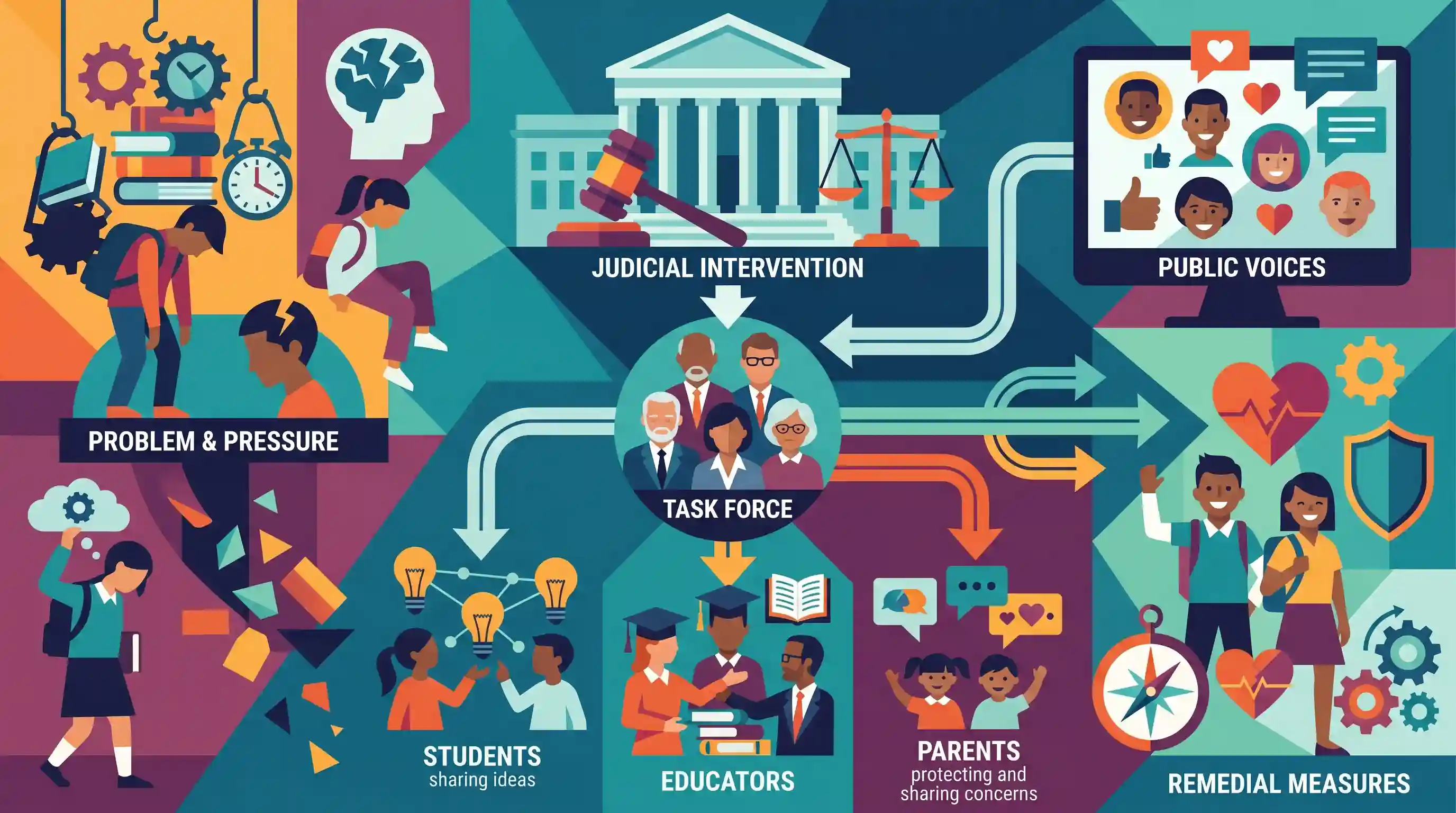
The Supreme Court has set up a task force to address the alarming rise in student suicides across the country. Recognizing the complexity of the issue, the task force is charting a path that involves broad consultations with various stakeholders, including students, educators, and parents. In a progressive step, it will also utilize social media to gather feedback and suggestions, ensuring that the voices of the youth and the public are integrated into the formulation of remedial measures.
Key Points
- The Supreme Court has constituted a task force to tackle the growing crisis of student suicides in India.
- The task force intends to conduct broad consultations with a variety of stakeholders, including students, educators, and parents.
- Social media platforms will be utilized to gather widespread feedback, ensuring a modern, inclusive, and participative approach to understanding youth stress.
- The initiative underscores a proactive judicial approach to addressing critical socio-educational and mental health issues affecting young people.
Important Terms
National Task Force on Mental Health

A Supreme Court-constituted body (2025) led by Justice S. Ravindra Bhat to investigate root causes of student suicides and recommend systemic reforms in higher education.
UPSC context
GS Paper 2: Governance & Judiciary; tests knowledge of judicial interventions in social welfare and institutional accountability.
Manodarpan
A Ministry of Education initiative providing psychosocial support to students, teachers, and families for mental health and emotional well-being during and after the COVID-19 pandemic.
UPSC context
GS Paper 2: Social Justice; relevant for questions on government schemes for vulnerable sections and the education sector.
National Crime Records Bureau (NCRB)
A central agency responsible for collecting and analyzing crime data, including the annual 'Accidental Deaths and Suicides in India' (ADSI) report used for policy formulation.
UPSC context
GS Paper 1: Social Issues; provides critical data for analyzing trends in youth distress and societal health.
Article 21
Fundamental Right guaranteeing that "no person shall be deprived of his life or personal liberty except according to procedure established by law," interpreted to include mental health.
UPSC context
GS Paper 2: Constitution; essential for discussing the right to health and the state's obligation to protect citizens' lives.
Section 154 CrPC (BNSS Section 173)
Mandatory legal provision requiring police to register a First Information Report (FIR) upon receiving information about the commission of a cognizable offence.
UPSC context
GS Paper 2: Criminal Justice System; tests understanding of legal procedures and institutional duties in sensitive cases.
Public Interest Litigation (PIL)
A legal mechanism allowing individuals or groups to seek judicial redress for matters of public interest, often used to prompt executive action on social issues.
UPSC context
GS Paper 2: Judiciary; core concept for evaluating judicial activism and the protection of minority/student rights.
Caste-based Discrimination
Social exclusion and harassment based on the Varna/Caste system, identified by the Supreme Court as a critical trigger for suicides in elite educational institutions.
UPSC context
GS Paper 1: Indian Society; vital for analyzing structural inequalities and the "merit vs. reservation" debate in HEIs.
Prelims Trap
The National Task Force to address student suicides in HEIs was constituted by the Ministry of Education.
Aspirants might assume this task force falls under the Ministry of Education. However, it was constituted directly by the Supreme Court of India.
Static Concepts Connected
Who publishes official suicide statistics in India and what are the key trends?
- Publishing Agency: The National Crime Records Bureau (NCRB) under the Ministry of Home Affairs publishes the annual 'Accidental Deaths and Suicides in India' (ADSI) report.
- Recent Trends: Student suicides have surged 65% over the past decade, outpacing the national average increase and surpassing the total number of farmer suicides.
What are the mandatory grievance redressal and support mechanisms in HEIs?
- Equal Opportunity Cells (EOCs): Mandated by the UGC to oversee the implementation of policies and affirmative action for disadvantaged groups (SC/ST/OBC/Minorities/PwD).
- Internal Complaints Committees (ICCs): Mandatory bodies required under the PoSH Act 2013 to receive and address complaints of sexual harassment at the workplace/institution.
- UMMEED Guidelines: Introduced by the Ministry of Education to form School Wellness Teams (SWTs) and provide immediate response protocols for at-risk school children.
Cross-Topic Patterns
Judicial intervention in educational policy
The SC drafting SOPs for mental health in HEIs highlights judicial activism stepping into educational governance to fill executive policy vacuums.
Demographic Dividend vs. Youth Distress
Rising student suicides, now statistically outpacing farmer suicides, reflect a shift from an agrarian crisis to an urban/youth distress crisis, directly threatening India's demographic dividend.

Expect a GS-2 Mains question linking the tokenism of institutional grievance cells (EOCs/ICCs) to the crisis of student suicides in HEIs.
Linked PYQs · 2
Linked PYQs · 2
- 2023MainsGS1
Explain why suicide among young women is increasing in Indian society.
- 2021MainsGS4
In case of crisis of conscience does emotional intelligence help to overcome the same without compromising the ethical or moral stand that you are likely to follow? Critically examine.
