US Supreme Court Strikes Down Global Reciprocal Tariffs
Source:Indian Express ↗
Why It Matters
The shift from multilateralism to protectionism in advanced economies directly threatens India's export-led growth and macroeconomic stability. This event highlights how constitutional checks in a foreign democracy (the US) can tangibly impact India's trade prospects.
Summary
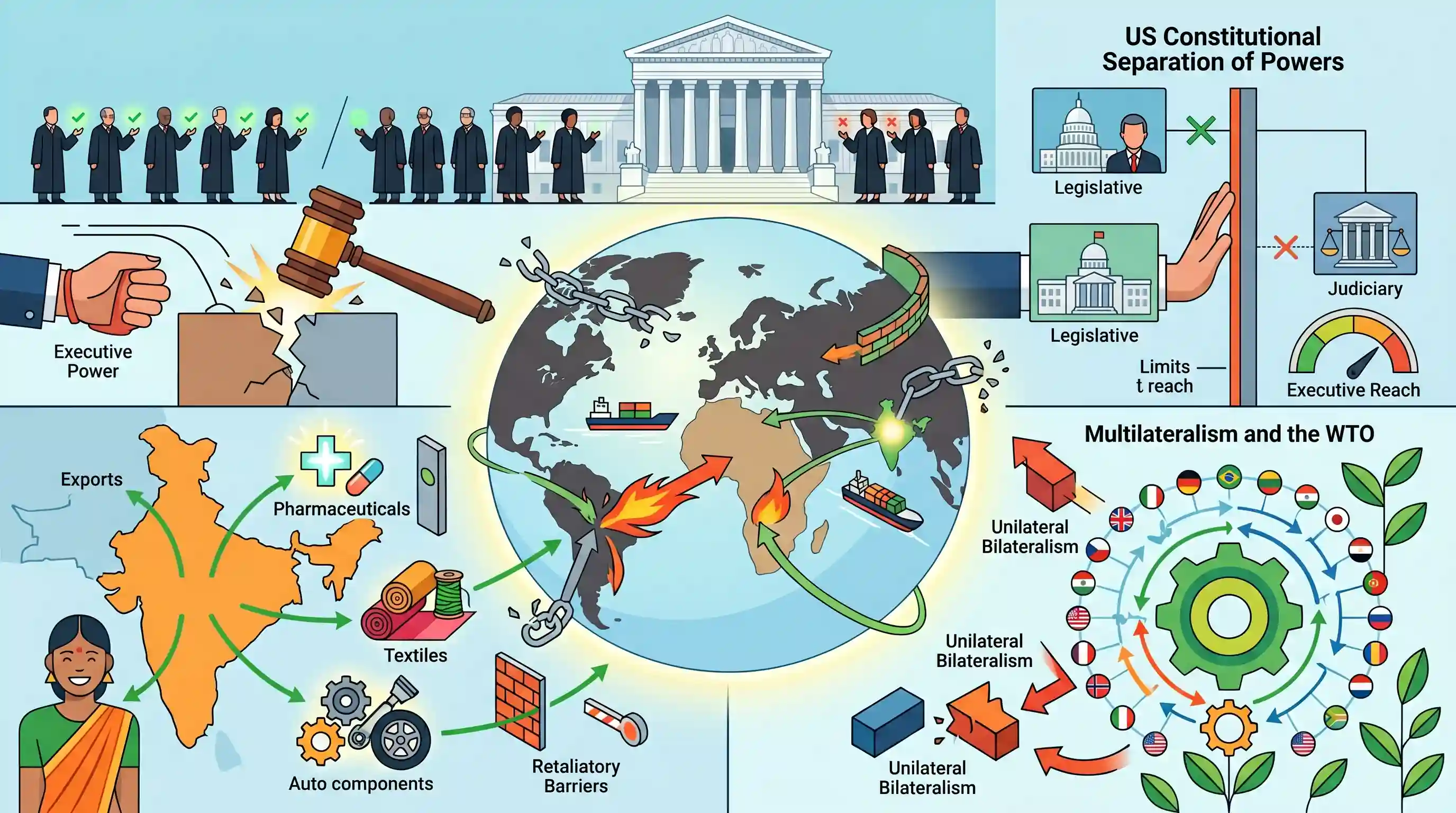
The US Supreme Court's 6-3 ruling striking down President Donald Trump's global reciprocal tariffs has halted a major protectionist economic agenda. By curbing the executive branch's power to unilaterally impose tariffs, the ruling prevents a looming global trade war. For India, this development is highly favorable as it protects crucial export sectors—such as pharmaceuticals, textiles, and auto components—from retaliatory trade barriers. Furthermore, the decision underscores the constitutional separation of powers in the US and provides a breather for the multilateral, rules-based international trading system championed by the WTO against unilateral bilateralism.
Key Points
- The US Supreme Court delivered a 6-3 ruling striking down President Donald Trump's sweeping 'Reciprocal Tariffs' policy, a cornerstone of his protectionist economic agenda.
- The ruling checks the unilateral executive power to impose sweeping tariffs without Congressional approval, highlighting the separation of powers in the US Constitution.
- The decision provides immense relief to the global economy and India, averting a potential trade war and safeguarding Indian export sectors like pharmaceuticals, textiles, and IT services.
- The overturning of these tariffs inadvertently bolsters the relevance of multilateral rule-based trading systems under the WTO, pushing back against unilateral protectionism.
Important Terms
Reciprocal Tariffs

A trade policy where a country imposes tariffs on imports equivalent to the duties its own exports face in the partner country.
UPSC context
GS Paper III (Economy). Relevant for understanding trade barriers, bilateral relations, and global trade dynamics.
Separation of Powers
A constitutional principle dividing government authority into legislative, executive, and judicial branches to prevent any single branch from exercising absolute power.
UPSC context
GS Paper II (Polity). Crucial for comparative constitutional analysis of the limits of executive authority.
World Trade Organization (WTO)
An international organization that regulates global trade, provides a forum for negotiations, and settles trade disputes based on rules-based multilateralism.
UPSC context
GS Paper II & III. Focuses on international institutions and global economic order.
International Emergency Economic Powers Act (IEEPA)
A 1977 US law granting the President authority to regulate commerce during national emergencies; the Court ruled it does not authorize unilateral tariff imposition.
UPSC context
GS Paper II (Polity). Relevant for comparing executive emergency powers and judicial limitations in democracies.
Protectionism
Economic policy of restricting imports through tariffs or quotas to safeguard domestic industries from foreign competition.
UPSC context
GS Paper III (Economy). Vital for analyzing global trade shifts and their impact on Indian exports.
Retaliatory Tariffs
Punitive duties imposed by a nation against another country that has previously increased its own tariffs or implemented unfair trade practices.
UPSC context
GS Paper III (Economy). Important for discussing 'trade wars' and implications for macroeconomic stability.
Most-Favoured-Nation (MFN) Principle
A WTO rule requiring member countries to treat all trading partners equally by applying the same tariff rates to all.
UPSC context
GS Paper III (Economy). Fundamental for understanding rules-based trade and non-discrimination in global commerce.
Prelims Trap
"The US President holds primary constitutional authority to regulate foreign commerce and levy tariffs."
In the US Constitution, regulating foreign commerce and levying tariffs is explicitly an Article I power vested in Congress, not the Executive.
Static Concepts Connected
How does the separation of powers differ between India and the US?
- Strict vs Fused: The US has a rigid separation where the Executive is entirely outside the Legislature. India has a fused parliamentary model where the Executive is drawn from the Legislature.
- Trade Authority: The US Congress directly controls foreign commerce and tariffs. The Indian Parliament passes broad laws (Customs Act) but delegates daily tariff rate-setting and trade policy to the Executive.
What is the Most-Favored-Nation (MFN) principle under the WTO?
- Core Rule: Nations must treat all WTO members equally. If a country grants a special trade favor or lowers a tariff for one partner, it must do so for all WTO members.
- Valid Exceptions: Free Trade Agreements (FTAs) and preferential treatment programs for developing nations (like the Generalized System of Preferences) are permitted exemptions to the MFN rule.
Cross-Topic Patterns
Tariffs and Currency Devaluation
Escalating trade tariffs often incentivize nations to artificially devalue their currencies, seeking to maintain export competitiveness and potentially triggering global currency wars.
Comparative Constitutional Law (GS2)
The US Supreme Court checking executive trade policy contrasts sharply with India, where the judiciary rarely interferes in macroeconomic or tariff policy decisions, deferring to the executive.

A multi-statement Prelims question combining WTO's MFN principle, reciprocal tariffs, and US-India trade balance is highly probable in 2026.
Linked PYQs · 4
Linked PYQs · 4
- 2025MainsGS3
What are the challenges before the Indian economy when the world is moving away from free trade and multilateralism to protectionism and bilateralism? How can these challenges be met?
- 2018MainsGS3
How would the recent phenomena of protectionism and currency manipulations in world trade affect macroeconomic stability of India?
- 2018MainsGS2
What are the key areas of reform if the WTO has to survive in the present context of "Trade War', especially keeping in mind the interest of India?
- 2025MainsGS2
Discuss the evolution of collegium system in India. Critically examine the advantages and disadvantages of the system of appointment of the Judges of the Supreme Court of India and that of the USA.
