Supreme Court Verdict on Ex Post Facto Environmental Clearances
Source:The Hindu ↗
Why It Matters
This judgment is highly relevant for GS-3 (Environment) as it reinforces the statutory importance of prior Environmental Impact Assessments (EIA). It highlights the judiciary's strict stance against the regularisation of environmental violations and underscores the balance between development and ecological conservation (sustainable development).
Summary
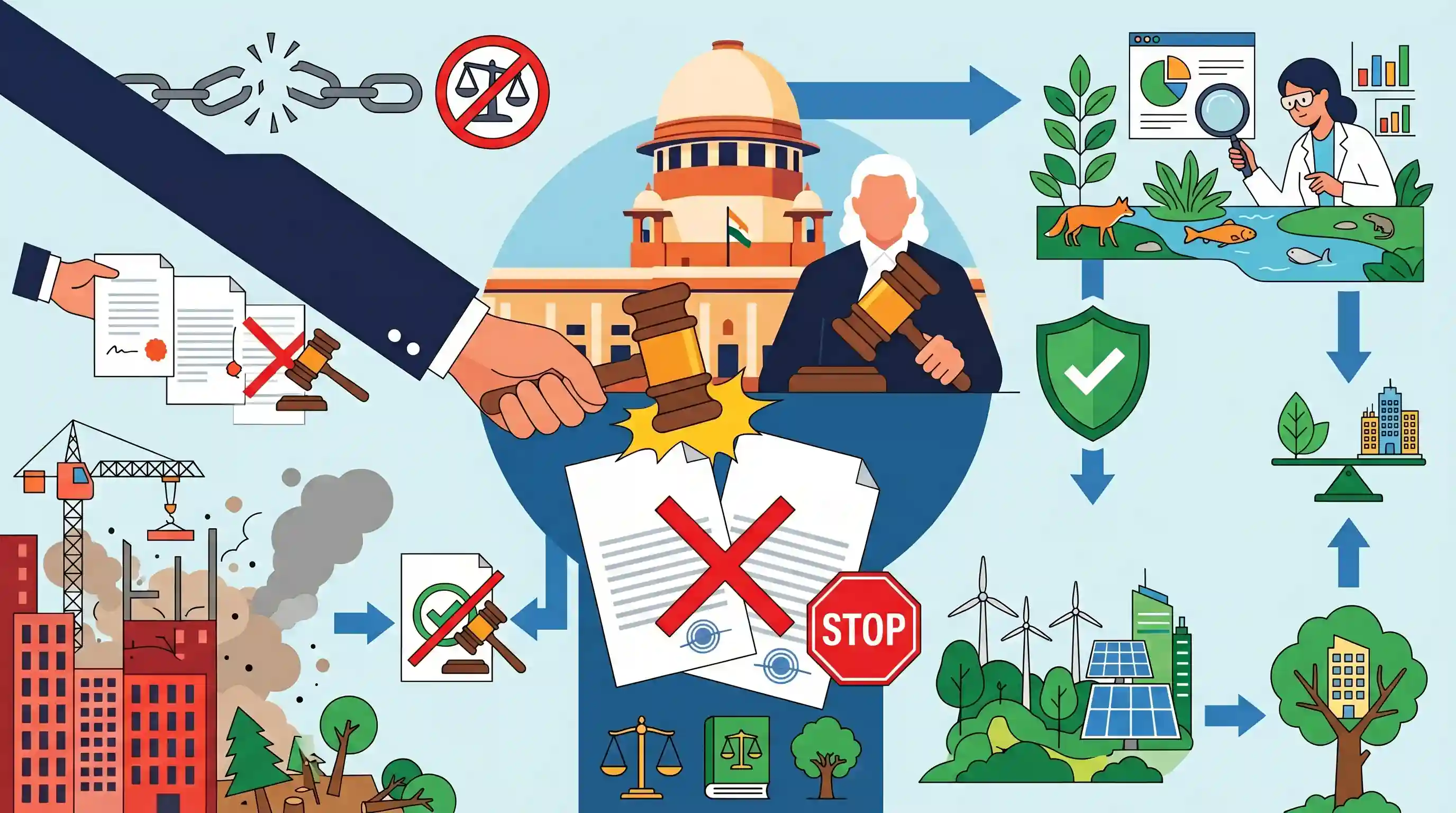
The Supreme Court of India has struck down government orders from 2017 and 2021 that permitted ex post facto (retrospective) Environmental Clearances (EC) for building projects and constructions. The Bench ruled that such retrospective clearances are a "gross illegality" and contradict fundamental environmental jurisprudence, including the Environmental Impact Assessment (EIA) Notification of 1994. The Court reiterated that prior environmental clearance is mandatory to properly assess the ecological consequences of any proposed development, asserting that economic development cannot come at the cost of the environment. However, clearances already granted under the struck-down orders will remain valid.
Key Points
- The Supreme Court struck down the Union government's 2017 notification and 2021 Office Memorandum that allowed ex post facto (retrospective) Environmental Clearances (ECs).
- The Court ruled that granting retrospective ECs is a "gross illegality" and violates the fundamental principles of environmental jurisprudence and the EIA Notification of 1994.
- Justices A.S. Oka and Ujjal Bhuyan emphasized that a prior EC is mandatory, as it involves a study of the likely environmental consequences before a project commences.
- The judgment noted that ex post facto clearances essentially regularise illegal constructions with retrospective effect, which contradicts the concept of sustainable development.
- ECs already granted under the 2017 notification and 2021 OM prior to this judgment will remain unaffected.
Important Terms
Environmental Impact Assessment (EIA)

A tool used to identify and evaluate the potential environmental, social, and economic impacts of a proposed project before a decision is made to proceed.
UPSC context
GS Paper III: Environment. Central to sustainable development and regulatory compliance for industrial/infrastructure projects.
Ex Post Facto Environmental Clearance
An environmental approval granted for a project that has already commenced construction or operation without obtaining the mandatory prior clearance.
UPSC context
GS Paper III: Environment/Governance. Tests understanding of judicial vs. executive stances on regularizing environmental violations.
Precautionary Principle
A legal doctrine stating that if an action has a suspected risk of causing harm to the environment, the burden of proof falls on those proposing the action.
UPSC context
GS Paper III: Environmental Ethics/Judiciary. A foundational principle often cited by the Supreme Court in environment cases.
EIA Notification 1994
The first legislative notification under the EPA 1986 that made Environmental Clearance (EC) mandatory for setting up new projects or expansion of activities in India.
UPSC context
GS Paper III: Environmental Legislation. Represents the origin of statutory environmental clearances in India.
Office Memorandum (OM)
An administrative order issued by a ministry to communicate policies or procedures; in this case, used by MoEFCC to establish SOPs for regularizing violations.
UPSC context
GS Paper II: Governance. Relevant for understanding the limits of executive power versus statutory environmental laws.
Environment (Protection) Act, 1986 (EPA)
India's umbrella environmental legislation that empowers the Central Government to protect and improve environmental quality and prevent pollution.
UPSC context
GS Paper III: Environmental Laws. The primary parent act under which all EIA notifications are issued.
Prelims Trap
"The Supreme Court revoked all environmental clearances previously granted under the 2017 and 2021 ex post facto policies."
The Supreme Court struck down the government orders but explicitly stated that clearances already granted under these policies prior to the judgment will remain valid.
Static Concepts Connected
What is the statutory framework governing Environmental Impact Assessments (EIA) in India?
- Legal Backing: EIA is statutorily backed by the Environment (Protection) Act, 1986.
- EIA Notification 2006: Decentralized the process. Category A projects require MoEFCC clearance, while Category B projects are cleared by State Environmental Impact Assessment Authorities (SEIAA).
- 4 Key Stages: Screening, Scoping, Public Consultation, and Appraisal. 'Prior' clearance before project commencement is fundamentally mandatory.
Which key doctrines form the bedrock of Indian environmental jurisprudence against ex-post facto approvals?
- Precautionary Principle: Lack of full scientific certainty cannot be used as a reason to postpone measures to prevent environmental degradation. Action must be anticipatory.
- Polluter Pays Principle: The financial burden of preventing or remedying pollution must lie with the polluting enterprise, not the state or society.
- Sustainable Development: Irreversible ecological damage cannot be compensated merely by paying a penalty after the fact, negating post-facto regularization.
Cross-Topic Patterns
Delegated Legislation vs. Parent Act
The 2017 and 2021 executive orders (delegated legislation) were struck down because they violated the preventive intent of the parent Environment (Protection) Act 1986, a classic Polity-Environment intersection.
Ease of Doing Business vs. Ecology
Government attempts to introduce post-facto clearances stem from a desire to prevent stalling large infrastructure and real-estate projects, highlighting the eternal GS3 friction between economic growth and ecological conservation.

EIA categorization (A vs B) and its statutory backing under the Environment Protection Act 1986 are prime 2026 Prelims targets.
Linked PYQs · 4
Linked PYQs · 4
- 2014MainsGS3
Environmental Impact Assessment studies are increasingly undertaken before a project is cleared by the Government. Discuss the environmental impacts of coal-fired thermal plants located at coal pitheads.
- 2020MainsGS3
How does the draft Environment Impact Assessment (EIA) Notification, 2020 differ from the existing EIA Notification, 2006?
- 2024MainsGS3
What role do environmental NGOs and activists play in influencing Environmental Impact Assessment (EIA) outcomes for major projects in India? Cite four examples with all important details.
- 2019MainsGS3
Define the concept of carrying capacity of an ecosystem as relevant to an environment. Explain how understanding this concept is vital while planning for sustainable development of a region.
