Supreme Court Upholds Animal Birth Control Rules for Stray Dogs
Source:Indian Express ↗
Why It Matters
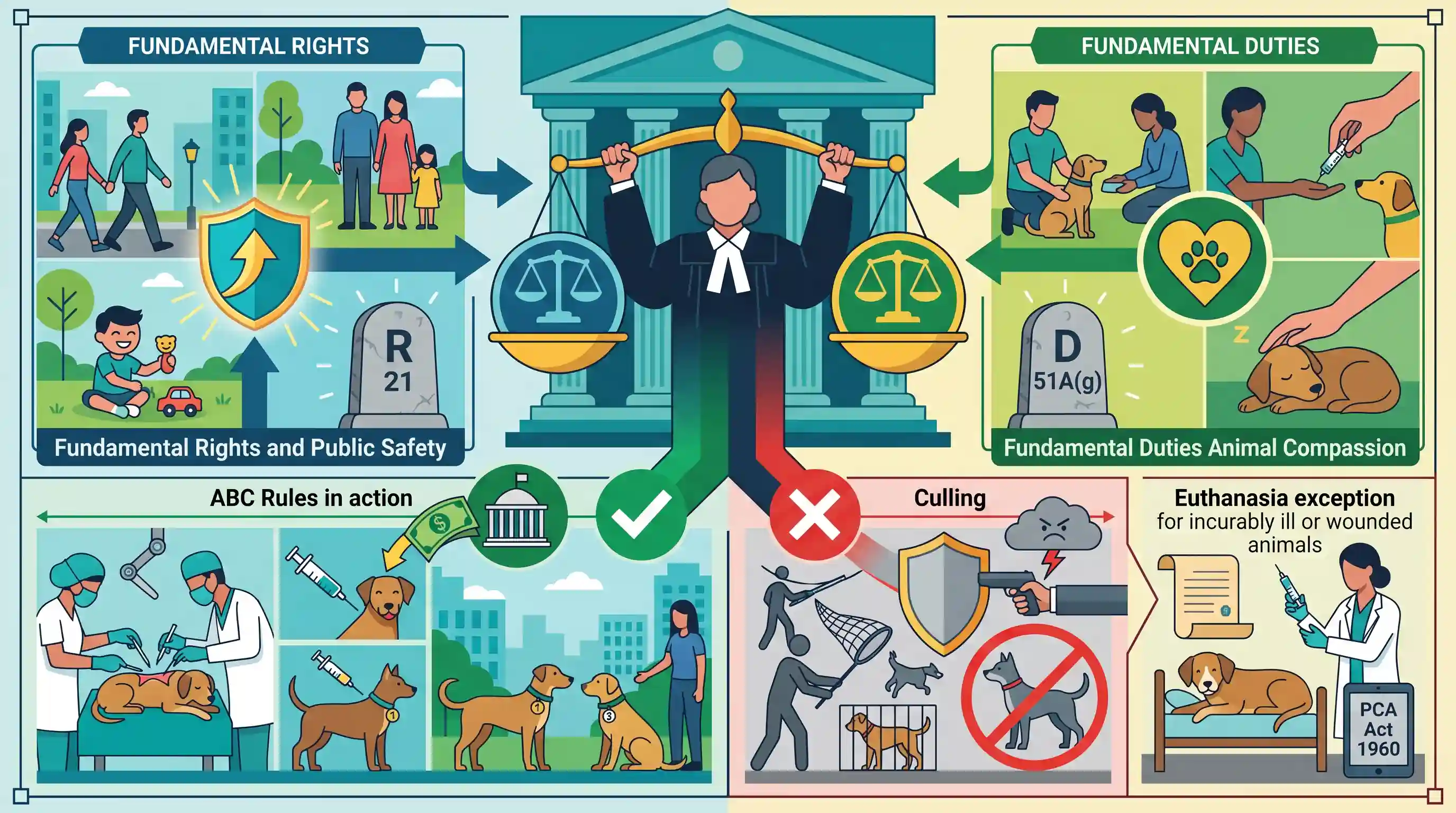
The ruling is a significant judicial interpretation of the expanding horizons of Article 21 (Right to Life) against Article 51A(g) (Fundamental Duties). It sets a nationwide legal precedent for urban governance and public health management concerning stray animals.
Summary
The Supreme Court of India has upheld the constitutional validity of the Animal Birth Control (ABC) Rules, 2023, highlighting the delicate balance between public safety and animal welfare. The judgment navigated the tension between a citizen's fundamental right to life and safe movement under Article 21, and the fundamental duty to exhibit compassion for living creatures under Article 51A(g). The Court reinforced that stray dog population control must be handled via sterilisation and vaccination rather than culling. Euthanasia remains legally permissible only under the strict conditions of the Prevention of Cruelty to Animals (PCA) Act, 1960, specifically for incurably ill or mortally wounded animals.
Key Points
- The Supreme Court upheld the Animal Birth Control (ABC) Rules, 2023, mandating states and union territories to implement them effectively.
- The verdict addressed the conflict between the fundamental right to life and safety (Article 21) and the fundamental duty of compassion toward living creatures (Article 51A(g)).
- Under the ABC Rules, stray dogs cannot be broadly culled for being a nuisance; population control must rely on catch, sterilise, vaccinate, and release programs.
- Euthanasia of stray dogs is strictly limited to cases where the animal is incurably ill or mortally wounded, per the Prevention of Cruelty to Animals Act, 1960.
Important Terms
Animal Birth Control (ABC) Rules, 2023

Rules notified under the PCA Act 1960, standardizing 'catch-neuter-vaccinate-return' (CNVR) protocols for stray dogs to humanely manage population and rabies.
UPSC context
GS Paper 2 & 3; tests statutory frameworks for animal welfare and human-animal conflict management.
Prevention of Cruelty to Animals (PCA) Act, 1960
A landmark 1960 central legislation enacted to prevent 'unnecessary pain or suffering' to animals and provide for their welfare.
UPSC context
GS Paper 3; foundational legislation for animal rights and biodiversity ethics.
Animal Welfare Board of India (AWBI)
Statutory advisory body established under the PCA Act 1960 to promote animal welfare and oversee implementation of animal protection laws.
UPSC context
GS Paper 2; tested regarding its statutory status, parent act, and nodal ministry.
Article 21
Fundamental Right guaranteeing protection of life and liberty, interpreted by the Supreme Court to include the right to safe movement in public spaces.
UPSC context
GS Paper 2; core concept tested through broad judicial interpretations of personal liberty.
Article 51A(g)
Fundamental Duty requiring Indian citizens to protect the natural environment and show compassion for all living creatures.
UPSC context
GS Paper 2; links civic responsibilities to environmental conservation and animal ethics.
Euthanasia
The act of humanely ending life, legally restricted under the PCA Act to animals that are incurably ill, mortally wounded, or dangerously rabid.
UPSC context
GS Paper 4; tests ethical dilemmas between public safety and the right to life for animals.
Prelims Trap
Municipalities can cull stray dogs for population control if they are declared a public nuisance.
The Supreme Court and ABC Rules strictly prohibit culling for population control or nuisance. Euthanasia is allowed only for incurably ill or mortally wounded animals.
Static Concepts Connected
What is the constitutional framework for animal welfare in India?
- Article 51A(g): Mandates a fundamental duty for every citizen to protect the natural environment and have explicit compassion for living creatures.
- Directive Principles: Directs the State to organize agriculture and animal husbandry on modern, scientific lines and preserve or improve breeds.
- Concurrent List: The subject "Prevention of cruelty to animals" falls under Entry 17 of the Concurrent List in the Seventh Schedule.
What is the Animal Welfare Board of India (AWBI)?
- Statutory Origin: Established in 1962 under Section 4 of the Prevention of Cruelty to Animals (PCA) Act, 1960. It is not under the Wildlife or Environment Protection Acts.
- Key Mandate: Acts as a primary statutory advisory body to the Government of India on animal welfare laws and promotes welfare.
Cross-Topic Patterns
Harmonising Fundamental Rights and Duties
SC uses Article 51A(g) to limit absolute anthropocentric rights under Article 21, mirroring environmental jurisprudence where duties to nature actively shape the scope of human rights.
Urban Governance & Zoonotic Diseases
Effective implementation of the ABC Rules links municipal civic management to India's public health goals, specifically targeting rabies eradication through the 'One Health' paradigm.

Expect a multi-statement question testing the statutory backing of the AWBI (PCA 1960) against constitutional duties (Art 51A(g)).
Linked PYQs · 3
Linked PYQs · 3
- 2023MainsGS2
“The Constitution of India is a living instrument with capabilities of enormous dynamism. It is a constitution made for a progressive society.” Illustrate with special reference to the expanding horizons of the right to life and personal liberty.
- 2024MainsGS2
Right to privacy is intrinsic to life and personal liberty and is inherently protected under Article 21 of the constitution. Explain. In this reference discuss the law relating to D.N.A. testing of child in the womb to establish its paternity.
- 2022PrelimsGS1
With reference to Indian laws about wildlife protection, consider the following statements : 1. Wild animals are the sole property of the government. 2. When a wild animal is declared protected, such animal is entitled for equal protection whether it is found in protected areas or outside. 3. Apprehension of a protected wild animal becoming a danger to human life is sufficient ground for its capture or killing. Which of the statements given above is/are correct?
