IAF Permanent Commission: Judicial Intervention for Gender Justice
Source:The Hindu ↗
Why It Matters
This case is a key development in the ongoing legal and institutional discourse regarding gender parity and equal opportunity in the Indian Armed Forces. It provides a contemporary example of case law enforcing constitutional perspectives of gender justice, relevant for answers on women's empowerment and fundamental rights.
Summary
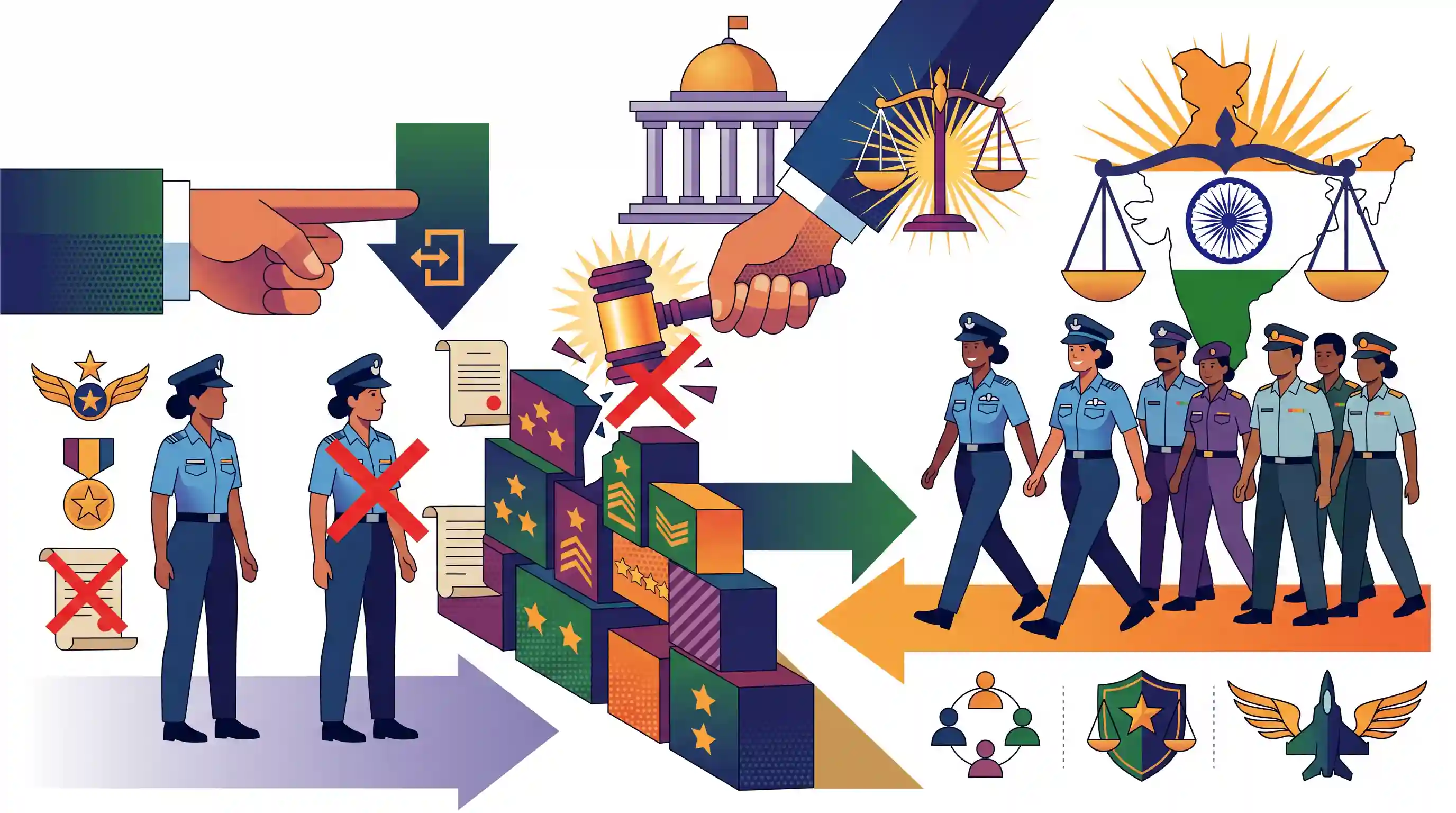
The Supreme Court of India has intervened to stop the Centre and the Indian Air Force (IAF) from releasing Wing Commander Kavita Bhati from service after she was denied a Permanent Commission. A bench led by Chief Justice Sanjiv Khanna found her case similar to that of Wing Commander Niketa Pandey, an outstanding officer involved in Operation Balakot, who also faced denial of a Permanent Commission. The judicial intervention underscores the continued legal battles and scrutiny over gender parity, equality of opportunity, and the evaluation standards applied to women officers seeking a Permanent Commission in the armed forces.
Key Points
- The Supreme Court has stayed the release of Wing Commander Kavita Bhati from the Indian Air Force after she was denied a Permanent Commission.
- The Court noted that Bhati's case mirrors that of Wing Commander Niketa Pandey, who was also denied a Permanent Commission despite her exemplary service.
- Niketa Pandey was notably a part of critical missions, including Operation Balakot and Operation Sindoor.
- The case highlights ongoing judicial scrutiny over the evaluation metrics and potential systemic discrimination in granting Permanent Commissions to women officers in the armed forces.
Important Terms
Permanent Commission (PC)

A career path in the Indian Armed Forces allowing officers to serve until retirement with full pension benefits, as opposed to the fixed-tenure Short Service Commission.
UPSC context
GS Paper 2 (Gender Justice/Judiciary). Tests understanding of institutional reforms and substantive equality for women in the military.
Operation Sindoor
A 2025 Indian Air Force precision strike operation targeting terror infrastructure in Pakistan following an attack in Pahalgam, characterized by calibrated force and minimal escalation.
UPSC context
GS Paper 3 (Security). Relevant for analyzing India’s evolving air power doctrine and strategic response to cross-border terrorism.
Operation Balakot
The 2019 aerial strike conducted by the Indian Air Force against Jaish-e-Mohammad camps in Balakot, Pakistan, following the Pulwama terror attack.
UPSC context
GS Paper 3 (Internal Security). Tests knowledge of India's counter-terrorism strategy and recent military history.
Supreme Court of India
The highest judicial authority in India, serving as the guardian of Fundamental Rights and final interpreter of the Constitution.
UPSC context
GS Paper 2 (Polity). Tests understanding of judicial intervention to uphold Articles 14 and 16 regarding gender parity.
Indian Air Force (IAF)
The air arm of the Indian Armed Forces tasked with aerial warfare and securing national airspace; currently undergoing major policy shifts regarding gender inclusion.
UPSC context
GS Paper 3 (Security). Relevant for defense modernization and the implementation of gender-neutral service conditions.
Ministry of Defence
The administrative body responsible for national security and the Armed Forces; it manages service policies and legal responses in military service litigations.
UPSC context
GS Paper 2 (Governance). Tests knowledge of the executive’s role in defense administration and civil-military relations.
Prelims Trap
Women officers are now mandated by the Supreme Court to receive Permanent Commission across all combat arms.
The Babita Puniya (2020) judgment mandated Permanent Commission in non-combat branches where women were already serving on SSC, not universally across pure combat units like Infantry.
Static Concepts Connected
What distinguishes a Permanent Commission (PC) from a Short Service Commission (SSC)?
- Tenure: SSC officers typically serve for 10-14 years, whereas PC guarantees service until the age of superannuation (retirement).
- Pension Benefits: PC ensures full pensionary benefits upon retirement. SSC officers do not receive full pensionary benefits upon release after 14 years.
- Command Appointments: PC enables officers to achieve higher ranks and holds the legal entitlement to hold command appointments, critical for career parity.
What is the doctrine of "indirect discrimination" in Indian constitutional law?
- Facially Neutral: Policies or criteria that appear neutral on paper but disproportionately disadvantage a specific marginalized group in practice.
- Nitisha Case (2021): In the Lt. Col. Nitisha (2021) case, the SC ruled that evaluating older women officers with medical standards meant for younger men was systemically biased.
- Discriminatory Impact: It shifts the constitutional focus (Article 15) from proving discriminatory intent to demonstrating the discriminatory impact of institutional structures.
Cross-Topic Patterns
Judicial Review vs Military Policy
SC's intervention into defense HR policies tests the boundaries of judicial review, balancing Article 14/16 equality rights against the executive's traditional domain over military structuring and operations.
Glass Ceilings & Facially Neutral Rules
Evaluation metrics in the military (like delayed fitness tests) mirror systemic biases in the civilian sector, connecting GS1 women's empowerment themes to GS2 constitutional justice.

GS2 Mains 2026: Analyze how judicial rulings (Babita Puniya, Nitisha) expanded Article 15 to counter indirect discrimination in the military.
Linked PYQs · 2
Linked PYQs · 2
- 2023MainsGS2
Explain the constitutional perspectives of Gender Justice with the help of relevant Constitutional Provisions and case laws.
- 2019MainsGS1
What are the continued challenges for women in India against time and space?
