Supreme Court Stay on Tree Felling in Hyderabad Forest Area
Source:The Hindu ↗
Why It Matters
This article serves as a prime case study for Mains GS3 (Environmental Impact Assessment, balancing urbanization with conservation) and GS2 (Constitutionalization of environmental issues and the Supreme Court's proactive interventions). It demonstrates the critical role of civil society (university students/conservationists) and the judiciary in enforcing environmental laws against aggressive state-led infrastructural projects.
Summary
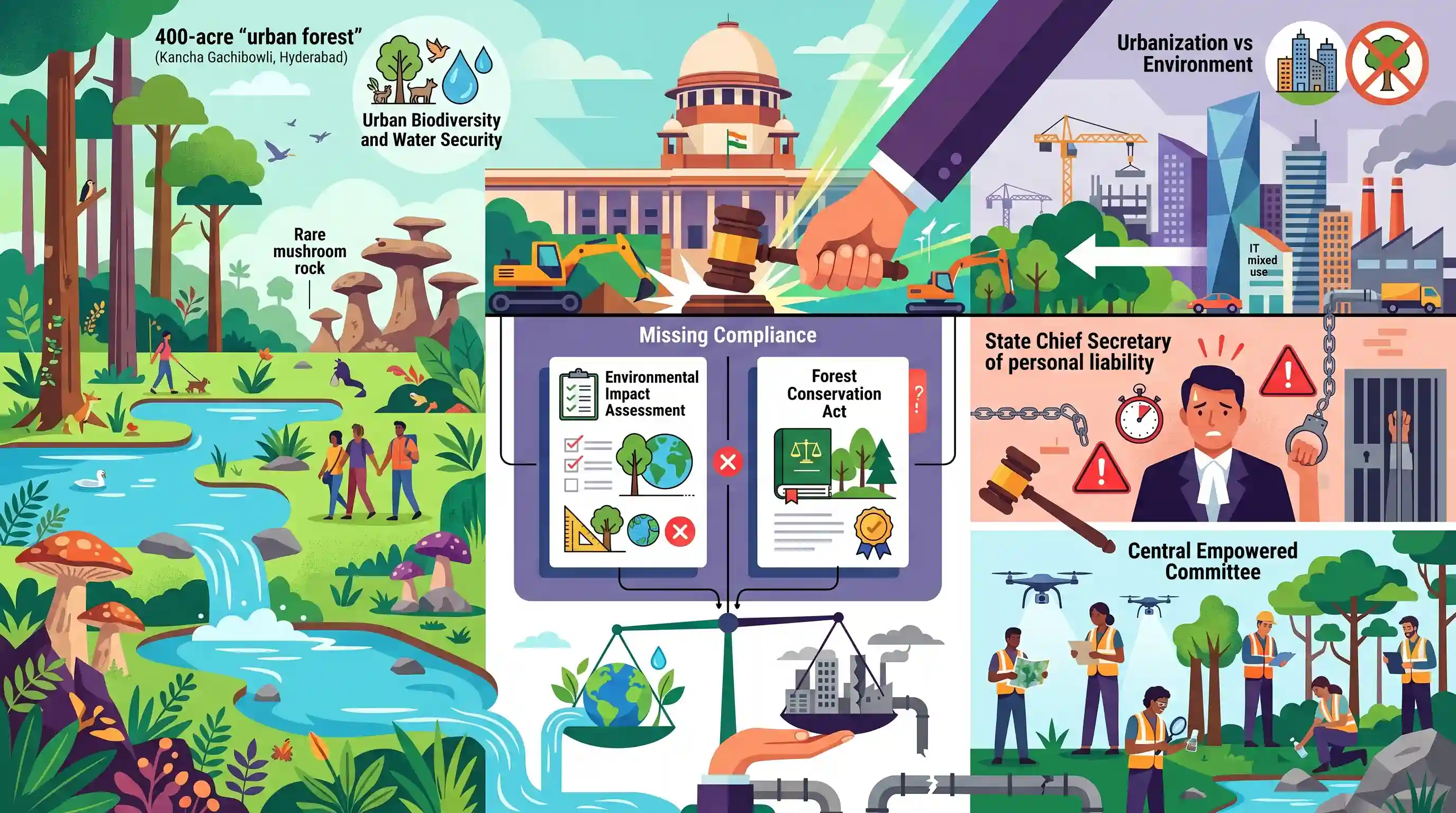
The Supreme Court of India intervened suo motu to halt the destruction of a 400-acre urban "forest" in Kancha Gachibowli, Hyderabad, which the Telangana government had slated for an IT and mixed-use development project. Recognizing the area's rich biodiversity—including rare mushroom rock formations and critical drinking water catchment lakes—the Court demanded accountability for the lack of an Environmental Impact Assessment (EIA) and requisite clearances under the Forest Conservation Act. Warning the State Chief Secretary of personal liability and potential imprisonment, the Court directed the Central Empowered Committee to investigate the site. This case underscores the ongoing friction between rapid urbanization and environmental conservation, as well as the judiciary's active role in enforcing ecological protections.
Key Points
- The Supreme Court took suo motu cognizance to stay tree-felling across 100 acres of a 400-acre land parcel in Kancha Gachibowli, Hyderabad, which was allocated to TGIIC for an IT project.
- The contested land is an ecologically sensitive urban "forest" featuring diverse wildlife, two-billion-year-old mushroom rock formations, and vital drinking water catchment bodies like Peacock Lake and Buffalo Lake.
- The Supreme Court bench sharply questioned the Telangana government on whether an Environmental Impact Assessment (EIA) was conducted and if requisite permissions under the Forest Conservation Act were obtained.
- Issuing a stern warning, the Court held that the State Chief Secretary could face imprisonment for ignoring the Van (Sanrakshan Evam Samvardhan) Rules, 2023, regarding expert committee formation for forest identification.
- The Central Empowered Committee (CEC) has been directed to inspect the site and submit a report, highlighting the judiciary's proactive role in curbing ecologically destructive urban development.
Important Terms
Forest Conservation Act, 1980

Primary legislation regulating the diversion of forest land for non-forestry purposes, requiring mandatory prior approval from the Central Government.
UPSC context
GS Paper III: Environmental Conservation. It is the central legal pillar for preventing arbitrary deforestation by state governments.
Van (Sanrakshan Evam Samvardhan) Rules, 2023
Procedural rules notified following the 2023 amendment to streamline forest clearances and align forest management with India's Net Zero and carbon sink targets.
UPSC context
GS Paper III: Environment. Tests understanding of the shift from the 1980 framework to the 2023 "augmentation" focus.
Environmental Impact Assessment (EIA)
A statutory process under the Environment (Protection) Act, 1986, to identify, predict, and mitigate the ecological and social impacts of proposed developmental projects.
UPSC context
GS Paper III: Impact Assessment. A high-utility topic for both Prelims (process) and Mains (governance debates).
Central Empowered Committee (CEC)
A statutory expert body that assists the Supreme Court in monitoring compliance with environmental orders and conducting field inspections of disputed forest sites.
UPSC context
GS Paper II: Statutory/Regulatory Bodies. Essential for understanding the institutional framework of environmental monitoring in India.
Suo Motu Cognizance
The power of the judiciary to take up a matter on its own motion, without a formal petition, typically triggered by media reports.
UPSC context
GS Paper II: Judiciary. Highlights judicial activism and the court's role as a guardian of the public interest and environment.
T.N. Godavarman Case (1996)
A landmark judgment that expanded the scope of forest protection to include any land matching the dictionary definition of "forest," regardless of ownership.
UPSC context
GS Paper III: Environment. Critical legal precedent for identifying and protecting "deemed forests" from industrial encroachment.
Sustainable Development
Development that balances economic growth with environmental protection to ensure that resources remain available for future generations.
UPSC context
GS Paper III: Economic & Environmental Development. The standard guiding principle for adjudicating infrastructure vs. ecology conflicts.
Compensatory Afforestation
A mandatory mitigation measure requiring afforestation on alternative land to replace the ecosystem services lost when forest land is diverted for projects.
UPSC context
GS Paper III: Conservation. Relates to the "Polluter Pays" principle and the management of the CAMPA fund.
Prelims Trap
"The 2023 Forest Amendment Act removes all central protections for unrecorded, unclassed urban 'forest-like' tracts."
This is false. The Supreme Court has clarified that the broad 'dictionary definition' of forests (Godavarman, 1996) still applies until states finalize their Expert Committee reports.
Static Concepts Connected
What is the origin and statutory status of the Central Empowered Committee (CEC)?
- Judicial Origin: Formed by the Supreme Court in 2002 under the Godavarman case to monitor and ensure compliance with judicial forest conservation orders.
- Statutory Upgrade: Notified as a permanent statutory body in 2023 under the Environment (Protection) Act, 1986 by the MoEFCC.
- Shift in Control: The 2023 notification transferred administrative control to the Central Government, which now nominates its members, replacing SC appointments.
How are 'Mushroom Rocks' (Pedestal Rocks) geomorphologically formed?
- Aeolian Erosion: Formed primarily by wind (aeolian) abrasion in arid and semi-arid regions where wind-blown sand acts as a powerful abrasive agent.
- Differential Erosion: Wind carries heavier sand particles closer to the ground, eroding the softer lower rock base faster than the harder, resistant top cap.
Cross-Topic Patterns
Urban Wetlands & Flood Management
The loss of catchment bodies like Peacock Lake ties directly into the recurring GS1/GS3 theme of urban flooding caused by the concretization of natural wetlands and drainage basins.
Geo-Heritage Legislation gaps
Protecting 2-billion-year-old rock formations highlights the gap in India's legal framework for Geo-Heritage Sites, which currently relies on fragmented broader environmental or ASI laws.

Expect a 2026 Prelims question mapping the statutory evolution of the CEC alongside the 'dictionary definition' of forests under FCA 2023.
Linked PYQs · 3
Linked PYQs · 3
- 2022MainsGS2
“The most significant achievement of modern law in India is the constitutionalization of environmental problems by the Supreme Court.” Discuss this statement with the help of relevant case laws.
- 2024MainsGS3
What role do environmental NGOs and activists play in influencing Environmental Impact Assessment (EIA) outcomes for major projects in India? Cite four examples with all important details.
- 2020MainsGS3
How does the draft Environment Impact Assessment (EIA) Notification, 2020 differ from the existing EIA Notification, 2006?
