Supreme Court Stays High Court Transgender Law Pleas
Source:The Hindu ↗
Why It Matters
This development is critical for GS2 as it intersects fundamental rights (Article 21, self-perceived gender identity), the welfare of vulnerable sections (Transgender Persons Act), and judicial processes (Supreme Court's power to transfer cases from High Courts to ensure constitutional uniformity). It highlights the ongoing tension between legislative measures and landmark judicial precedents like the NALSA judgment.
Summary
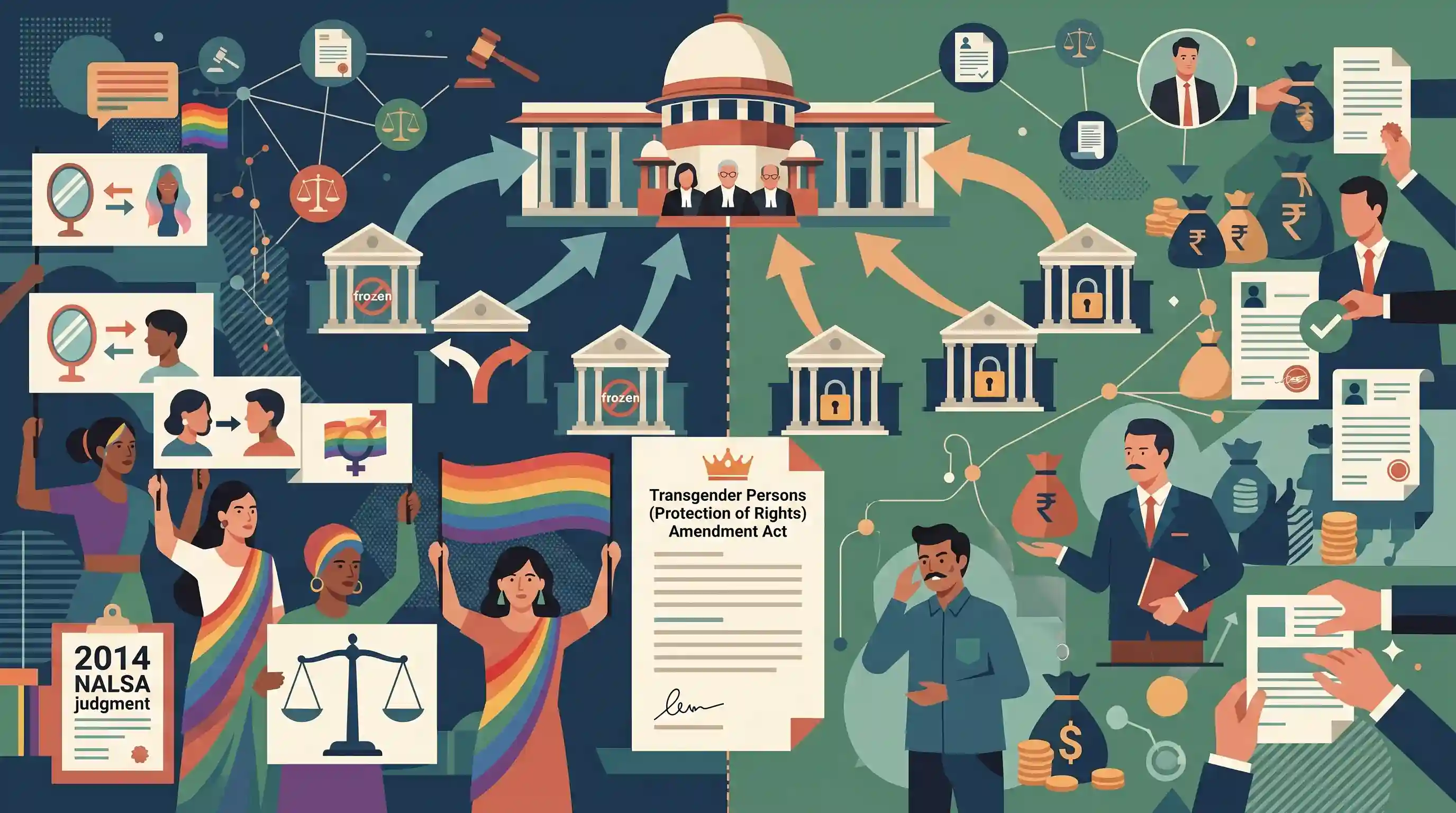
The Supreme Court stayed proceedings across multiple High Courts concerning challenges to the Transgender Persons (Protection of Rights) Amendment Act, 2026. The Centre successfully sought the transfer of these cases to the apex court to avoid conflicting verdicts. The legal battle centers on petitioners' claims that the 2026 amendment undermines the 2014 NALSA judgment, which recognized self-perceived gender identity as a fundamental right under Article 21. Conversely, the government, supported by remarks from Chief Justice Surya Kant, argues the amendment prevents individuals from falsely claiming transgender status to access reservation benefits. The Solicitor General has requested a three-judge Bench for the hearings.
Key Points
- The Supreme Court has stayed all proceedings in various High Courts regarding challenges to the constitutional validity of the Transgender Persons (Protection of Rights) Amendment Act, 2026.
- The Centre filed a transfer petition to bring all such cases to the Supreme Court to prevent diverging judgments from different High Courts.
- Petitioners argue that the 2026 amendment violates the landmark 2014 NALSA judgment, which established the right to self-perceived gender identity as a fundamental right.
- Solicitor General Tushar Mehta suggested the matter be heard by a three-judge Bench, as the NALSA judgment was delivered by a two-judge Bench.
- Chief Justice Surya Kant noted the government's concern that the amendment is necessary to prevent individuals from 'masquerading' as transgender to wrongfully claim reservation benefits.
Important Terms
Transgender Persons (Protection of Rights) Amendment Act, 2026

A 2026 law amending the 2019 Act, reportedly narrowing the transgender definition to socio-cultural identities and mandating medical certification for legal recognition, replacing the previous self-identification model.
UPSC context
GS Paper II: Social Justice and Government Policies. Tests understanding of legislative changes affecting vulnerable sections and gender rights.
NALSA Judgment (2014)
Landmark Supreme Court ruling recognizing transgender persons as the 'third gender' and affirming their fundamental right to self-determine gender identity under Articles 14, 19, and 21.
UPSC context
GS Paper II: Judiciary and Constitutional Rights. A must-know precedent for gender justice and judicial activism.
Article 139A
Constitutional provision allowing the Supreme Court to withdraw cases from High Courts to itself if they involve similar 'substantial questions of law' of general importance.
UPSC context
GS Paper II: Indian Judiciary. Tests knowledge of SC's extraordinary jurisdictions and judicial efficiency mechanisms.
Self-perceived Gender Identity
A person's internal sense of their own gender, which the SC recognized in NALSA as a fundamental right tied to dignity and privacy under Article 21.
UPSC context
GS Paper II: Fundamental Rights. Relevant for debates on personal liberty, privacy (Puttaswamy), and identity-based rights.
Transfer Petition
A procedural request made to the Supreme Court to move a case between courts to ensure uniformity of justice or resolve conflicting verdicts across different states.
UPSC context
GS Paper II: Judiciary. Pertains to judicial processes used by the Union to consolidate legal challenges in the apex court.
Prelims Trap
"The NALSA judgment mandated a medical board to verify transgender identity to prevent false reservation claims."
NALSA established self-perceived identity under Article 21. The medical board is a contentious feature of the 2026 Amendment Act, not the NALSA judgment.
Static Concepts Connected
Under what conditions can the Supreme Court withdraw cases from High Courts?
- Article 139A: Article 139A allows the Supreme Court to transfer cases pending before one or more High Courts to itself.
- Substantial question: It applies when cases involve the same or substantially the same questions of law of general public importance.
- Initiation: The SC can act suo motu, or on an application by the Attorney General of India, or by a party to any such case.
What are the core constitutional mandates of the NALSA (2014) judgment?
- Third Gender recognition: Legally recognized transgender persons as a distinct 'third gender' eligible for full constitutional protection.
- Article 21 protection: Ruled that the right to self-perceived gender identity is a fundamental right inherent to personal autonomy and dignity.
- SEBC status: Directed the government to treat transgender individuals as Socially and Educationally Backward Classes (SEBCs) and extend reservation benefits.
Cross-Topic Patterns
Transgender rights & SEBC quota complexities
The intersection of gender identity and affirmative action creates legal friction, mirroring ongoing debates about horizontal versus vertical reservations for marginalized communities and women.
Article 139A and centralization of judicial review
The Centre increasingly utilizes Article 139A to bypass fragmented High Court scrutiny on sensitive legislation (like IT Rules, CAA, and this Act), consolidating constitutional review directly in the Supreme Court.

Expect a multi-statement Prelims question contrasting the NALSA 'self-determination' principle with the 2026 Act's medical board mandate.
Linked PYQs · 3
Linked PYQs · 3
- 2023MainsGS2
Explain the constitutional perspectives of Gender Justice with the help of relevant Constitutional Provisions and case laws.
- 2023MainsGS2
Who are entitled to receive free legal aid? Assess the role of the National Legal Services Authority (NALSA) in rendering free legal aid in India.
- 2024PrelimsGS1
Under which of the following Articles of the Constitution of India, has the Supreme Court of India placed the Right to Privacy ?
