Supreme Court stays High Court proceedings on transgender welfare law
Source:The Hindu ↗
Why It Matters
This issue lies at the intersection of fundamental rights (Article 21), gender justice, and judicial administration. It demonstrates the tension between the landmark NALSA judgment's guarantee of self-identified gender and state regulations to prevent exploitation of welfare schemes.
Summary
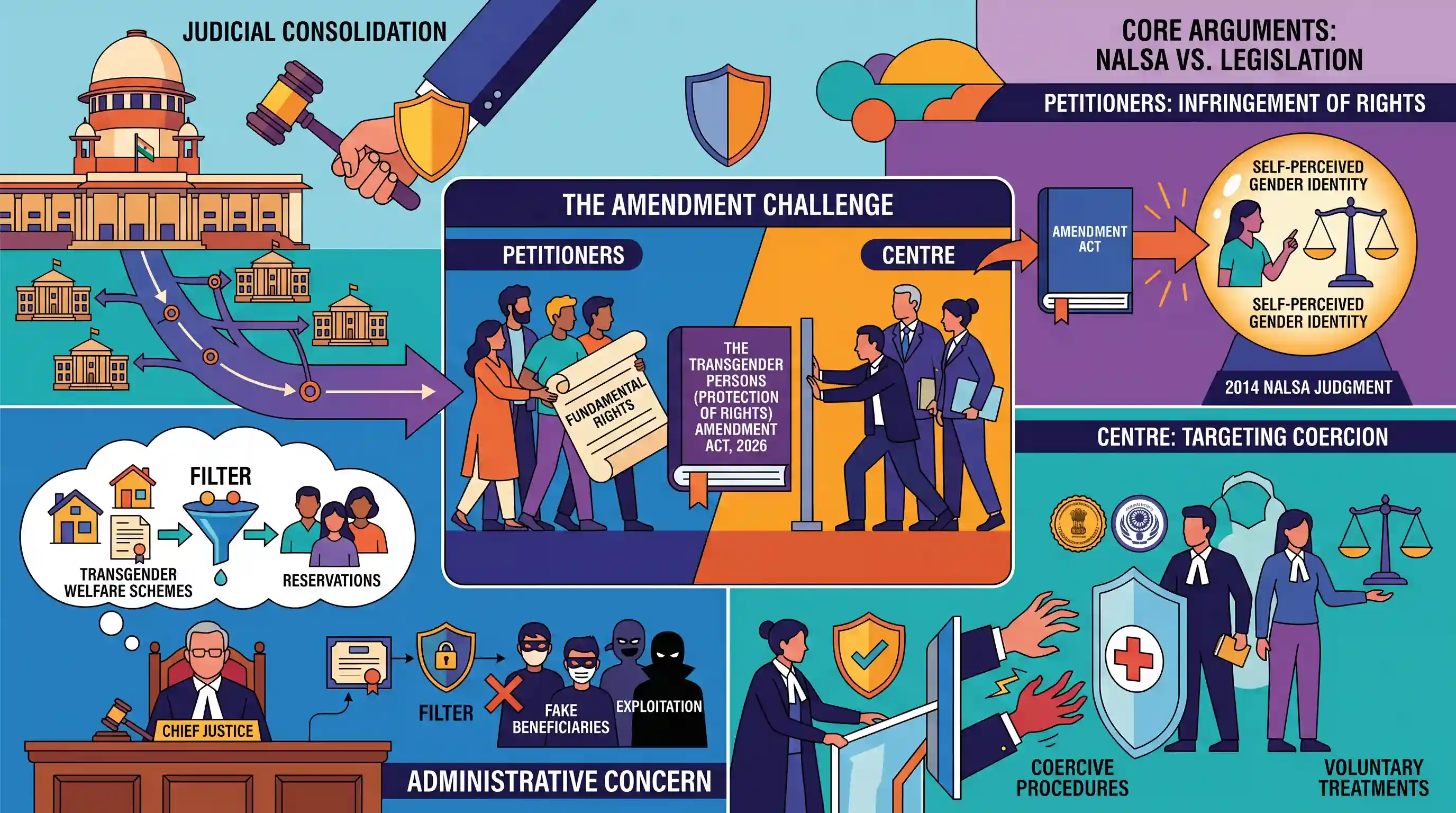
The Supreme Court of India has stayed multiple High Court proceedings challenging the Transgender Persons (Protection of Rights) Amendment Act, 2026, consolidating the cases to avoid conflicting judicial decisions. Petitioners argue the amendment infringes upon the 2014 NALSA judgment's recognition of self-perceived gender identity as a fundamental right. The Centre counters that the legislation specifically targets coercive procedures rather than voluntary treatments. The case also brings to light administrative concerns, with the Chief Justice noting the challenge of preventing fake beneficiaries from exploiting transgender welfare schemes and reservations.
Key Points
- The Supreme Court stayed proceedings in four High Courts challenging the constitutional validity of the Transgender Persons (Protection of Rights) Amendment Act, 2026.
- The Centre requested the transfer of all petitions to the Supreme Court to prevent 'divergence of views' and conflicting judgments among High Courts.
- Petitioners argue the 2026 amendment undermines the 2014 NALSA judgment by omitting the fundamental right to self-perceived gender identity.
- The Centre defends the amendment, stating it aims to regulate forced medical procedures rather than restricting voluntary gender-affirming treatments.
- The Chief Justice highlighted the administrative challenge of individuals 'masquerading' as transgender to unfairly claim welfare benefits and reservations meant for genuine beneficiaries.
Important Terms
NALSA judgment

Landmark 2014 Supreme Court ruling recognizing transgender individuals as the "third gender." It affirmed that the right to self-perceived gender identity is a fundamental right under Articles 14, 19, and 21.
UPSC context
GS Paper II (Social Justice/Judiciary). Tests understanding of LGBTQIA+ rights and judicial interpretation of fundamental rights.
Self-perceived gender identity
An individual's innate psychological sense of their own gender, independent of biological sex. The Supreme Court considers this a core component of personal autonomy, dignity, and liberty.
UPSC context
GS Paper II (Fundamental Rights). Relevant for debates on the boundaries between individual rights and state regulation.
Transgender Persons (Protection of Rights) Amendment Act, 2026
A (2026) legislative update to transgender rights law, challenged for introducing medical board certification and allegedly diluting the "self-identification" standard established by the NALSA ruling.
UPSC context
GS Paper II (Social Justice/Welfare Mechanisms). Evaluates legislative compliance with judicial precedents for vulnerable sections.
Article 139A (Transfer Petition)
A constitutional provision (Article 139A) allowing the Supreme Court to withdraw cases involving "substantial questions of law" from High Courts to ensure judicial uniformity and avoid conflicting decisions.
UPSC context
GS Paper II (Judiciary). Essential for understanding the Supreme Court’s powers and the integrated nature of India's judicial system.
Fake beneficiaries
The state's administrative challenge of preventing ineligible persons from misusing affirmative action (reservations) and social security benefits designed specifically for the transgender community.
UPSC context
GS Paper II (Welfare Schemes/Governance). Highlights implementation hurdles in targeted delivery of benefits to marginalized groups.
Prelims Trap
"The Supreme Court can transfer pending cases from High Courts only upon the request of the Attorney General."
Under Article 139A, the Supreme Court can withdraw cases involving identical questions of law suo motu, or via application by a party, not just the AG.
Static Concepts Connected
What are the Supreme Court's case transfer powers under Article 139A?
- Substantial question of law: The SC can withdraw cases pending in one or more HCs if they involve the same substantial question of law of general importance.
- Initiation mechanism: The transfer can be initiated suo motu, on the application of the Attorney General of India, or by a party to the case.
- Inter-HC transfers: The SC is also empowered to transfer any case from one High Court to another to serve the ends of justice.
What were the core directives of the NALSA vs. Union of India (2014) judgment?
- Third Gender recognition: Legally recognized transgender persons as a distinct 'third gender' for the purpose of safeguarding their rights under Part III of the Constitution.
- Article 21 mandate: Declared that the right to self-perceived gender identity is an intrinsic part of the right to life, dignity, and personal liberty.
- SEBC Status: Directed the Centre and States to treat transgender persons as Socially and Educationally Backward Classes (SEBC) and extend welfare and reservation benefits.
Cross-Topic Patterns
Judicial consolidation vs High Court autonomy
Consolidating cases at the SC ensures uniformity but bypasses the filtering benefit of diverse High Court interpretations, a frequent debate in judicial federalism and constitutional bench formations.
Welfare targeting and ghost beneficiaries
The CJI's concern over fake beneficiaries exploiting transgender quotas mirrors GS2/GS3 themes of inclusion/exclusion errors in DBT, PDS, and the friction between rigorous certification and self-declaration.

Expect a multi-statement Prelims question merging Article 139A case-transfer powers with the NALSA judgment's SEBC directives.
Linked PYQs · 2
Linked PYQs · 2
- 2023MainsGS2
Explain the constitutional perspectives of Gender Justice with the help of relevant Constitutional Provisions and case laws.
- 2023MainsGS2
Who are entitled to receive free legal aid? Assess the role of the National Legal Services Authority (NALSA) in rendering free legal aid in India.
