Supreme Court stays Madras High Court order on university appointments
Source:The Hindu ↗
Why It Matters
This case is highly relevant for UPSC aspirants as it underscores the ongoing friction between elected State governments and Governors regarding the administration of state universities (Chancellor role vs State autonomy). It also highlights important procedural concepts in law, such as the 'reasonable opportunity of being heard' (Audi alteram partem) in judicial proceedings.
Summary
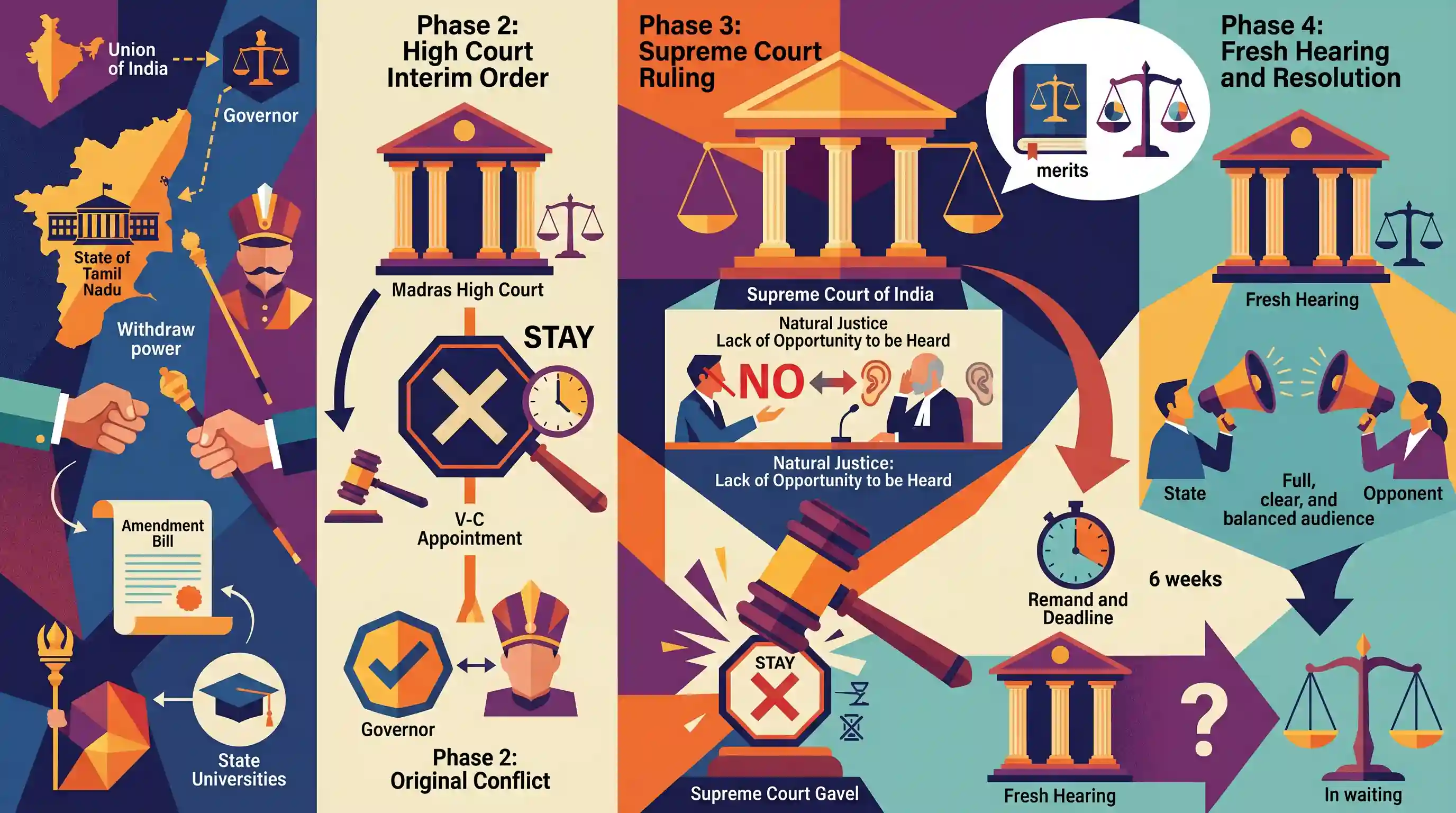
The Supreme Court has stayed a Madras High Court interim order that halted the Tamil Nadu government's amended provision empowering it to appoint Vice-Chancellors to State-run universities instead of the Governor. A Bench led by CJI Surya Kant set aside the High Court's stay primarily on technical grounds, noting that the State was not granted a reasonable opportunity to be heard. The apex court clarified that its ruling does not touch upon the merits of the legislative conflict and remanded the matter back to the Madras High Court for a fresh hearing, to be concluded within six weeks.
Key Points
- The Tamil Nadu government amended provisions to empower itself to appoint Vice-Chancellors to State-run universities, transferring this power away from the Governor.
- In May 2025, a vacation Bench of the Madras High Court passed an interim order staying this amended provision.
- The Supreme Court, led by CJI Surya Kant, set aside the Madras HC's interim stay on technical grounds without addressing the merits of the case.
- The SC observed that the State of Tamil Nadu was not provided a 'reasonable opportunity of being heard', emphasizing the principles of natural justice.
- The case has been remanded back to the Madras High Court with a request to hear and decide it afresh within six weeks.
Important Terms
Governor as Chancellor

The Governor acts as the ex-officio head of state universities, exercising statutory powers to appoint Vice-Chancellors and oversee administration, often independently of the State Cabinet's advice.
UPSC context
GS II (Polity): Tests statutory vs. constitutional powers and gubernatorial discretion causing federal friction.
Centre-State Relations
The constitutional division of legislative, administrative, and financial powers between the Union and States, currently strained by disputes over university governance and gubernatorial roles.
UPSC context
GS II (Federalism): Core topic evaluating the Governor’s dual role as a constitutional head and a central link.
Principles of Natural Justice
Fundamental legal requirements for fairness, primarily 'Audi Alteram Partem' (right to be heard), ensuring that no party is condemned or their laws stayed without a fair hearing.
UPSC context
GS II & IV: Tests legal fairness, administrative law, and safeguards against arbitrary judicial or executive actions.
Vice-Chancellor (VC)
The principal executive and academic head of a university; the appointment process is a frequent flashpoint between State legislatures and Chancellors (Governors).
UPSC context
GS II (Governance): Examines educational administration and the conflict between State laws and central guidelines.
UGC Regulations
Centralized standards for higher education that often conflict with State-specific university laws, leading to legal disputes over legislative competence and Article 254 (Repugnancy).
UPSC context
GS II (Federalism): Focuses on conflicts between Union guidelines and State laws under the Concurrent List.
Interim Order
A temporary judicial directive issued during a pending case to maintain the status quo; here, the SC vacated one for bypassing procedural fairness.
UPSC context
GS II (Judiciary): Evaluates understanding of judicial process and the limits of courts in staying duly enacted laws.
Prelims Trap
"The Governor acts as the Chancellor of state universities by virtue of a Constitutional mandate."
The role of Chancellor is a statutory position created by individual State University Acts, not a Constitutional mandate. State legislatures can legally amend these Acts to remove this power.
Static Concepts Connected
How does the Governor's role as Chancellor differ from their role as Constitutional Head?
- Statutory Role: Derived from State University Acts passed by the legislature, not from the Constitution of India.
- Aid & Advice: The Supreme Court ruled that as Chancellor, the Governor acts independently and is not bound by the Council of Ministers' 'aid and advice' under Article 163.
- Legislative Competence: Because it is a statutory role, State Legislatures have the competence to amend the law and transfer the appointing authority to the State Government.
How do Vice-Chancellor appointments differ between Central and State Universities?
- Central Universities: The President of India acts as the 'Visitor' and appoints VCs through search committees formed by the Union government.
- State Universities: The Governor typically acts as the 'Chancellor' and appoints VCs, unless state statutes are explicitly amended to empower the state government (e.g., Tamil Nadu, West Bengal).
Cross-Topic Patterns
Concurrent List friction in Higher Education
Education is in the Concurrent List (Entry 25). Clashes frequently arise when State University Acts regarding Vice-Chancellor appointments conflict with central UGC regulations, triggering Article 254 (repugnancy) debates.
Natural Justice in Judicial Reviews
The SC stayed the HC order purely because the State wasn't heard. This highlights 'Audi Alteram Partem' (hear the other side) as a non-negotiable threshold for interim judicial orders.

Expect a multi-statement Prelims question contrasting the Governor's statutory powers as Chancellor with constitutional discretionary powers.
Linked PYQs · 4
Linked PYQs · 4
- 2022MainsGS2
Discuss the essential conditions for exercise of the legislative powers by the Governor. Discuss the legality of re-promulgation of ordinances by the Governor without placing them before the Legislature.
- 2018MainsGS2
Whether the Supreme Court Judgement (July 2018) can settle the political tussle between the Lt. Governor and elected government of Delhi? Examine.
- 2024MainsGS2
What changes has the Union Government recently introduced in the domain of Centre-State relations ? Suggest measures to be adopted to build the trust between the Centre and the States and for strengthening federalism.
- 2020MainsGS2
Judicial Legislation is antithetical to the doctrine of separation of powers as envisaged in the Indian Constitution. In this context justify the filing of large number of public interest petitions praying for issuing guidelines to executive authorities.
