State Government Recruitment Drives and Judicial Oversight
Source:The Hindu ↗
Why It Matters
This case is a classic example of the friction between judicial intervention and executive functioning. It highlights how blanket stays or injunctions by High Courts on administrative processes (like state recruitment) can stall governance, and demonstrates the Supreme Court's role in balancing individual grievances with larger public interest and administrative efficiency.
Summary
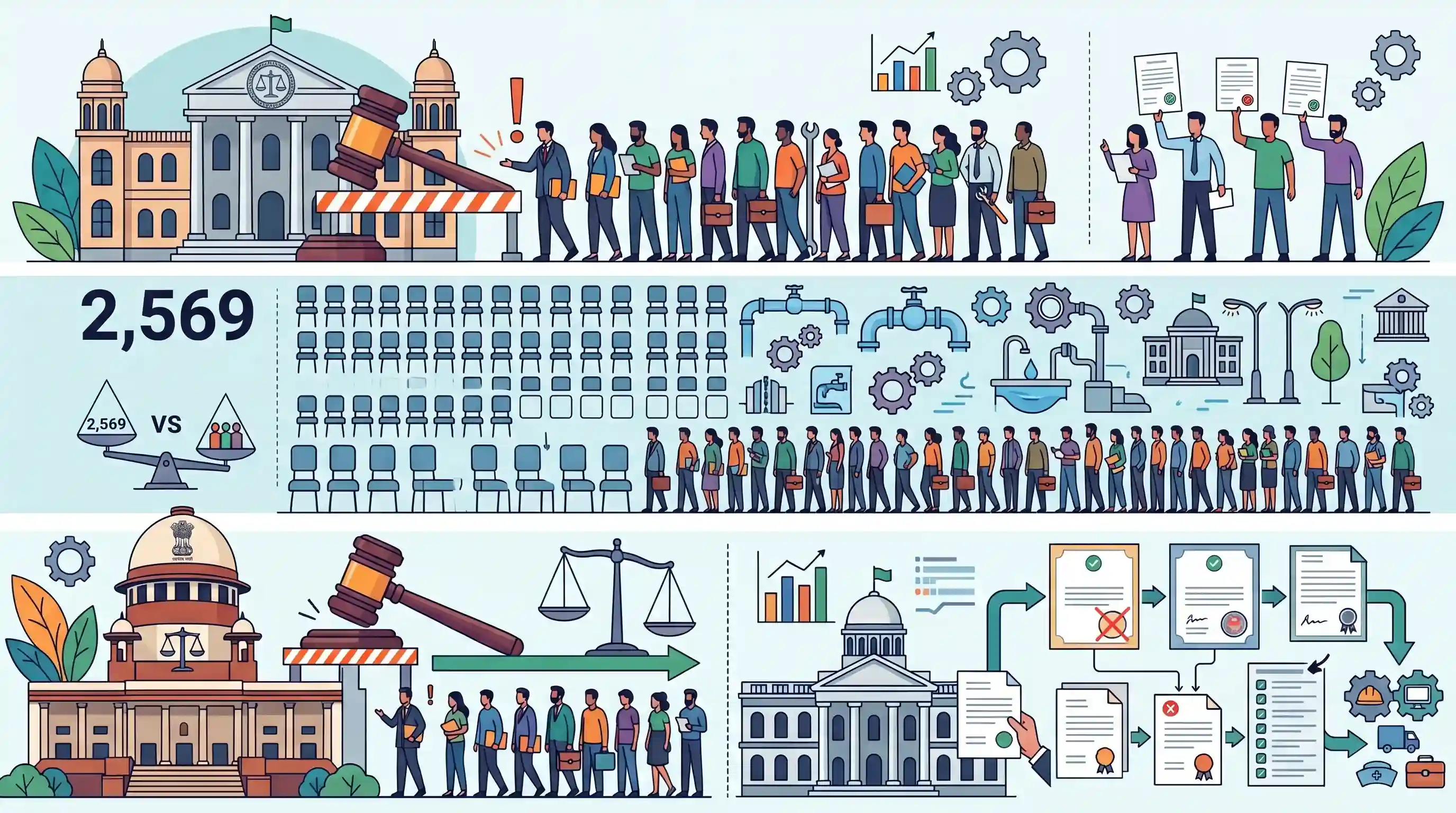
The Supreme Court of India has stayed a Madras High Court decision that halted a massive Tamil Nadu government recruitment drive for 2,569 vacancies in the Municipal Administration and Water Supply Department (MAWS). The High Court's stay was prompted by grievances from four candidates who claimed they were unfairly excluded under the Persons Studied in Tamil Medium (PSTM) quota. The Supreme Court bench, led by Justice Surya Kant, ruled that stalling an entire recruitment process over four unselected candidates was unjustified. The State government clarified that the required technical diplomas did not offer Tamil as a medium of instruction until 2022-2023, making it impossible for the petitioners to possess valid PSTM certificates.
Key Points
- The Supreme Court stayed a Madras High Court order that halted the Tamil Nadu government's recruitment process for 2,569 vacancies in the Municipal Administration and Water Supply Department.
- The High Court had paused the recruitment based on the grievances of four candidates who alleged that the 20% quota for Persons Studied in Tamil Medium (PSTM) was not being properly implemented.
- The Supreme Court observed that halting a massive state-wide recruitment drive over the non-selection of merely four candidates was disproportionate and unjustified.
- The Tamil Nadu government argued that the posts required technical diplomas, and since Tamil as a medium of instruction for these diploma courses was introduced only in 2022-2023, the candidates could not retroactively produce valid PSTM certificates.
Important Terms
Persons Studied in Tamil Medium (PSTM) Act, 2010

A Tamil Nadu state law providing 20% preferential reservation in government appointments for candidates who completed their entire education (from primary to qualifying degree) in Tamil medium.
UPSC context
GS Paper 2: Governance and Social Justice; tests understanding of linguistic-based reservation and state-specific affirmative action policies.
Supreme Court of India
India’s highest judicial body (Articles 124–147) that acts as the final interpreter of the Constitution and protector of fundamental rights through appellate and original jurisdictions.
UPSC context
GS Paper 2: Judiciary; tests knowledge of the hierarchy of courts, judicial review, and constitutional authorities.
Madras High Court
The high court for Tamil Nadu and Puducherry, exercising writ jurisdiction under Article 226 to protect legal and fundamental rights within its territorial limits.
UPSC context
GS Paper 2: Judiciary; tests the role of High Courts in overseeing state executive actions and administrative recruitment.
Municipal Administration and Water Supply (MAWS) Department
A key Tamil Nadu state department responsible for urban infrastructure, civic services, and water management across urban local bodies and municipalities.
UPSC context
GS Paper 2: Governance/Local Self-Government; relevant for administrative structure and service delivery in urban development.
Stay Order
A temporary suspension of a judicial proceeding or the execution of a judgment/order, often used by higher courts to halt lower court decisions pending further review.
UPSC context
GS Paper 2: Judiciary; tests understanding of legal procedures and the power of higher courts over subordinate courts.
Horizontal Reservation
A form of reservation that applies across different vertical categories (like SC, ST, OBC) to ensure representation for specific groups like women, PwD, or PSTM.
UPSC context
GS Paper 2: Social Justice; tests the conceptual difference between vertical (caste-based) and horizontal (characteristic-based) reservation models.
Prelims Trap
"Article 16(2) prohibits discrimination in public employment on the grounds of religion, race, caste, sex, descent, place of birth, residence, and language."
Article 16(2) lists religion, race, caste, sex, descent, place of birth, and residence. Unlike Article 29, it explicitly omits 'language' as a prohibited ground.
Static Concepts Connected
What are the permissible exceptions to equality of opportunity under Article 16?
- Residence Laws: Parliament (not state legislatures) can prescribe residence as a condition for certain state/UT employment under Article 16(3).
- Backward Classes: The State can provide reservations for any backward class of citizens not adequately represented in state services under Article 16(4).
- Religious Offices: A law can require that the incumbent of a religious office profess a particular religion under Article 16(5).
What are the Doctrines of Proportionality and Balance of Convenience?
- Doctrine of Proportionality: A judicial principle dictating that administrative or judicial interventions must be balanced and not excessively restrictive compared to the problem solved.
- Balance of Convenience: A legal test for granting injunctions, requiring courts to weigh the widespread harm to public interest against the individual harm to petitioners.
Cross-Topic Patterns
Domicile vs. Language-Medium Quotas
While state domicile quotas in employment face strict scrutiny under Articles 14 and 16(3), language-medium preferences (like TN's PSTM) operate differently, leveraging state educational mediums rather than pure birth/residence.
74th CAA and Municipal State Capacity
The freezing of 40% of municipal vacancies directly undermines the 74th Amendment's objectives, paralyzing urban local bodies' capacity to deliver basic services like water and sanitation.

Expect a Prelims statement testing the exact prohibited grounds under Article 16(2)—aspirants often falsely assume 'language' is included.
Linked PYQs · 3
Linked PYQs · 3
- 2020MainsGS2
Judicial Legislation is antithetical to the doctrine of separation of powers as envisaged in the Indian Constitution. In this context justify the filing of large number of public interest petitions praying for issuing guidelines to executive authorities.
- 2024MainsGS2
What are the aims and objects of recently passed and enforced, The Public Examination (Prevention of Unfair Means) Act, 2024? Whether University/State Education Board examinations, too, are covered under the Act ?
- 2024MainsGS2
Explain the reasons for the growth of public interest litigation in India. As a result of it, has the Indian Supreme Court emerged as the world's most powerful judiciary ?
