Contempt of Court: Supreme Court Stay on High Court Order
Source:The Hindu ↗
Why It Matters
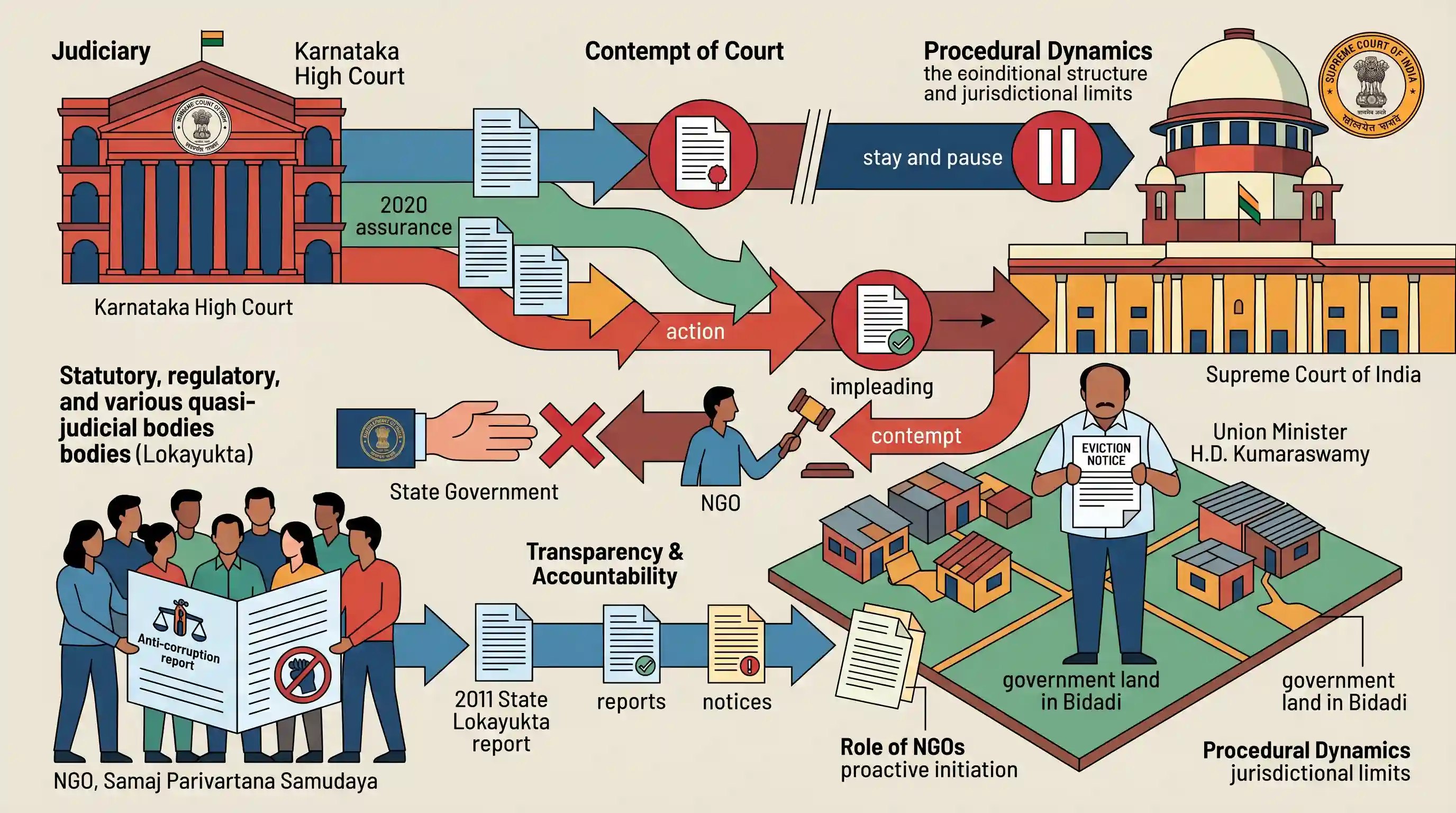
Illustrates the procedural aspects and limitations of contempt of court jurisdiction, the dynamic of appellate intervention by the Supreme Court over High Courts, and the challenges faced by anti-corruption bodies like the Lokayukta regarding their jurisdictional authority over public representatives.
Summary
The Supreme Court stayed a Karnataka High Court order impleading Union Minister H.D. Kumaraswamy in a contempt of court case related to alleged encroachment of government land in Bidadi. The case, initiated by the NGO Samaj Parivartana Samudaya, is based on a 2011 State Lokayukta report. The contempt proceedings were filed after the State government failed to fulfil a 2020 assurance to the High Court to take action on the encroachments, leading to eviction notices being issued to Kumaraswamy. The case underscores procedural dynamics between the High Court and Supreme Court, and highlights jurisdictional limits of anti-corruption bodies like the Lokayukta.
Key Points
- The Supreme Court stayed a Karnataka High Court order that impleaded Union Minister H.D. Kumaraswamy in a contempt of court case.
- The contempt case originates from allegations of government land encroachment by Kumaraswamy and his family in Kethaganahalli village, Bidadi, highlighted by a 2011 State Lokayukta report.
- The NGO Samaj Parivartana Samudaya filed a contempt case after the State government failed to act on its 2020 assurance to the High Court to clear the encroachments.
- Kumaraswamy was issued an eviction notice based on the contempt proceedings and subsequently impleaded in the case, prompting his appeal to the Supreme Court.
- The State Lokayukta had closed proceedings on the matter citing a lack of jurisdiction.
Important Terms
Supreme Court

The highest judicial body under the Indian Constitution (Articles 124-147). It serves as the final court of appeal, protector of fundamental rights, and the ultimate interpreter of the Constitution.
UPSC context
GS Paper 2: Judiciary; powers, jurisdiction (Original, Appellate, Advisory), and its role as the guardian of the Constitution and fundamental rights.
State Lokayukta
A statutory anti-corruption ombudsman at the state level (Lokpal and Lokayuktas Act, 2013). It investigates allegations of corruption against public functionaries to ensure administrative transparency and accountability.
UPSC context
GS Paper 2: Statutory, regulatory and various quasi-judicial bodies; anti-corruption mechanisms, transparency, and accountability in governance.
Contempt of Court
Actions that disrespect or disobey judicial authority. Civil contempt involves willful disobedience of orders; criminal contempt involves scandalizing or obstructing the administration of justice (Contempt of Courts Act, 1971).
UPSC context
GS Paper 2: Judiciary; balancing judicial dignity with freedom of speech (Article 19) and the powers of Courts of Record.
Karnataka High Court
The highest judicial authority in a state (Articles 214-231). It exercises superintendence over subordinate courts and has the power to issue writs for enforcing rights (Article 226).
UPSC context
GS Paper 2: Structure, organization, and functioning of the State Judiciary; writ jurisdiction vs. Supreme Court.
Samaj Parivartana Samudaya
A prominent Karnataka-based NGO (Civil Society Organization) significant for its public interest litigation (PIL) against illegal mining and corruption, highlighting the role of non-state actors in governance.
UPSC context
GS Paper 2: Role of NGOs, SHGs, and various groups in governance; impact of civil society on policy and accountability.
Impleading
A procedural legal action (Code of Civil Procedure, Order I Rule 10) where a court adds a new party to an existing lawsuit to ensure all necessary parties are present for complete adjudication.
UPSC context
GS Paper 2: Important aspects of governance, transparency, and accountability; legal procedures in judicial adjudication.
Prelims Trap
"The Constitution of India defines Civil and Criminal Contempt under Articles 129 and 215."
While Articles 129 and 215 grant the Supreme Court and High Courts the power to punish for contempt, the Constitution itself does not define the terms. They are defined statutorily.
Static Concepts Connected
How does Indian law classify and define Contempt of Court?
- Civil Contempt: Wilful disobedience to any judgment, decree, direction, order, or wilful breach of an undertaking given to a court.
- Criminal Contempt: Any publication or act that scandalises, lowers court authority, prejudices pending proceedings, or interferes with the administration of justice.
- Statutory Framework: The Contempt of Courts Act, 1971 governs the procedure. Post-2006 amendment, 'truth' (if in public interest) is allowed as a valid defence.
What are the jurisdictional limits of the State Lokayukta?
- Recommendatory Nature: They are statutory bodies with primarily investigative and recommendatory powers. They lack direct punitive or binding executive authority to enforce their own reports.
- State-level Variance: Because they are created by individual State legislatures, their exact jurisdiction—such as the power to investigate Chief Ministers or initiate prosecution—varies significantly across states.
Cross-Topic Patterns
NGOs enforcing executive accountability
Civil society often uses civil contempt petitions to force state compliance, bridging the gap between purely recommendatory ombudsman reports (Lokayukta) and binding judicial enforcement.
Statutory limits vs. Constitutional remedies
The case highlights the tension between constitutional courts and statutory tribunals. The Lokayukta dropped it for lack of jurisdiction, leaving the High Court's contempt jurisdiction as the only remedial avenue.

Expect a 2026 Prelims statement contrasting the constitutional powers of SC/HCs (Art 129/215) with the statutory definitions of contempt.
Linked PYQs · 4
Linked PYQs · 4
- 2025MainsGS2
"Constitutional morality is the fulcrum which acts as an essential check upon the high functionaries and citizens alike...." In view of the above observation of the Supreme Court, explain the concept of constitutional morality and its application to ensure balance between judicial independence and judicial accountability in India.
- 2025MainsGS2
Discuss the 'corrupt practices' for the purpose of the Representation of the People Act, 1951. Analyze whether the increase in the assets of the legislators and/or their associates, disproportionate to their known sources of income, would constitute 'undue influence' and consequently a corrupt practice.
- 2020MainsGS2
There is a need for simplification of procedure for disqualification of persons found guilty of corrupt practices under the Representation of Peoples Act". Comment.
- 2024MainsGS2
Explain the reasons for the growth of public interest litigation in India. As a result of it, has the Indian Supreme Court emerged as the world's most powerful judiciary ?
